Font
Color
Graphics
Изображение точки

To see AR mode in action:

1. Install ARTEFACT app for iOS or Android;

2. Find the exhibition «The Music Ark»

3. Push the «Augmented reality» button and point your phone's camera at the exhibit;

Скрыть точки интересаПоказать точки интереса
Показать в высоком качестве

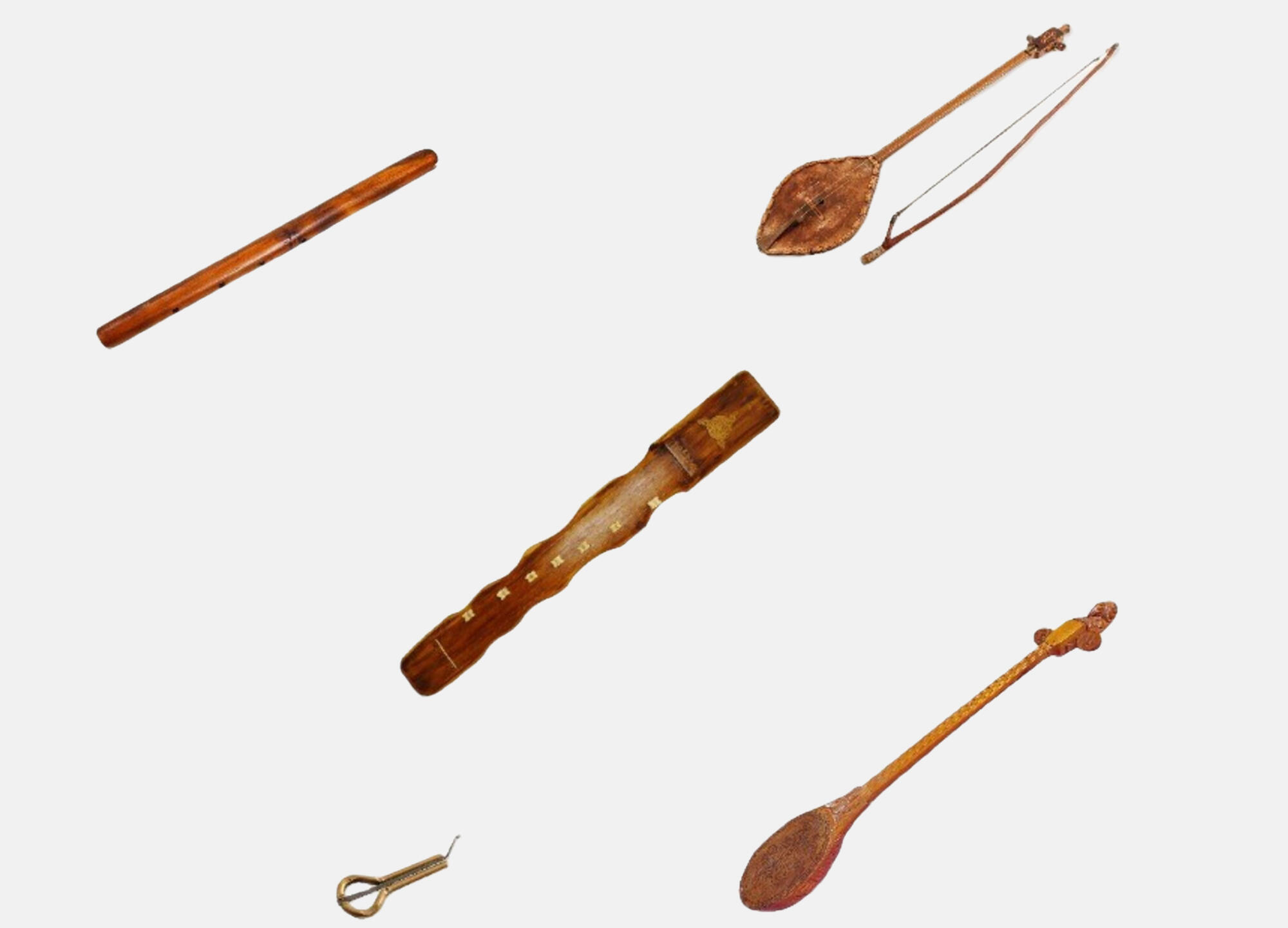
Yadagan, Topshur, Shoor, Ikili, Komus

Exhibition
0
Open in app
#1

Topshur

#2

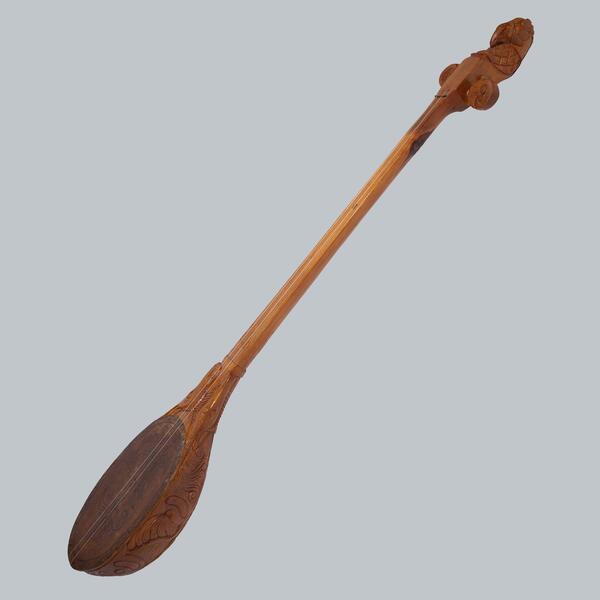
The topshur (also spelled topshuur) is the most widespread instrument among Altai kaychi storytellers. They play the topshur and narrate folk tales (such an accompaniment is known as kaidyn kuuzi). Moreover, meditation, dancing, and simple tunes can be accompanied by the topshur. There is also a term for solo topshur improvisation — “topshur oynop jat”.

Although “topshur” is literally translated as “a percussive musical instrument”, there are several techniques for producing sound from the topshur, and the type of accompaniment depends on the content of the music piece. The most common technique consists in strumming both strings rhythmically with the fingers. For example, it can be used to imitate a fast race or other movement. A lyrical mood can be achieved by plucking the strings with the thumb (pizzicato) or rapidly articulating notes on one string (tremolo).

The topshur has no standard tuning, and its range rarely exceeds one octave. Each musician tunes the strings, taking into account their own performing style.

The composer and ethnographer Andrey Anokhin wrote that Asians“consider a fourth to be the most consonant interval because they begin and end singing with this interval, regarded as the most harmonious chord.”

Other peoples also have similar ancient instruments: the Kazakhs have the “sherter”, the Khakasses — “khomys”, the Shors — “sherchen khomus”, the Mongols — “topshur”, and the Tuvans — “dopshulur”. Traditionally, the body and fingerboard are carved out of a solid piece of pine or cedar, chiseled out, and covered with raw calfskin that is stretched on top (such a topshur should be dried over the fire before playing). Instead of calfskin, thin wooden boards can be used. The former produce a duller sound, while the latter resembles the sound of a semi-acoustic guitar.

The shape of the sound board varies: it can be rounded, triangular, square, or spoon-shaped. The sound board (or membrane) has one or several small resonator holes.

The strings of the topshur were traditionally woven into thin ropes using hair from a horsetail (usually white). The strings were fastened to the instrument’s body using leather straps on one end and wound around wooden pegs on the other end. The displayed topshur made at the end of the 20thcentury has synthetic strings.

The exhibit used to belong to Bolot Bayryshev, a popular master of Altai throat singing “kai”, an Honored Artist of Russia and the Altai Republic.
#3
Name: Topshur
Date of creation: 1998
Place of creation: Gorno-Altaysk, Altai Krai, Russia
Technique: wood, metal, synthetic strings; carving, handmade
Dimensions: 96,5×16,5×9,5 cm
№: 38793892
#4
Шоор
#5

The culture of the Altai peoples is inextricably related to nature which provides both inspiration and materials for music. The sounds of ikili, topshur, and other authentic musical instruments resemble rain, wind, and animal voices.

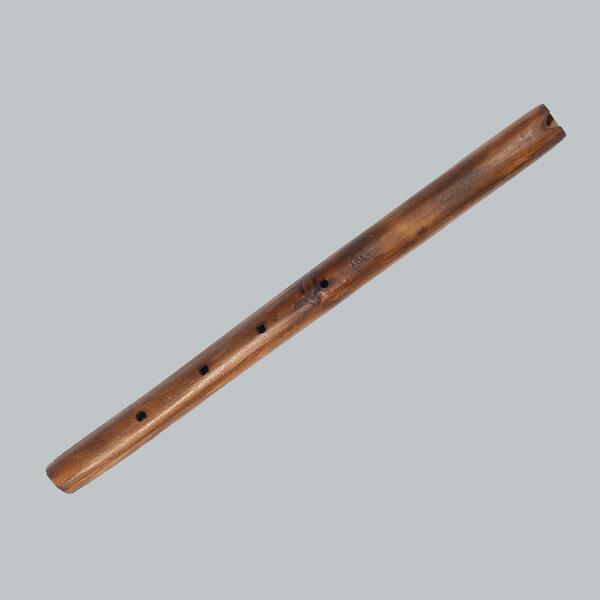
One of the oldest Altai woodwind instruments is the shoor, a type of end-blown flute without side holes. Chinese experts say that the Tuvan shoor originated from“the Chinese musical instrument hujia with a 1,600-year-old history… [The shoor] appeared so long ago that it is called a ‘musical fossil’ in China”(China Radio International). The Altai peoples believe that the instrument from the heroic epic “Maadai-Kara” is of divine origin.

Shoors are made from dried hollow stems of an Apiaceae plant known as “komurgai”, or “puchka”, collected in autumn. The instrument’s size depends on the length of the performer’s outstretched arm, on average — 50–80 centimeters, while the diameter varies from 1.5 to 3 centimeters. The narrow end of the stem is cut straight, while the wide end is cut at an angle.

The performer presses the wide end of the shoor against the upper teeth on the right side of the mouth. The sound is regulated by the blowing strength and by opening or closing the hole on the instrument’s body. The shoor can produce sounds within a range of one octave or more. Skillful performers can play multiphonics, producing two or even three notes at the same time.

Shoor playing accompanies important events in the life of Altai people and can be used to commemorate the dead as this instrument is believed to be heard by spirits. Shepherds and cowherds are especially fond of the shoor. A Tuvan woman named Taivan told the China Radio International,“The Tuvans used to play the shoor, performing tunes for [cows and sheep] and wild animals… Sometimes, the animals even forget to eat while listening attentively to the shoor.”

There are several legends explaining the origin of the shoor. According to one of them, it was designed by a shepherd who heard the sounds of the “zalat” reed in the wind. According to another legend, the instrument was invented by a young man who could not marry the girl he loved because of his humble origin; having created a reed flute, he charmed the bride’s parents by playing the instrument and achieved his goal. The third legend tells of a man who kept finding his home destroyed upon return and once picked up the song of the wind blowing among the ruins.

The displayed shoor was made of a solid piece of cedar and designed by the musical instrument maker Mikhail Naurchakov.

#6
Name: Shoor
Author: Mikhail Naurchakov
Date of creation: 2013
Place of creation: Gorno-Altaysk, Altai Krai, Russia
Technique: wood, carving; handmade
Dimensions: 1,5×2,5×2,5 cm, hole diameter — 0.6 cm
№: 38793885
#7
Yadagan (tyadagan)
#8

Bolat Sarybaev (1927–1984), a music scholar and Doctor of Art History, wrote that in ancient times the Turkic-speaking population of Siberia used around sixty musical instruments. Versions of the same instruments were often found among the Altai, Tuvans, Yakuts, Khakasses, and other ethnic groups.

The yadagan (more correctly pronounced as “tyadagan”) and related instruments were used by many Turkic and Mongolian peoples. The Khakasses call it the “chatkan”, the Kazakhs — “jetigen”, the Kalmyks — “yatkh” or “yatka”, and the Mongols — “yatga”. Similar instruments existed in ancient China; moreover, the yadagan and Russian gusli have some common traits.

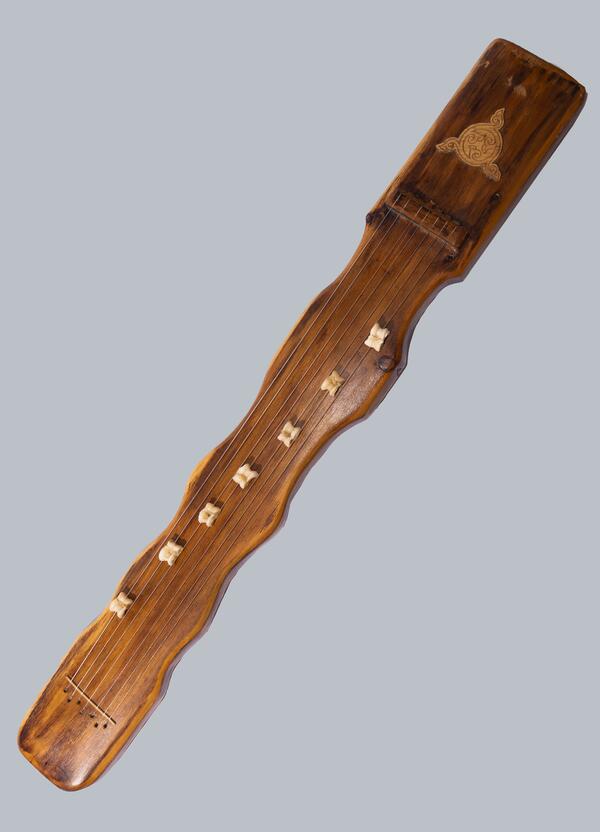
This plucked string instrument was used mainly as an accompaniment for epic tales. Its design resembles a gusli or a horizontal harp. In his 1908 article “On Asian Music of Turkic and Mongolian Tribes”, the musical ethnographer Andrey Anokhin described the “chatygan” as a narrow oblong box with one open side, six or seven strings, and no tuning pegs.

Originally, the role of pegs was performed by movable bridges made of astragali — ram’s vertebrae, known in Altai as “kazhyk”. By moving them freely under the strings, the musician set the necessary pitch (the Greek monochord was tuned in a similar way).

The metal pegs of the rebuilt instrument are located on the back side of the body and can be used for tuning the yadagan in the required key.

As a rule, the performer would sit with the instrument in their lap. They would pluck the strings with the right hand and hold the head of the yadagan with the left one, stopping unnecessary vibration and plucking the strings that were difficult to reach with the “leading” hand. When playing with both hands, the left hand was used for the bass strings, while the right hand was used for all other strings.

During the Soviet period, the rules and traditions of yadagan playing were lost. In recent years, interest in the instrument has begun to revive, with musicians developing their own unique techniques.

#9
Name: Yadagan (tyadagan)
Author: Mikhail Naurchakov
Date of creation: 2013
Place of creation: Gorno-Altaysk, Altai Krai, Russia
Technique: wood, metal, bone, synthetic strings; carving, handmade
Dimensions: 111×14,5×6 cm
№: 38793877
#10
Ikili
#11

The ikili is one of the Altai folk musical instruments rebuilt by Alexander Gnezdilov.

Legend has it that a young man once wandered into a cave and received the ikili from a spirit dwelling there. Upon returning home, the young man discovered that while he had been talking to the spirit inside the cave, many years had passed in the outside world. The young man became a wandering storyteller.

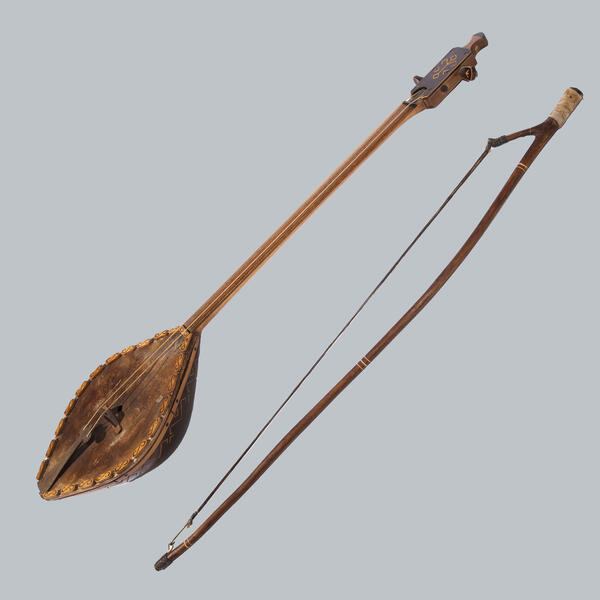
The ikili is played only by men — sitting cross-legged on a carpet, with the instrument placed on the left knee or slightly tilted to the left and held with both knees. Performers hold the bow in different ways, depending on their skills. Traditionally, the ikili was used to accompany vocal and instrumental folk tunes, songs, and simple pieces. Mordents, trills, and other ornaments were performed with the left hand.

This instrument is tuned in fourths and resembles a topshur, but has a higher range, a thin elongated fingerboard, and a high bridge.

Traditionally, the ikili’s body was made of cedar or larch wood from a tree that had grown in the shade, in the lowlands, because such wood is denser. To avoid cracking, the wood was boiled for several hours, removing the resin through evaporation, and then thoroughly dried. Leather was stretched over the sound board after soaking, while it was still wet, and then dried over a fire: the material had to become permeated with smoke.

The bow was made of a willow or bird cherry twig and strung using a twisted horsehair. For improving the sound, the bow was rubbed with cedar or larch resin. As the bow was not equipped with a nut, the musician simply tightened the loose strings with the playing hand.

Alexander Gnezdilov made his first ikili in the early 1990s. Having made upgrades to the technology, the craftsman managed to improve the quality of the instrument’s sound. The displayed ikili can be used not only as an accompaniment but also as a solo instrument. Nogon Shumarov, a prominent Altai poet and narrator of folk tales, highly appreciated Gnezdilov’s instrument.

#12
Name: Ikili
Author: Alexander Gnezdilov
Date of creation: the 1990s
Place of creation: Barnaul, Altai Krai, the RSFSR
Technique: wood, leather, metal; handmade, turning
Dimensions: 83×18,5×12 cm, bow — 75×6.5 cm; case — 90×25×15.5 cm
№: 3561620
#16
Komus
#15

According to an Altai legend, the idea to make a komus was suggested to humans by a bear. A hunter once heard unfamiliar melodious sounds in the forest and went to see what it was. There, he saw a bear sitting on a tree and plucking a wood chip that became the prototype of the new instrument.

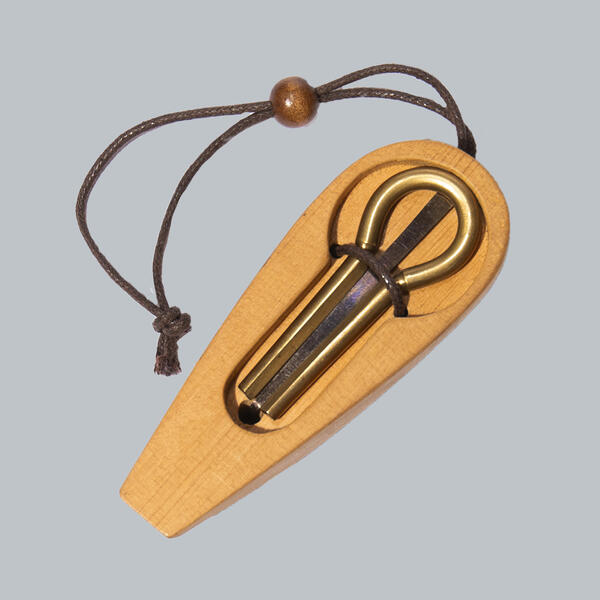
This musical instrument has been known to various peoples since the earliest times: the Kyrgyz call it “temir komuz”, the Yakuts — “khomus”, and the Russians — “vargan”. All these instruments produce sound with the help of a reed and have a sacred value.

Originally, the secrets of making, tuning, and ritual playing were known only to a select few. Nowadays, the komus can be played by anyone.

Vladimir Potkin (born in Tomsk in 1949) is an Altai musical instrument maker who is considered to be the developer of the modern and improved komus. According to the craftsman, he made his first komuses in 1988–1993 by following precisely the Tuvan and Yakut designs. Over time, having studied the playing technique and its influence on the performer, having communicated with musicians and other craftsmen, Vladimir Potkin decided to depart from traditions and “create a fundamentally new, modern, elegant, and nice sounding vargan”.

Vladimir Potkin and his assistants built their own workshop on the outskirts of the Maima village. They also developed their own machines. The craftsman comments, “The manufacturing technology is only 20% machine processing. The rest is manual, painstaking labor.” Vladimir Potkin delegates mechanical and manual work to his assistants, while he is responsible for designing the instruments, developing the technology, preparing the machines, performing final processing, and tuning the instruments. He says that tuning takes at least half of the entire time.

On average, the range of a komus does not exceed a fourth. The performer takes into account the instrument’s size and material, as well as breathing and precise articulation. The instrument is placed in the mouth, pressed lightly against the front teeth, and the reed’s bent end is plucked with the right hand. The mouth acts as a resonator and tool to alter the pitch.

An experienced vargan player can use the komus to reproduce the sounds of nature and melodies with a rich sound palette.

#14
Name: Komus
Author: Vladimir Potkin
Date of creation: 2014
Place of creation: Gorno-Altaysk, Altai Krai, Russia
Technique: brass, spring steel; handmade
Dimensions: 6,5×2,5×0,5 cm
№: 38793876
#13
read morehide

Yadagan, Topshur, Shoor, Ikili, Komus

Exhibition
0
Point your smartphone camera to open in the app
Share
VkontakteOdnoklassnikiTelegram
Share on my website
Copy linkCopied
Copy
Open in app
To see AR mode in action:
  1. Install ARTEFACT app for 
  2. iOS or Android;
  3. Find and download the «Paintings in Details» exhibition
  4. Push the «Augmented reality» button and point your phone's camera at the painting;
  5. Watch what happens on your phone screen whilst you flip through the pictures.
 
We use Cookies
Cookies on the Artefact Website. We use cookies to ensure that we give you the best experience on our website. If you continue without changing your settings, we'll assume that you are happy to receive all cookies on the Artefact website. However, if you would like to, you can change your cookie settings at any time.
Learn more about useHide
Content is available only in Russian

X

Нашли опечатку?...

%title%%type%