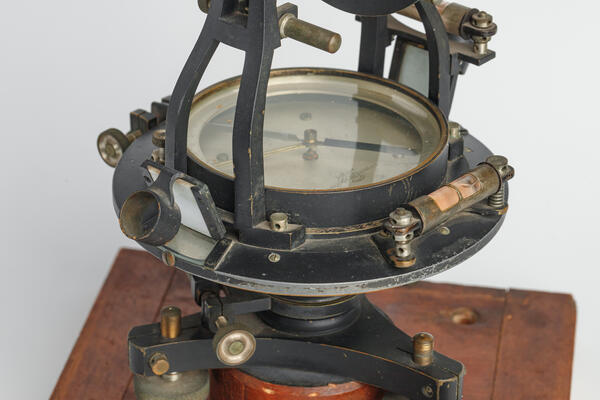
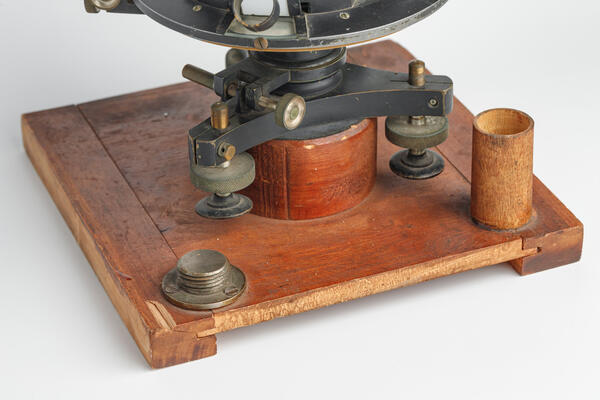
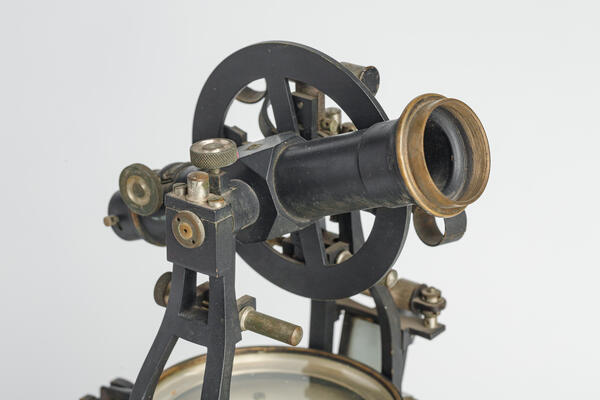
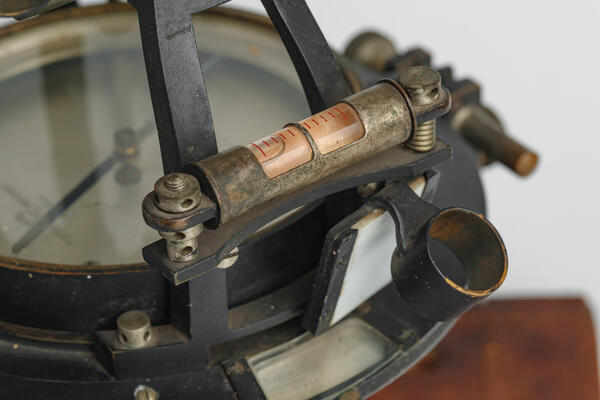
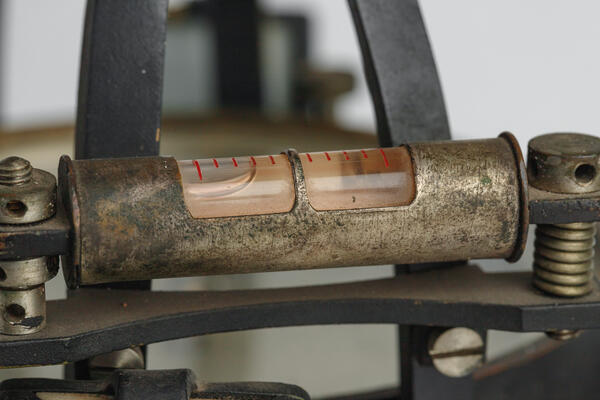
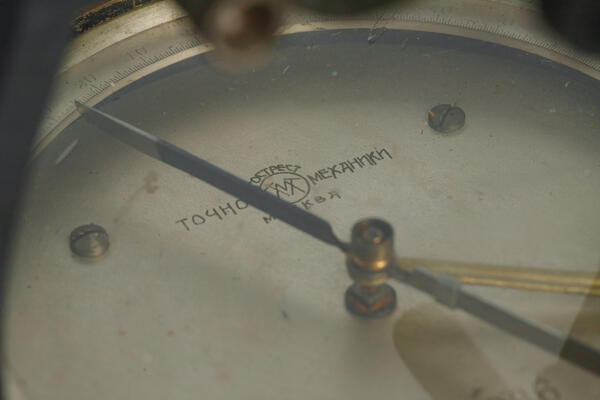
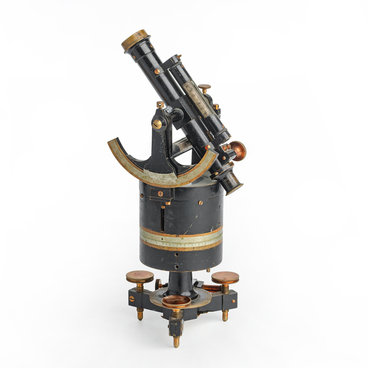
The Museum of Intelligence Officer Nikolai Ivanovich Kuznetsov houses a theodolite. During field practicums at the Talitsa Forestry College, the future spy and partisan Nikolai Ivanovich Kuznetsov — like his fellow students — actively worked with this instrument.
A theodolite is an angle-measuring device designed for the precise measurement of horizontal and vertical angles in geodetic and surveying operations. It is widely used in land surveying, geodetic control networks, construction, and other technical fields.
Surveying measurements have been regarded as especially challenging since ancient times. Originally, the discipline was known by the German term Markscheidenkunst, meaning “the art of setting boundaries”.
The first theodolite in Russia appeared thanks to Emperor Peter the Great. On his orders, the instrument was imported from France. Franz Timmerman, a Dutchman residing in Moscow, taught Peter how to use this “mysterious” device and also demonstrated how to measure the elevation angles of stars using an astrolabe. Following this, Russia began producing its own angle-measuring instruments.
In 1763, Mikhail Vasilyevich Lomonosov published his work “The First Foundations of Metallurgy or Ore Mining” — the first Russian textbook on mining. In the chapter “On Measuring Mines”, he provided the first technical guidelines for mine surveying and effectively developed a comprehensive method for underground surveying, which helped solve numerous practical engineering problems.
In the late 18th and early 19th centuries, geodetic instruments were manufactured in St. Petersburg at workshops affiliated with the Academy of Sciences, the General Staff, and the Pulkovo Observatory. However, large-scale industrial production was never established, so such instruments had to be imported from abroad.
Beginning in the 1920s, specialized enterprises were founded in Moscow, including the Geodesy and Geophysics factories and the Factory of Geodetic Instruments (“Aerogeopribor”). These facilities launched serial production of high-precision geodetic instruments that met international standards.
The TG-1 mining theodolite was developed for surveying in underground mines and for engineering and geodetic work on the surface. This instrument became one of the mass-produced tools widely used by surveyors during post-war reconstruction efforts in the Soviet mining industry.