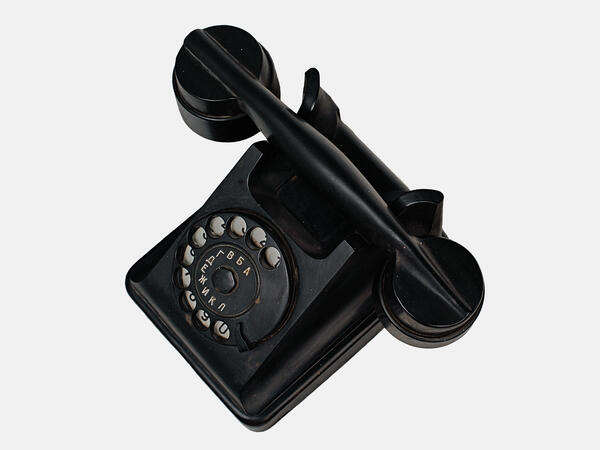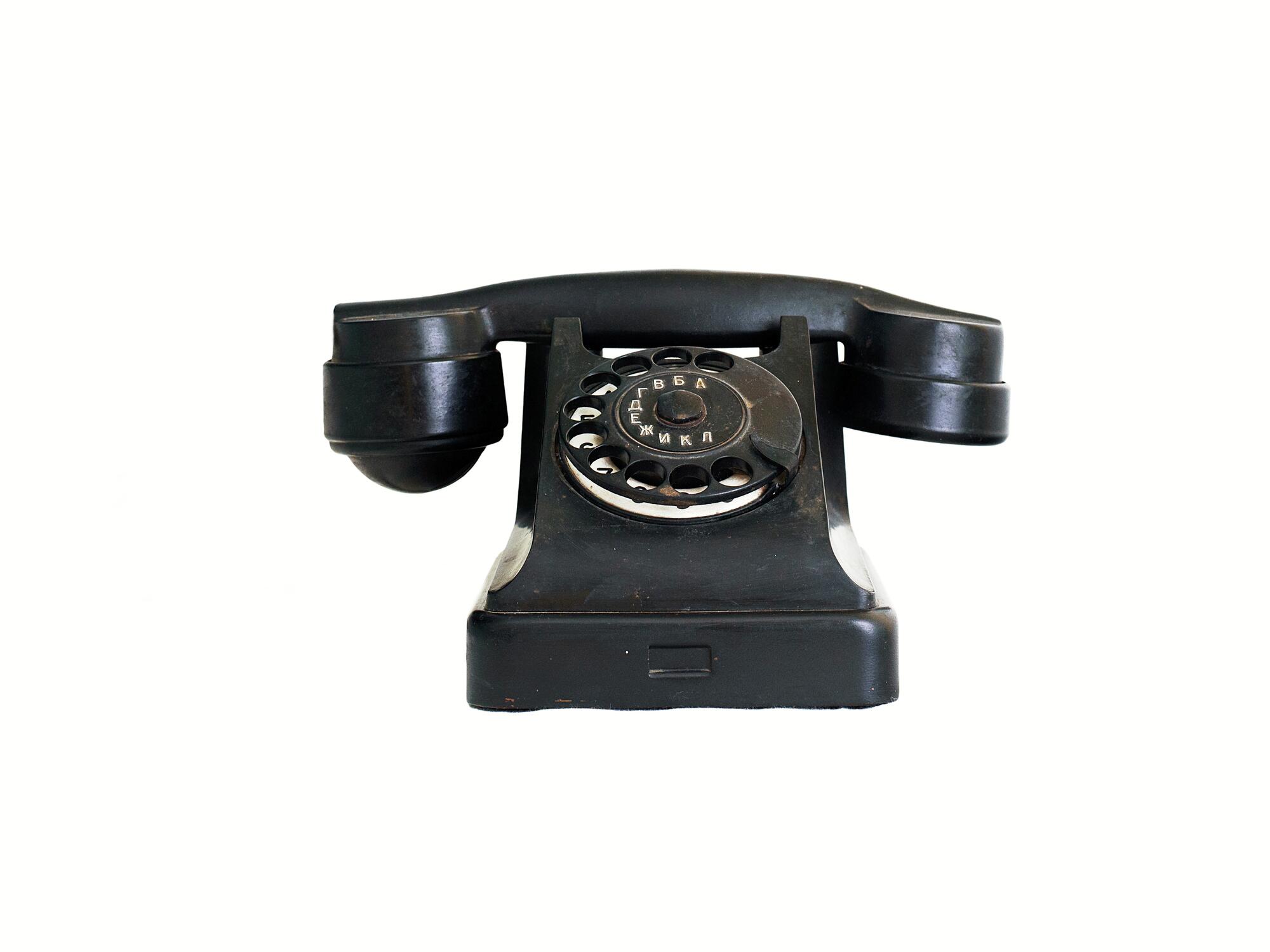


In the 1950s, the Sergeyev-Tsenskys used this black plastic telephone with a big receiver.
There are letters opposite each digit on the dial: until 1968, telephone numbers were recorded as a set of one or two letters plus digits. This was done to make the number easier to remember. The system of alphanumeric numbers was adopted from the Anglo-American tradition and adapted to the Russian alphabet. In English, each digit had several letters attached to it. The first three letters of the number stood for certain digits and were the beginning of a word, which was memorized by associating it with the letters at the beginning of the number. Interestingly enough, the combinations of English letters and digits were further used on the keypad of mobile phones.
In 1968, the USSR decided to give up the system of using letters in telephone numbers, because it proved to be inconvenient and there were no more letters for new numbers.
Since he was an honorary member of the Academy of Sciences of the Soviet Union, Sergey Sergeyev-Tsensky had a private telephone line installed in his home on Orlinaya Mountain in Alushta, and the line for it was extended from the city for several kilometers. The writer was entitled to a telephone due to his status as an academician and needed it in case of emergency to communicate with Moscow, the Academy of Sciences of the Soviet Union and publishing houses. A private telephone line was considered a luxury at that time.
In the 1950s and 1960s, there were very few private phone numbers even in the whole of Crimea, not to mention Alushta. The maintenance and long-distance calls were expensive. Also, that kind of call had to be ordered and paid for in advance. The connection was of extremely poor quality, so long-distance calls were made only in emergencies and did not last long. The detailed discussion of all necessary issues was carried out through letters.
People exchanged letters even within the same city. When Khristina Sergeyeva-Tsenskaya was engaged in the establishment of the Sergeyev-Tsensky Museum, she resolved all arising issues via personal correspondence with the writer Ivan Shevtsov and her sister Maria Muravlyova, who helped her.
The last time Sergeyev-Tsensky used the telephone was on December 3, 1958, when he asked his wife to call his friend, the writer Ivan Shevtsov, to say goodbye to him.