#2
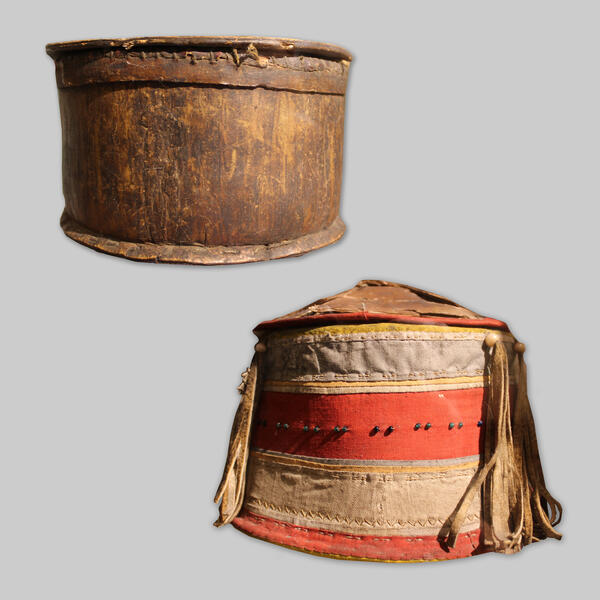
Ostyaks birch bark box for storage of raw materials, Birch bark tursuk, covered with cloth and decorated with beads
#3
#9

#5
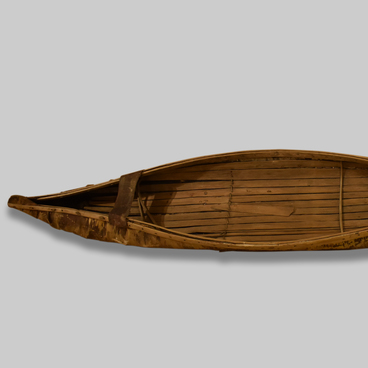
Birch bark, or the top layer of birch — a unique material from which for centuries in Russia were used to make dishes, shoes, boats, roofs and also used for writing. Birch bark played an important role in Ostyaks household. Dishes, baskets for berry, baby cradles, and many other household items were made from it. Birch bark, sewn into a rolled-up cloth, served as a waterproof material — it was used for burial rites. The bark, divided into thin layers, was used for pasting objects to protect them from dampness.
In the old days, for lack of boilers, water was boiled in specially arranged baskets — boxes without a lid with oval sides, the white side of the birch bark facing out. Old baskets which had been used for several times, were used for feeding dogs.
Birch bark was extracted three times a year: in spring, when it easily peels off from the tree bast, in early June and in autumn, when the leaves fall. Women were engaged in the preparation of bark for utensils. Birch bark products were used as decorations with various patterns. For their application, there were about nine different techniques: embossing, openwork carving, applique, mosaic, impaling, applying a pattern with a stamp, and others. Almost all the techniques of ornamentation were held by women, but stamped patterns on birch bark were applied by a man. When working with birch bark, a knife and a needle were used to sew the pattern and products.
When going hunting, each Ostyak took a long black robe to the place of sacrifice for the spirit, similar to the clothes of a shaman, and a doll made of black rags. Also, for offerings, Ostyaks baked unleavened bread in a special dish. This bread, together with a piece of butter, sugar, and dried fish, was placed in a birch bark basket and left in the forest near the sacred tree they revered, firing five or more blanks into the air. Ostyak would leave a few pellets by the tree in honor of the spirit and, raising his head high, says: ‘Unhu, keep me safe so I do not fall by. You must comply with my request. I have already fulfilled your orders’. If Ostyak would want to drink wine in the forest under a sacred tree, he always poured the first glass under the tree.
In the old days, for lack of boilers, water was boiled in specially arranged baskets — boxes without a lid with oval sides, the white side of the birch bark facing out. Old baskets which had been used for several times, were used for feeding dogs.
Birch bark was extracted three times a year: in spring, when it easily peels off from the tree bast, in early June and in autumn, when the leaves fall. Women were engaged in the preparation of bark for utensils. Birch bark products were used as decorations with various patterns. For their application, there were about nine different techniques: embossing, openwork carving, applique, mosaic, impaling, applying a pattern with a stamp, and others. Almost all the techniques of ornamentation were held by women, but stamped patterns on birch bark were applied by a man. When working with birch bark, a knife and a needle were used to sew the pattern and products.
When going hunting, each Ostyak took a long black robe to the place of sacrifice for the spirit, similar to the clothes of a shaman, and a doll made of black rags. Also, for offerings, Ostyaks baked unleavened bread in a special dish. This bread, together with a piece of butter, sugar, and dried fish, was placed in a birch bark basket and left in the forest near the sacred tree they revered, firing five or more blanks into the air. Ostyak would leave a few pellets by the tree in honor of the spirit and, raising his head high, says: ‘Unhu, keep me safe so I do not fall by. You must comply with my request. I have already fulfilled your orders’. If Ostyak would want to drink wine in the forest under a sacred tree, he always poured the first glass under the tree.
#6
Date: XIX century
Technique: birch bark
Place: Yeniseysk district
Dimensions: 8×15 cm
Collection: Yenisei Museum of Local Lore, History and Economy named after Alexander Ignatievich Kytmanov, Yeniseisk, Krasnoyarsk Territory
Copyright: Yenisei Museum of Local Lore, History and Economy named after Alexander Ignatievich Kytmanov, Yeniseisk, Krasnoyarsk Territory
Technique: birch bark
Place: Yeniseysk district
Dimensions: 8×15 cm
Collection: Yenisei Museum of Local Lore, History and Economy named after Alexander Ignatievich Kytmanov, Yeniseisk, Krasnoyarsk Territory
Copyright: Yenisei Museum of Local Lore, History and Economy named after Alexander Ignatievich Kytmanov, Yeniseisk, Krasnoyarsk Territory
#4
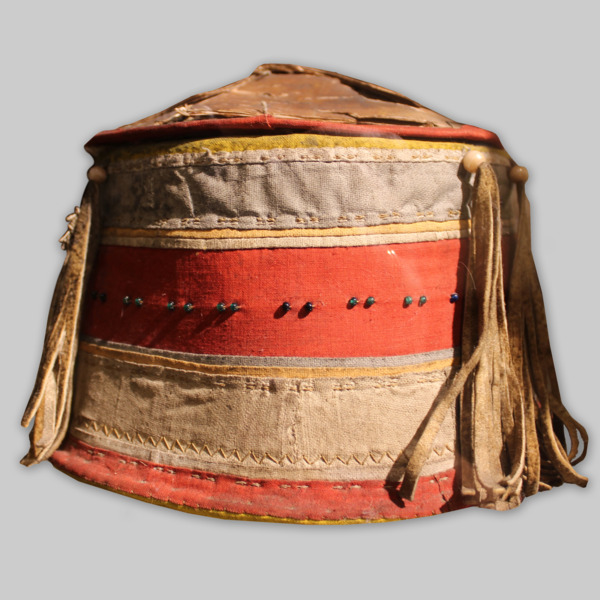
Birch bark tursuk, covered with cloth and decorated with beads
#10
#7
Tursuk — a birch-bark pot that was used for storing various food supplies: herbs, pigweed, nuts, dried berries, flour, cereals, spices. The bread in the birch-bark bread bin remained fresh and fragrant for a very long time. Cloudberries without sugar in a birch bark tursuk can be kept at the cellar all winter. At the same time, the birch bark would not allow the product to absorb any odors. It has long been known that salt stored in tursuk will not absorb moisture, and salted mushrooms and cucumbers will not only be stored for a long time, but will also acquire a pleasant aroma.
Also with tursuk it was convenient to collect mushrooms and berries in the forest — the traditions of collecting and storing them among the people of the North developed over the centuries. The harvest of wild plants has been determined since spring. According to ancient signs, if the cuckoo arrives before the first thunder breaks out, then there will be a lot of berries in the tundra, and if later — there will be few. During the harvest, you can not take all the berries — you need to leave treats for birds and animals.
Many northerners still follow these rules today. They do not forget the old ways of preparing berries, since the northern wild plants are not only delicious, but also a healthy, rich in vitamins.
Birch — the white outer part of the birch bark, which consists of many thin layers that do not allow moisture and air to pass through. The upper layer is covered with a white coating that reflects the sun’s rays, the inner layers have a variety of colors — from golden yellow to pinkish-brown.
The device of the tursuk resembles a thermos: it has an outer and inner walls, between which there is a small air insulation layer. The inner wall must be without a single crack to hold the liquid. The task of the outer wall — to be beautiful and elegant. It was often called a shirt, and the craftswomen covered it with cloth, decorated it with beads and leather decorative elements.
The birch bark box displayed at the Museum’s exposition was used mainly for collecting berries and vegetables. Such tursuks were widespread in the Krasnoyarsk region in the 18th–20th centuries, but now they are almost completely out of use.
Also with tursuk it was convenient to collect mushrooms and berries in the forest — the traditions of collecting and storing them among the people of the North developed over the centuries. The harvest of wild plants has been determined since spring. According to ancient signs, if the cuckoo arrives before the first thunder breaks out, then there will be a lot of berries in the tundra, and if later — there will be few. During the harvest, you can not take all the berries — you need to leave treats for birds and animals.
Many northerners still follow these rules today. They do not forget the old ways of preparing berries, since the northern wild plants are not only delicious, but also a healthy, rich in vitamins.
Birch — the white outer part of the birch bark, which consists of many thin layers that do not allow moisture and air to pass through. The upper layer is covered with a white coating that reflects the sun’s rays, the inner layers have a variety of colors — from golden yellow to pinkish-brown.
The device of the tursuk resembles a thermos: it has an outer and inner walls, between which there is a small air insulation layer. The inner wall must be without a single crack to hold the liquid. The task of the outer wall — to be beautiful and elegant. It was often called a shirt, and the craftswomen covered it with cloth, decorated it with beads and leather decorative elements.
The birch bark box displayed at the Museum’s exposition was used mainly for collecting berries and vegetables. Such tursuks were widespread in the Krasnoyarsk region in the 18th–20th centuries, but now they are almost completely out of use.
#8
Date: XIX century
Technique: wood, birch bark, glue
Place: Yeniseysk district
Dimensions: 17×20 cm
Collection: Yenisei Museum of Local Lore, History and Economy named after Alexander Ignatievich Kytmanov, Yeniseisk, Krasnoyarsk Territory
Copyright: Yenisei Museum of Local Lore, History and Economy named after Alexander Ignatievich Kytmanov, Yeniseisk, Krasnoyarsk Territory
Technique: wood, birch bark, glue
Place: Yeniseysk district
Dimensions: 17×20 cm
Collection: Yenisei Museum of Local Lore, History and Economy named after Alexander Ignatievich Kytmanov, Yeniseisk, Krasnoyarsk Territory
Copyright: Yenisei Museum of Local Lore, History and Economy named after Alexander Ignatievich Kytmanov, Yeniseisk, Krasnoyarsk Territory
read morehide
00:00
00:00
1x
Ostyaks birch bark box, Birch bark tursuk
Collection
Exhibition
1
 Point your smartphone camera to open in the app
Open in app
Share