#1
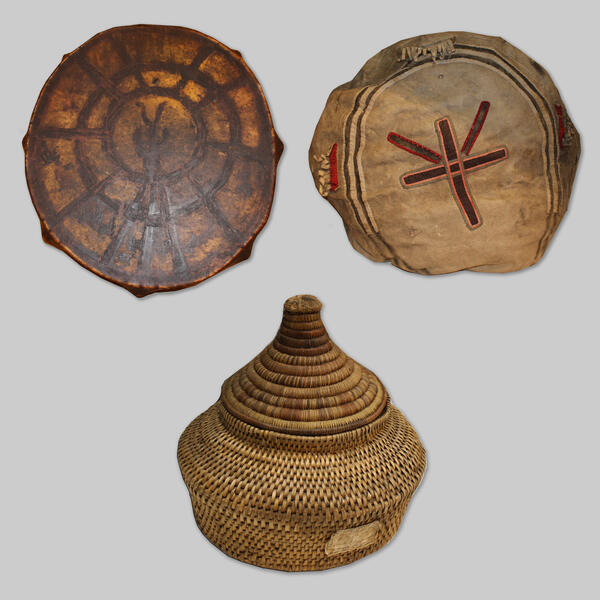
Shamanic ritual tambourine, Bag for the shaman"s tambourine was made of processed leather, Ostyak basket made of bird cherry root with lid
#2
#11
#5
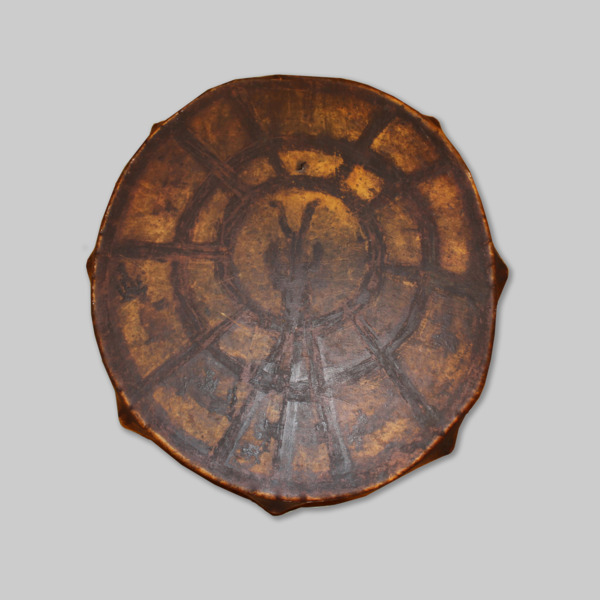
The shaman’s tambourine is a wooden instrument covered with well-tanned leather. According to the observations of the ethnographer Glafira Vasilevich, the tambourines of the western Evenks were ovoid, and the tambourines of the eastern ones — round or only slightly ovoid. The instruments carried a multi-dimensional semantic load: they symbolized the Universe, were the receptacle of shamanic spirits-helpers and the spirit of the Supreme deity and mistress of the earth Enekan Buga.
The shaman used the tambourine during songs, dances and various rituals — for him it was a faithful companion and guide to other worlds. The tambourine was often a reflection of the shaman’s vital energy, so the safety of the instrument was carefully observed. It was believed that, if the tambourine breaks, the shaman could die. After the shaman’s death, his tambourine was cut up, like all other things, and placed on the grave. Throughout his life, a shaman could have more than one tambourine, only not simultaneously.
To manufacture this ritual tool, special wood was chosen — not every tree could be suitable for the service of the shaman, but only those chosen by the spirits. The shell, that is, the hoop of the tambourine, was made of cedar wood — specifically from the part of the trunk that was facing South. Along the hoop there were “ears” — according to the level of the shaman’s power. The stronger he is in spirit, the more ‘ears’ were on the tambourine. These resonant bumps on the hoop gave the instrument a slightly wavy outline and served as a symbolic representation of an animal fangs, which added strength to the shaman.
To cover the tambourines with buckskin, they used the veins located along the cervical spine of a deer or elk, from which strong threads were obtained. The crosspiece inside the tambourine was made of durable wood or metal.
Also, the tambourines were decorated with paintings which were applied with natural colors that have their own symbols. The most common image on the front side of the instrument was the universe and its division into the upper, middle and lower worlds. In other images — a tree with branches, on which cradles hang, symbolizing human life. The same tree, with its roots facing upwards, meant the other world.
To make the sound of the tambourine more powerful, during kamlaniy (rituals) — communication with spirits — the instrument was heated with the fire. This could be done either by the shaman himself or by his assistant.
The shaman used the tambourine during songs, dances and various rituals — for him it was a faithful companion and guide to other worlds. The tambourine was often a reflection of the shaman’s vital energy, so the safety of the instrument was carefully observed. It was believed that, if the tambourine breaks, the shaman could die. After the shaman’s death, his tambourine was cut up, like all other things, and placed on the grave. Throughout his life, a shaman could have more than one tambourine, only not simultaneously.
To manufacture this ritual tool, special wood was chosen — not every tree could be suitable for the service of the shaman, but only those chosen by the spirits. The shell, that is, the hoop of the tambourine, was made of cedar wood — specifically from the part of the trunk that was facing South. Along the hoop there were “ears” — according to the level of the shaman’s power. The stronger he is in spirit, the more ‘ears’ were on the tambourine. These resonant bumps on the hoop gave the instrument a slightly wavy outline and served as a symbolic representation of an animal fangs, which added strength to the shaman.
To cover the tambourines with buckskin, they used the veins located along the cervical spine of a deer or elk, from which strong threads were obtained. The crosspiece inside the tambourine was made of durable wood or metal.
Also, the tambourines were decorated with paintings which were applied with natural colors that have their own symbols. The most common image on the front side of the instrument was the universe and its division into the upper, middle and lower worlds. In other images — a tree with branches, on which cradles hang, symbolizing human life. The same tree, with its roots facing upwards, meant the other world.
To make the sound of the tambourine more powerful, during kamlaniy (rituals) — communication with spirits — the instrument was heated with the fire. This could be done either by the shaman himself or by his assistant.
#6
Date: XIX century
Technique: wood, metal, rawhide, tendon threads
Place: Yeniseysk district
Dimensions: 68×68×17 cm
Collection: Yenisei Museum of Local Lore, History and Economy named after Alexander Ignatievich Kytmanov, Yeniseisk, Krasnoyarsk Territory
Copyright: Yenisei Museum of Local Lore, History and Economy named after Alexander Ignatievich Kytmanov, Yeniseisk, Krasnoyarsk Territory
Technique: wood, metal, rawhide, tendon threads
Place: Yeniseysk district
Dimensions: 68×68×17 cm
Collection: Yenisei Museum of Local Lore, History and Economy named after Alexander Ignatievich Kytmanov, Yeniseisk, Krasnoyarsk Territory
Copyright: Yenisei Museum of Local Lore, History and Economy named after Alexander Ignatievich Kytmanov, Yeniseisk, Krasnoyarsk Territory
#3
Bag for the shaman"s tambourine was made of processed leather
#12
#7
Shamanism — one of the oldest religions. With different distinctive features, but the same in essence, this religion existed among most people in the world. The main idea of shamanism was that the link between the world of spirits and the world of people is a shaman. The Evenks consider the shaman’s tambourine a raft or boat — on it the shaman (his soul) ‘floats’ along rivers and lakes in search of lost souls or in pursuit of stolen souls.
The shaman was traditionally approached on various issues: to cure a deer, to find a strayed deer from the herd, to ward off evil spirits, to protect against human diseases and failures, to send the soul of the deceased to the world of souls of dead people.
The shaman always had spirit helpers — often in the form of birds or animals. He was also helped by the spirits of his ancestors — mugda. They gave advice during the ritual. The shaman made a fire and slowly hitting on the tambourine, going round the fire. The dance would grow faster and faster until the shaman was in ecstasy. After that, he would fall into a long silence. While his body was in the middle world, his soul was in other worlds — he would meet with good spirits, asked them for health, well — being, protection and patronage. After saying goodbye to the spirits, he returned to his body, slowly opened his eyes and announced the will of the spirits to the people.
In addition, shamans were engaged in healing. To find out the cause of the disease, it was necessary to conduct a special rite — the source could be an evil eye or the tricks of evil spirits, which were unleashed by shamans of hostile clans. Based on the reason, the person was treated with a ritual or medication.
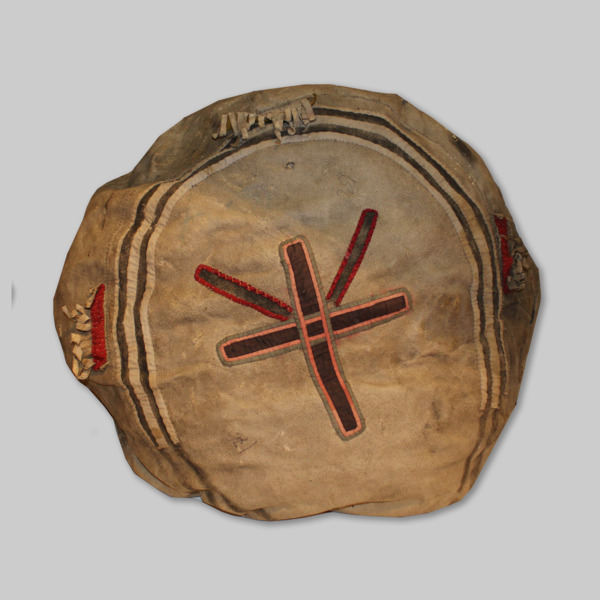
The Museum displays a bag made of deer skin, rounded shape and with a tie at the top. This case served as a protection for the tambourine from mechanical damage and moisture. On normal days, tools, costumes, and other ritual paraphernalia were placed in this bag and stored in the shaman’s plague. They were removed immediately before starting the rituals. This cover for the tambourine was made in the middle of the XIX century by handy craftsmen who lived in the North of the Yeniseysk district, in the Turukhansk region.
The shaman was traditionally approached on various issues: to cure a deer, to find a strayed deer from the herd, to ward off evil spirits, to protect against human diseases and failures, to send the soul of the deceased to the world of souls of dead people.
The shaman always had spirit helpers — often in the form of birds or animals. He was also helped by the spirits of his ancestors — mugda. They gave advice during the ritual. The shaman made a fire and slowly hitting on the tambourine, going round the fire. The dance would grow faster and faster until the shaman was in ecstasy. After that, he would fall into a long silence. While his body was in the middle world, his soul was in other worlds — he would meet with good spirits, asked them for health, well — being, protection and patronage. After saying goodbye to the spirits, he returned to his body, slowly opened his eyes and announced the will of the spirits to the people.
In addition, shamans were engaged in healing. To find out the cause of the disease, it was necessary to conduct a special rite — the source could be an evil eye or the tricks of evil spirits, which were unleashed by shamans of hostile clans. Based on the reason, the person was treated with a ritual or medication.
The Museum displays a bag made of deer skin, rounded shape and with a tie at the top. This case served as a protection for the tambourine from mechanical damage and moisture. On normal days, tools, costumes, and other ritual paraphernalia were placed in this bag and stored in the shaman’s plague. They were removed immediately before starting the rituals. This cover for the tambourine was made in the middle of the XIX century by handy craftsmen who lived in the North of the Yeniseysk district, in the Turukhansk region.
#8
Date: XVII century
Technique: leather, beads, birch bark
Dimensions: 66×30 cm
Collection: Yenisei Museum of Local Lore, History and Economy named after Alexander Ignatievich Kytmanov, Yeniseisk, Krasnoyarsk Territory
Copyright: Yenisei Museum of Local Lore, History and Economy named after Alexander Ignatievich Kytmanov, Yeniseisk, Krasnoyarsk Territory
Technique: leather, beads, birch bark
Dimensions: 66×30 cm
Collection: Yenisei Museum of Local Lore, History and Economy named after Alexander Ignatievich Kytmanov, Yeniseisk, Krasnoyarsk Territory
Copyright: Yenisei Museum of Local Lore, History and Economy named after Alexander Ignatievich Kytmanov, Yeniseisk, Krasnoyarsk Territory
#4
Ostyak basket made of bird cherry root with lid
#13
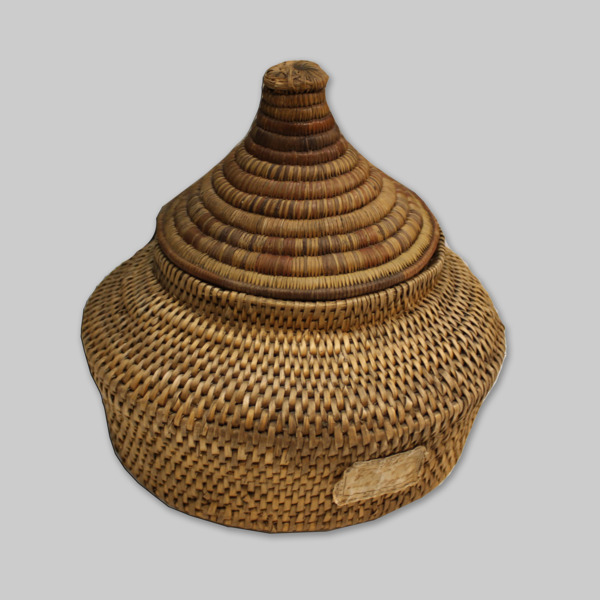
#10
Bird cherry wood is heavy, strong, dense, but flexible and almost not afraid of moisture — for these properties, it is highly valued by craftsmen and artisans. The wood of this breed has long been used to create many different household items — baskets of all sizes and purposes, dishes, rolls for washing clothes and other household utensils. Knife handles were made from burl (a growth on a tree), because this convenient porous material does not slip and does not freeze in the cold. Bird cherry was used even in the process of collecting sledges: the spears were twisted in a bundle made from a cherry trunk.
When processed, fresh bird cherry wood emits a light almond flavor similar to the smell of mountain ash wood. Practically it does not dry out, but you need to dry it with care — then it will not warp, crack and require a varnish coating. Moisture does not harm the wood, but on the contrary, makes it more elastic and durable. Due to its uniformity, bird cherry can be perfectly cut in all directions.
Bird cherry weaving is quite a time-consuming process, so only the simplest methods of this craft have taken root. It could take about eight hours on average to weave a small basket. In addition, some elements of the basket need intermediate drying, while others, on the contrary, require additional moisture in order for the product to eventually turn out to be dense and high quality.
A newly woven basket should not be use immediately — it must be left to dry and, if necessary, braided after complete drying. The full cycle of work, taking into account the harvesting of wood and drying the product, took much more time. It included searching the forest for young trees of the desired length and thickness, splitting wood into thin ribbons, planing stiffeners, and making a rim and handle.
Light and beautiful in texture, bird cherry wood is still deservedly popular among carpenters, turners and wood carvers. It is especially appreciated in carvings with fine details.
When processed, fresh bird cherry wood emits a light almond flavor similar to the smell of mountain ash wood. Practically it does not dry out, but you need to dry it with care — then it will not warp, crack and require a varnish coating. Moisture does not harm the wood, but on the contrary, makes it more elastic and durable. Due to its uniformity, bird cherry can be perfectly cut in all directions.
Bird cherry weaving is quite a time-consuming process, so only the simplest methods of this craft have taken root. It could take about eight hours on average to weave a small basket. In addition, some elements of the basket need intermediate drying, while others, on the contrary, require additional moisture in order for the product to eventually turn out to be dense and high quality.
A newly woven basket should not be use immediately — it must be left to dry and, if necessary, braided after complete drying. The full cycle of work, taking into account the harvesting of wood and drying the product, took much more time. It included searching the forest for young trees of the desired length and thickness, splitting wood into thin ribbons, planing stiffeners, and making a rim and handle.
Light and beautiful in texture, bird cherry wood is still deservedly popular among carpenters, turners and wood carvers. It is especially appreciated in carvings with fine details.
#9
Date: XVII–XVIII centuries
Technique: wood
Place: Yeniseysk district
Dimensions: 25×24 cm
Collection: Yenisei Museum of Local Lore, History and Economy named after Alexander Ignatievich Kytmanov, Yeniseisk, Krasnoyarsk Territory
Copyright: Yenisei Museum of Local Lore, History and Economy named after Alexander Ignatievich Kytmanov, Yeniseisk, Krasnoyarsk Territory
Technique: wood
Place: Yeniseysk district
Dimensions: 25×24 cm
Collection: Yenisei Museum of Local Lore, History and Economy named after Alexander Ignatievich Kytmanov, Yeniseisk, Krasnoyarsk Territory
Copyright: Yenisei Museum of Local Lore, History and Economy named after Alexander Ignatievich Kytmanov, Yeniseisk, Krasnoyarsk Territory
read morehide
00:00
00:00
1x
Shamanic tambourine, Bag, Ostyak basket
Collection
Exhibition
8
 Point your smartphone camera to open in the app
Open in app
Share