#1
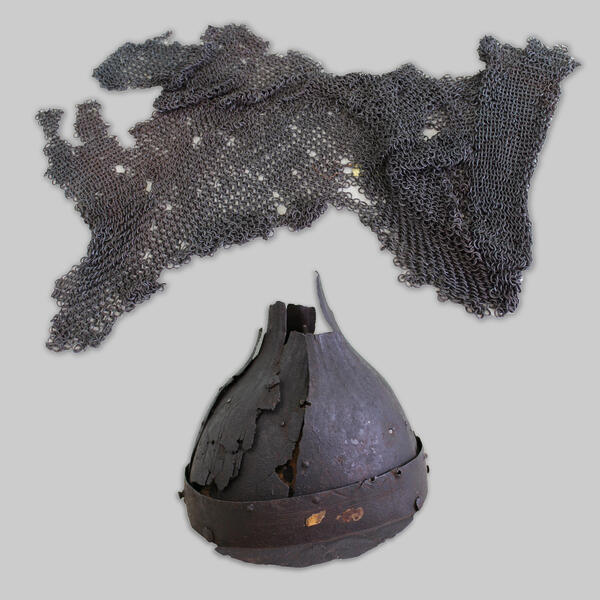
Metal Cossack helmet, Fragment of metal chain mail
#2
#8
#4
Helmet — part of a warrior’s protective armament, designed to cover the head and neck from enemy attacks. European people in the early Middle Ages used frame helmets, and from the 10th century switched to the Norman-type nasal helmets. In Russia, in the 10th century, helmets of the Chernigov type of sphero-conical shape appeared, riveted from four parts. Under Russian influence, they spread to the West of Eastern Europe and replaced the Normans, because they provided more reliable protection from above attacks.
Such helmets, consisting of four parts, were use among the nomads — the shape was apparently borrowed from them. The appearance of high sphero-conical helmets in Russia in the XII century is also associated with the Eastern influence. At the same time, the nomads of Eastern Europe began to use cylindrical-conical helmets with a cutout for the face and equipped with a mask — in the XIV century in Russia they were modified into the so-called eastern bascinets.
In the XIV century, lobster-tailed pot helmets were first mentioned and then spread. In the XVI, iron hats appeared, and under Turkish and Iranian influence — the Misyurks and Erikhonkas. By the end of the century, low lobster-tailed pot helmets and hats almost completely replaced high helmets. A century later, under Western influence, European infantry helmets, in particular, cabassets, came to Russia. After the advent of firearms, armor gradually disappeared, and in the 18th century, soldiers already fought without helmets.
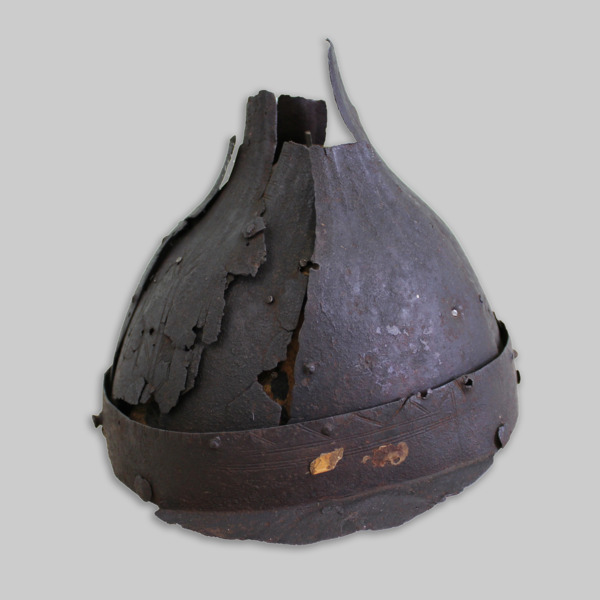
This helmet belongs to the cones, since at the base it is a hemisphere with an elevation on the top and a knob-like pommel. It consists of seven metal plates connected by rivets. Each plate is decorated with geometric ornaments. Also preserved are rivets for attaching a chain mail mesh-aventail (lost in this sample), which covered the warrior’s neck and consisted of the same rings as the chain mail. Probably, this helmet was worn not by the Cossacks, but by the local Yenisey Ostyaks or Tungus. This conclusion can be made based on the internal diameter of the helmet — it is less than 17 cm. The Yenisey Ostyaks and Tunguses belong to the Mongoloid race — their skull size is slightly smaller on average.
This specimen was found during the construction of the Yenisey — Ob canal (1882-1893) in the same grave as the chain mail displayed at the exhibition. The helmet was a gift to the Museum from Baron Bjork Alexis Aminov, who supervised the construction of the canal.
Such helmets, consisting of four parts, were use among the nomads — the shape was apparently borrowed from them. The appearance of high sphero-conical helmets in Russia in the XII century is also associated with the Eastern influence. At the same time, the nomads of Eastern Europe began to use cylindrical-conical helmets with a cutout for the face and equipped with a mask — in the XIV century in Russia they were modified into the so-called eastern bascinets.
In the XIV century, lobster-tailed pot helmets were first mentioned and then spread. In the XVI, iron hats appeared, and under Turkish and Iranian influence — the Misyurks and Erikhonkas. By the end of the century, low lobster-tailed pot helmets and hats almost completely replaced high helmets. A century later, under Western influence, European infantry helmets, in particular, cabassets, came to Russia. After the advent of firearms, armor gradually disappeared, and in the 18th century, soldiers already fought without helmets.
This helmet belongs to the cones, since at the base it is a hemisphere with an elevation on the top and a knob-like pommel. It consists of seven metal plates connected by rivets. Each plate is decorated with geometric ornaments. Also preserved are rivets for attaching a chain mail mesh-aventail (lost in this sample), which covered the warrior’s neck and consisted of the same rings as the chain mail. Probably, this helmet was worn not by the Cossacks, but by the local Yenisey Ostyaks or Tungus. This conclusion can be made based on the internal diameter of the helmet — it is less than 17 cm. The Yenisey Ostyaks and Tunguses belong to the Mongoloid race — their skull size is slightly smaller on average.
This specimen was found during the construction of the Yenisey — Ob canal (1882-1893) in the same grave as the chain mail displayed at the exhibition. The helmet was a gift to the Museum from Baron Bjork Alexis Aminov, who supervised the construction of the canal.
#5
Date: XVII century
Technique: metal
Place: Yeniseysk
Dimensions: 20×18 cm
Collection: Yenisei Museum of Local Lore, History and Economy named after Alexander Ignatievich Kytmanov, Yeniseisk, Krasnoyarsk Territory
Copyright: Yenisei Museum of Local Lore, History and Economy named after Alexander Ignatievich Kytmanov, Yeniseisk, Krasnoyarsk Territory
Technique: metal
Place: Yeniseysk
Dimensions: 20×18 cm
Collection: Yenisei Museum of Local Lore, History and Economy named after Alexander Ignatievich Kytmanov, Yeniseisk, Krasnoyarsk Territory
Copyright: Yenisei Museum of Local Lore, History and Economy named after Alexander Ignatievich Kytmanov, Yeniseisk, Krasnoyarsk Territory
#3
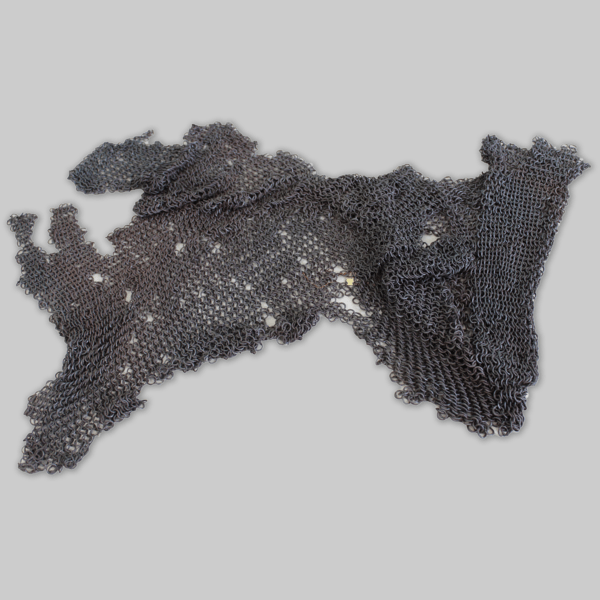
Fragment of metal chain mail
#9
#6
Chain mail — an ancient military armor in the form of a shirt made of metal rings. The so-called ‘iron shirt’ was made by a chain mail specialist. Depending on the size of the armor, with a wire thickness of 1-2 mm and a ring diameter of 10 mm, one such ‘shirt’ took 15-30 thousand rings. Accordingly, the weight of the product ranged from 5 to 15 kg.
Chain mail became widespread both in Europe and Asia due to the simple manufacturing technology. To assemble a chain mail, it required several kilograms of iron, a device for drawing wire, and patience for the monotonous work of making rings and weaving them into the chain mail itself. On average, it took several hundred men -hours to work. Once made, such armor could serve almost forever — if it was damaged, it was enough to patch the chain mail with a handful of new rings.
In Russia, chain mail became widespread in the days of Kiev Rus and was used until the end of the XVII century. The Persian encyclopedist Ibn Rusta, writing in the first third of the X century, notes that the ‘Slavic king’ had ‘beautiful, strong and precious chain mail’. In the miniatures of the Radziwill Chronicle, depicting warriors and battle scenes, according to the Soviet archeologist-Slavist and historian Artemy Artsikhovsky, chain mail, the folds of which are marked by shades of paint, noticeably prevails.
The Russian archaeologist Anatoly Kirpichnikov noted in his writings that in the second half of the XII century, Old Russian chain mail began to be made entirely from riveted rings (earlier they alternated with welded ones), and around 1200 flat rings appeared. By the 70s of the XV century, a new type of finely woven chain mail appeared in Russia, which was called pansyr, and in the XVI century, chain mails consisting entirely of flat rings — baydani — spread.
The fragment presented at the exhibition was found in the Ostyak grave during the construction of Ob — Yenisey canal in 1882-1893. It was presented to the Museum by Baron Bjork Alexis Aminov, a Russian hydraulic engineer, head of the Tomsk railway district and head of the canal construction.
Chain mail became widespread both in Europe and Asia due to the simple manufacturing technology. To assemble a chain mail, it required several kilograms of iron, a device for drawing wire, and patience for the monotonous work of making rings and weaving them into the chain mail itself. On average, it took several hundred men -hours to work. Once made, such armor could serve almost forever — if it was damaged, it was enough to patch the chain mail with a handful of new rings.
In Russia, chain mail became widespread in the days of Kiev Rus and was used until the end of the XVII century. The Persian encyclopedist Ibn Rusta, writing in the first third of the X century, notes that the ‘Slavic king’ had ‘beautiful, strong and precious chain mail’. In the miniatures of the Radziwill Chronicle, depicting warriors and battle scenes, according to the Soviet archeologist-Slavist and historian Artemy Artsikhovsky, chain mail, the folds of which are marked by shades of paint, noticeably prevails.
The Russian archaeologist Anatoly Kirpichnikov noted in his writings that in the second half of the XII century, Old Russian chain mail began to be made entirely from riveted rings (earlier they alternated with welded ones), and around 1200 flat rings appeared. By the 70s of the XV century, a new type of finely woven chain mail appeared in Russia, which was called pansyr, and in the XVI century, chain mails consisting entirely of flat rings — baydani — spread.
The fragment presented at the exhibition was found in the Ostyak grave during the construction of Ob — Yenisey canal in 1882-1893. It was presented to the Museum by Baron Bjork Alexis Aminov, a Russian hydraulic engineer, head of the Tomsk railway district and head of the canal construction.
#7
Date: XVII century
Technique: metal, forging
Place: Yeniseysk city
Dimensions: 41×70 cm
Collection: Yenisei Museum of Local Lore, History and Economy named after Alexander Ignatievich Kytmanov, Yeniseisk, Krasnoyarsk Territory
Copyright: Yenisei Museum of Local Lore, History and Economy named after Alexander Ignatievich Kytmanov, Yeniseisk, Krasnoyarsk Territory
Technique: metal, forging
Place: Yeniseysk city
Dimensions: 41×70 cm
Collection: Yenisei Museum of Local Lore, History and Economy named after Alexander Ignatievich Kytmanov, Yeniseisk, Krasnoyarsk Territory
Copyright: Yenisei Museum of Local Lore, History and Economy named after Alexander Ignatievich Kytmanov, Yeniseisk, Krasnoyarsk Territory
read morehide
00:00
00:00
1x
Metal Cossack helmet, Fragment of chain mail
Collection
Exhibition
2
 Point your smartphone camera to open in the app
Open in app
Share