#1
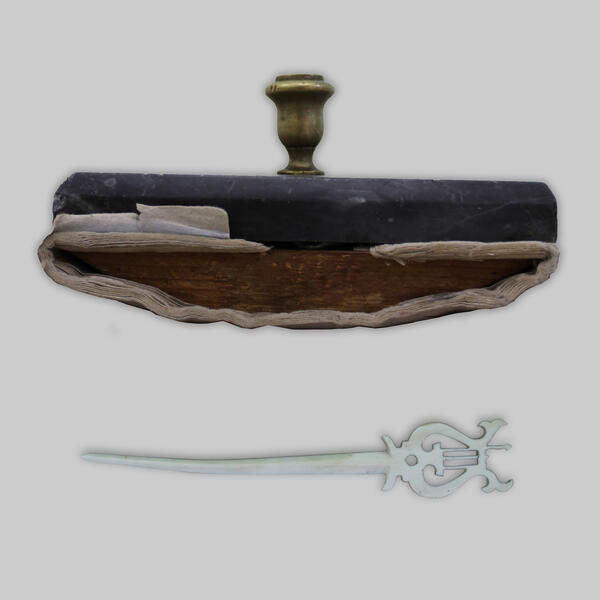
Paperweight, Utility knife ‘Lira’ for opening envelopes
#2
#8
#4
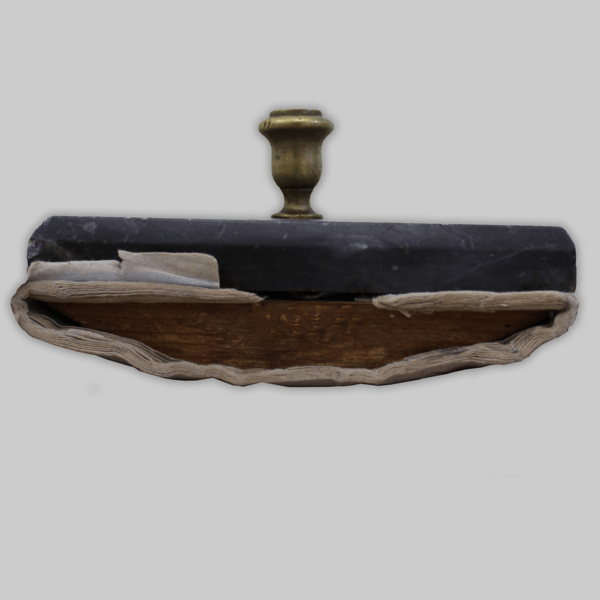
A paperweight is a writing instrument in the form of a rounded bar with blotting paper stretched over it to absorb excess ink on the document. The name comes from the French words presser — ‘to press’ and papier — ‘paper’. Usually a paperweight was made in the form of a semicircular bar, but it could have different shapes. The materials were bronze, marble, brass, and glass. Often the paperweight was inlaid, decorated with amber or metal figures, giving it a decorative function. But mostly paperweights were used for blotting ink and fixing papers lying on the table.
Blotting paper appeared only in the second half of the XIX century and at first was called ‘pass’, ‘leak’ or ‘blotter’. This non-glued and low-pressure paper consists of almost pure cellulose: its structure has many small capillaries, thanks to which it quickly absorbs liquids, such as ink. Before the appearance of such paper, paperweights were supplemented with a sandbox-the text was sprinkled with fine sand so that it absorbed excess ink an fast drying of the document.
‘Blotting paper’ was widely used in schools before the era of ballpoint pens. Manufacturers of school notebooks usually put one piece of blotting paper in each notebook. Schoolchildren of that time wrote with ink fountain pens, and the superimposed on the sheet that had just been written sped up the drying process of the ink, and also prevented them from smearing on the notebook, hands and clothes of schoolchildren.
Currently, paperweights have become a desirable object for collectors — many of them are real works of art and become a status decoration of the desktop. For its intended purpose, it is used mainly as an element of business Protocol — when signing documents with an ink pen or nib.
On the handle of the paperweight presented at the exhibition, there is a monogram ‘S. N’. — it belonged to Sergey Naumov, a teacher who arrived in Yeniseysk in 1913 on the steamer ‘Saint Nicholas’.
Blotting paper appeared only in the second half of the XIX century and at first was called ‘pass’, ‘leak’ or ‘blotter’. This non-glued and low-pressure paper consists of almost pure cellulose: its structure has many small capillaries, thanks to which it quickly absorbs liquids, such as ink. Before the appearance of such paper, paperweights were supplemented with a sandbox-the text was sprinkled with fine sand so that it absorbed excess ink an fast drying of the document.
‘Blotting paper’ was widely used in schools before the era of ballpoint pens. Manufacturers of school notebooks usually put one piece of blotting paper in each notebook. Schoolchildren of that time wrote with ink fountain pens, and the superimposed on the sheet that had just been written sped up the drying process of the ink, and also prevented them from smearing on the notebook, hands and clothes of schoolchildren.
Currently, paperweights have become a desirable object for collectors — many of them are real works of art and become a status decoration of the desktop. For its intended purpose, it is used mainly as an element of business Protocol — when signing documents with an ink pen or nib.
On the handle of the paperweight presented at the exhibition, there is a monogram ‘S. N’. — it belonged to Sergey Naumov, a teacher who arrived in Yeniseysk in 1913 on the steamer ‘Saint Nicholas’.
#5
Date: The beginning of the XX century
Technique: marble, copper, paper
Place: Krasnoyarsk
Dimensions: 18×6 cm
Collection: Yenisei Museum of Local Lore, History and Economy named after Alexander Ignatievich Kytmanov, Yeniseisk, Krasnoyarsk Territory
Copyright: Yenisei Museum of Local Lore, History and Economy named after Alexander Ignatievich Kytmanov, Yeniseisk, Krasnoyarsk Territory
Technique: marble, copper, paper
Place: Krasnoyarsk
Dimensions: 18×6 cm
Collection: Yenisei Museum of Local Lore, History and Economy named after Alexander Ignatievich Kytmanov, Yeniseisk, Krasnoyarsk Territory
Copyright: Yenisei Museum of Local Lore, History and Economy named after Alexander Ignatievich Kytmanov, Yeniseisk, Krasnoyarsk Territory
#3
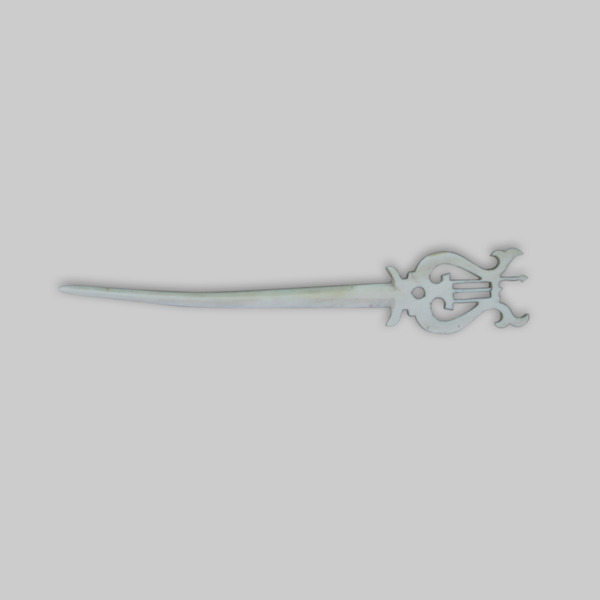
Utility knife ‘Lira’ for opening envelopes
#9
#6
A utility knife is a special tool that came into use in the XVIII–XIX centuries as an element of a writing set. It was a clumsy double-edged knife, often richly decorated. Such knives were made of not very strong steel, non-ferrous or precious metals, bone, stone. Designed primarily for cutting papers such as envelopes or book pages.
Previously, a new book bought in a store could not be opened without a book knife, since there was no hydraulic press that could cut through the thickness of the book pages. Therefore, a large sheet folded several times, containing up to 20 pages of the upcoming book, was simply stitched and joined to others — this is how the book was compiled, which immediately was taken for binding without cutting. It was impossible to flip the pages of such a book without first cutting it — the buyer brought the book home and cut the folds, separating the pages from each another.
The utility knife was irreplaceable both in the homes of Yeniseysk residents and employees of the Yeniseysk post and Telegraph office, organised in Yeniseysk in 1886 by connecting the post office and the Telegraph station.
A modern utility knife is a versatile small-sized tool, usually plastic, with a retractable replaceable metal blade. The main advantage of such a tool is that it does not need to be sharpened — during production, notches are applied to the blade, so that later you can easily break off a blunt segment. By the way, not everyone knows how to do this conveniently and safely. There is a lid on the handle of the knife that needs to be removed. It has a special slot in which the segment is placed and bent along the line from yourself.
The utility knife is used in absolutely different areas of household chores, for example, during repairs, in needlework, when working with various types of paper. At the same time, a modern utility knife has long gone beyond the utilitarian framework — it can act as an object of arts and crafts and sometimes a very refined or expensive business souvenir made of valuable materials. In addition, it can be connected to a fountain pen, ruler, and other office tools.
Previously, a new book bought in a store could not be opened without a book knife, since there was no hydraulic press that could cut through the thickness of the book pages. Therefore, a large sheet folded several times, containing up to 20 pages of the upcoming book, was simply stitched and joined to others — this is how the book was compiled, which immediately was taken for binding without cutting. It was impossible to flip the pages of such a book without first cutting it — the buyer brought the book home and cut the folds, separating the pages from each another.
The utility knife was irreplaceable both in the homes of Yeniseysk residents and employees of the Yeniseysk post and Telegraph office, organised in Yeniseysk in 1886 by connecting the post office and the Telegraph station.
A modern utility knife is a versatile small-sized tool, usually plastic, with a retractable replaceable metal blade. The main advantage of such a tool is that it does not need to be sharpened — during production, notches are applied to the blade, so that later you can easily break off a blunt segment. By the way, not everyone knows how to do this conveniently and safely. There is a lid on the handle of the knife that needs to be removed. It has a special slot in which the segment is placed and bent along the line from yourself.
The utility knife is used in absolutely different areas of household chores, for example, during repairs, in needlework, when working with various types of paper. At the same time, a modern utility knife has long gone beyond the utilitarian framework — it can act as an object of arts and crafts and sometimes a very refined or expensive business souvenir made of valuable materials. In addition, it can be connected to a fountain pen, ruler, and other office tools.
#7
Date: XVIII–XIX centuries
Technique: bone
Place: Yeniseysk city
Dimensions: 18×0,5 cm
Collection: Yenisei Museum of Local Lore, History and Economy named after Alexander Ignatievich Kytmanov, Yeniseisk, Krasnoyarsk Territory
Copyright: Yenisei Museum of Local Lore, History and Economy named after Alexander Ignatievich Kytmanov, Yeniseisk, Krasnoyarsk Territory
Technique: bone
Place: Yeniseysk city
Dimensions: 18×0,5 cm
Collection: Yenisei Museum of Local Lore, History and Economy named after Alexander Ignatievich Kytmanov, Yeniseisk, Krasnoyarsk Territory
Copyright: Yenisei Museum of Local Lore, History and Economy named after Alexander Ignatievich Kytmanov, Yeniseisk, Krasnoyarsk Territory
read morehide
00:00
00:00
1x
Paperweight, Utility knife «Lira»
Collection
Exhibition
1
 Point your smartphone camera to open in the app
Open in app
Share