

#1
Wicker basket made of sorghum, Birch bark bast shoes, Door hinge, Samovar, Metal sickle
#2
#17
#7
Today, we use boxes and containers made of plastic, metal or paper to store or transport various household items. And our ancestors wove vessels and baskets from roots, willow twigs, grass, reeds. Moreover, they did this long before they started making ceramic and fabrics.
For the first time wicker baskets appeared about 8,5 thousand years ago in Africa and the Middle East. This is evidenced by the excavations carried out by archaeologists at the sites of old civilizations. In Europe, similar products appeared much later. An interesting fact is that for so long the method of weaving has not undergone fundamental changes.
In ancient times, human life was almost unthinkable without wicker things. Cradles for babies were made of grass, and the bed was a mat of willow twigs. The roof and walls of the dwellings were built from reeds — to increase their strength and stability, hardened clay in the sun was used. People kept a variety of things in vine baskets: the harvested crop and seeds, caught fish and game, clothing and provisions.
Wicker baskets were placed in tombs to store things that belonged to the deceased and could be ‘useful’ in the afterlife. Each tribe decorated their products in their own way — according to the method of weaving and individual characteristic design elements, it was possible to determine whether a particular item belonged to a particular family clan.
Aeronautics pioneers attached wicker baskets to balloons. This tradition has survived to this day — aeronauts continue to use such structures in lifting balloons to the sky.
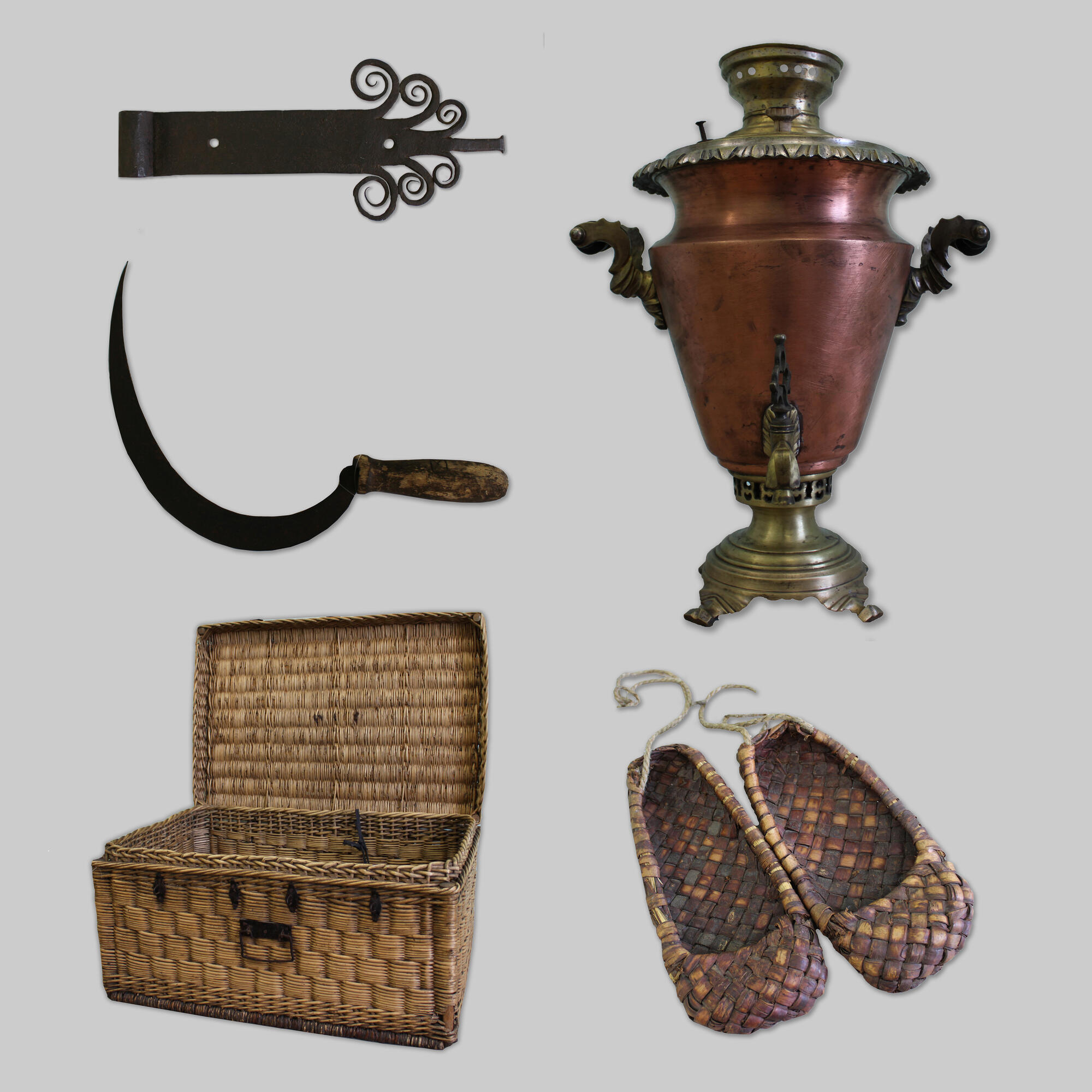
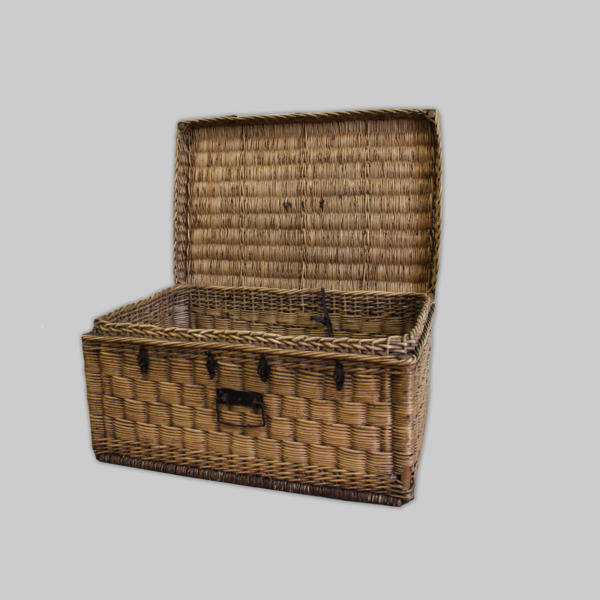
People have been cultivating sorghum for about 5 thousand years, and now all its variety of species can be divided into 4 types according to the principle of use: grain, sugar, broom and herbaceous. Flour, cereals, starch and alcohol are obtained from the grain. Straw is used for making paper, cardboard, wicker products, brooms, and also covers the roofs of houses. Some species are used to make red leather dyes. Wicker basket made of sorghum presented at the exhibition is suitable for travelling, Luggage transportation, and storage of various things.
For the first time wicker baskets appeared about 8,5 thousand years ago in Africa and the Middle East. This is evidenced by the excavations carried out by archaeologists at the sites of old civilizations. In Europe, similar products appeared much later. An interesting fact is that for so long the method of weaving has not undergone fundamental changes.
In ancient times, human life was almost unthinkable without wicker things. Cradles for babies were made of grass, and the bed was a mat of willow twigs. The roof and walls of the dwellings were built from reeds — to increase their strength and stability, hardened clay in the sun was used. People kept a variety of things in vine baskets: the harvested crop and seeds, caught fish and game, clothing and provisions.
Wicker baskets were placed in tombs to store things that belonged to the deceased and could be ‘useful’ in the afterlife. Each tribe decorated their products in their own way — according to the method of weaving and individual characteristic design elements, it was possible to determine whether a particular item belonged to a particular family clan.
Aeronautics pioneers attached wicker baskets to balloons. This tradition has survived to this day — aeronauts continue to use such structures in lifting balloons to the sky.
People have been cultivating sorghum for about 5 thousand years, and now all its variety of species can be divided into 4 types according to the principle of use: grain, sugar, broom and herbaceous. Flour, cereals, starch and alcohol are obtained from the grain. Straw is used for making paper, cardboard, wicker products, brooms, and also covers the roofs of houses. Some species are used to make red leather dyes. Wicker basket made of sorghum presented at the exhibition is suitable for travelling, Luggage transportation, and storage of various things.
#8
Technique: rods
Dimensions: 45×67×31cm
Collection: Yenisei Museum of Local Lore, History and Economy named after Alexander Ignatievich Kytmanov, Yeniseisk, Krasnoyarsk Territory
Copyright: Yenisei Museum of Local Lore, History and Economy named after Alexander Ignatievich Kytmanov, Yeniseisk, Krasnoyarsk Territory
Dimensions: 45×67×31cm
Collection: Yenisei Museum of Local Lore, History and Economy named after Alexander Ignatievich Kytmanov, Yeniseisk, Krasnoyarsk Territory
Copyright: Yenisei Museum of Local Lore, History and Economy named after Alexander Ignatievich Kytmanov, Yeniseisk, Krasnoyarsk Territory
#3
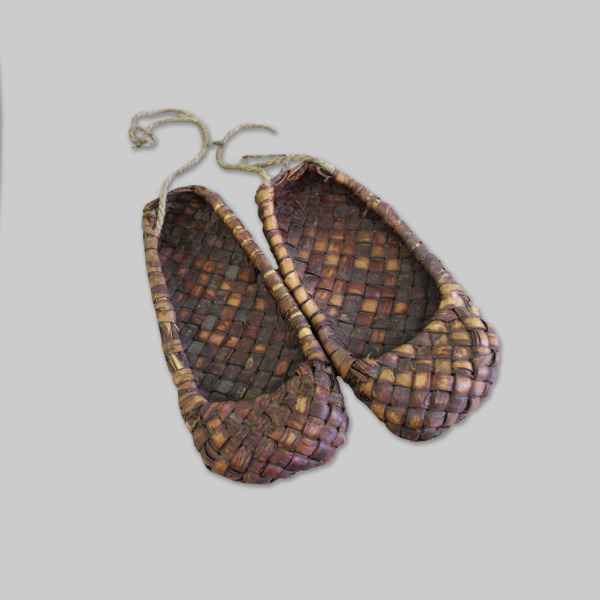
Birch bark bast shoes
#18
#9
Bast shoes — low flimsy shoes, woven from bast fibre, birch bark or hemp. They were worn in the old days in Russia almost everywhere and up to the 1930s. Bast shoes nowadays — one of the main symbols of traditional national life.
In Siberia, such shoes were inappropriate and impractical: they were rarely worn there — bast shoes were easily recognized by families of immigrants who had just moved to the north, for example, from the western provinces. And although the entire Russian population of Siberia at different times came here from the west, the first settlers (chaldons) treated the new settlers with some prejudice, calling them lapotnik (bast shoes). The Siberians themselves preferred teal or brodni, but occasionally there were also birch bark bast shoes. To strengthen it, the sole of the bast shoes was tied with a rope or sewn with leather.
To make one bast shoe, seven birch bark bast fibres were required, two meters long each. The bast fibre had to be removed from the smooth part of the birch trunk so that it had no defects along its entire length. Therefore, grown, smooth and tall trees were chosen for harvesting. Often, after removing the bark suitable for weaving, the tree was left with a bare trunk. The width of one bast was about the width of the thumb on a person’s hand — it was men who harvested bast and wove them into bast shoes (they were taught this craft from childhood to develop skill).
Also, the work required a wooden block, approximately corresponding to the size of a man’s or a woman’s foot, and a knife for cutting bast. Another mandatory and special tool — the kochedyk, which resembles a flat curved awl. The purpose of this tool — to lift one of the loops of the already woven part of the bast shoe in order to thread the free end of the bast into it.
Due to the simplicity of manufacture and fragility, bast shoes were distinguished by extremely low cost. They were not woven in all regions of Russia, so they were often the subject of barter. Weaving was done mainly in winter, when there was no field work. A farmer wore at least 50 pairs of bast shoes a year, but it was still cheaper than buying leather boots.
In Siberia, such shoes were inappropriate and impractical: they were rarely worn there — bast shoes were easily recognized by families of immigrants who had just moved to the north, for example, from the western provinces. And although the entire Russian population of Siberia at different times came here from the west, the first settlers (chaldons) treated the new settlers with some prejudice, calling them lapotnik (bast shoes). The Siberians themselves preferred teal or brodni, but occasionally there were also birch bark bast shoes. To strengthen it, the sole of the bast shoes was tied with a rope or sewn with leather.
To make one bast shoe, seven birch bark bast fibres were required, two meters long each. The bast fibre had to be removed from the smooth part of the birch trunk so that it had no defects along its entire length. Therefore, grown, smooth and tall trees were chosen for harvesting. Often, after removing the bark suitable for weaving, the tree was left with a bare trunk. The width of one bast was about the width of the thumb on a person’s hand — it was men who harvested bast and wove them into bast shoes (they were taught this craft from childhood to develop skill).
Also, the work required a wooden block, approximately corresponding to the size of a man’s or a woman’s foot, and a knife for cutting bast. Another mandatory and special tool — the kochedyk, which resembles a flat curved awl. The purpose of this tool — to lift one of the loops of the already woven part of the bast shoe in order to thread the free end of the bast into it.
Due to the simplicity of manufacture and fragility, bast shoes were distinguished by extremely low cost. They were not woven in all regions of Russia, so they were often the subject of barter. Weaving was done mainly in winter, when there was no field work. A farmer wore at least 50 pairs of bast shoes a year, but it was still cheaper than buying leather boots.
#10
Technique: bast fibre
Dimensions: 28 cm
Collection: Yenisei Museum of Local Lore, History and Economy named after Alexander Ignatievich Kytmanov, Yeniseisk, Krasnoyarsk Territory
Copyright: Yenisei Museum of Local Lore, History and Economy named after Alexander Ignatievich Kytmanov, Yeniseisk, Krasnoyarsk Territory
Dimensions: 28 cm
Collection: Yenisei Museum of Local Lore, History and Economy named after Alexander Ignatievich Kytmanov, Yeniseisk, Krasnoyarsk Territory
Copyright: Yenisei Museum of Local Lore, History and Economy named after Alexander Ignatievich Kytmanov, Yeniseisk, Krasnoyarsk Territory
#4
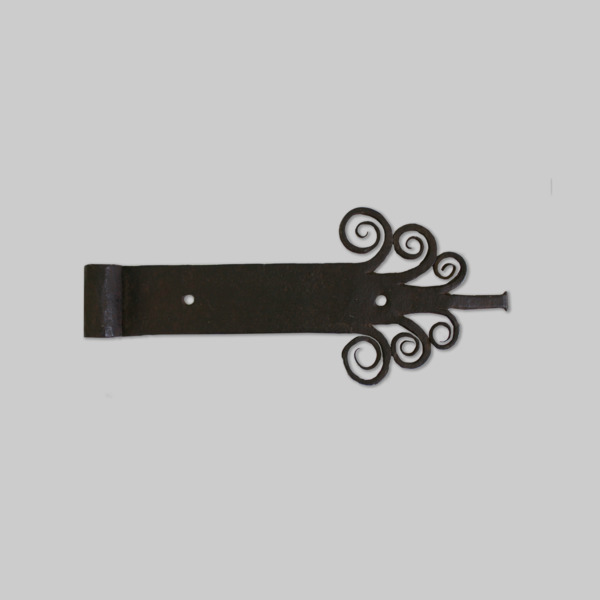
Door hinge
#19
#11
Door hinges — a type of hinge. This mechanism has long been used for attaching doors to a door frame, so that it opens and closes. Modern door hinges are distinguished by the method of installation, direction of opening, weight of the door and classified according to the established GOST (governmental standard).
Now, it is impossible to imagine a door without hinges, and it seems that it has always been so. However, it is still unknown who invented this. The oldest hinges — dated back to somewhere 1600 BC — were found on the gates of Hattusa, the capital of the ancient Hittite Kingdom, now known as Turkey. Hinges were also used in Ancient Egypt and Ancient Rome.
Yeniseysk played a major role as commercial and industrial center not only of the Yenisey province, but also the entire Eastern Siberia. Since the 60s of the XVIII century, it had been an annual fair that brought together Siberian and Russian merchants. They brought all sorts of goods, in return for which they purchased furs. When the Irbit fair started, the value of the Yeniseysk fair fell.
However, Yeniseysk did not lose its industrial significance — the city was still famous for its artisans and craftsmen. Yeniseysk people were known as painters, carvers, carpenters, armourers, and especially as experienced and skilled blacksmiths. Blacksmithing flourished there — iron was produced in significant quantities from nearby ores. Yeniseysk supplied Irkutsk, Tomsk, Barnaul, Biysk and other cities its axes, nails, coulters and other forged items. For example, in 1820, up to 6 thousand pounds of iron in various crafts were taken from Yeniseysk district to Irkutsk district. In 1833, this volume was already 30 thousand pounds.
In the 80s of the XVIII century, there were about 40 smithies in the city, in which 80 blacksmiths worked. Five of them had ore-smelting furnaces. All the smithies were located at one place — across the Melnichnaya river on Kuznechnaya street.
The door hinge presented at the exhibition is made of local iron ore and is an excellent example of high-quality work of Yeniseysk blacksmiths. It was found on the banks of the Yenisey and Melnichnaya river. The Museum received hinges on December 26, 1991 from pupils of school № 1.
Now, it is impossible to imagine a door without hinges, and it seems that it has always been so. However, it is still unknown who invented this. The oldest hinges — dated back to somewhere 1600 BC — were found on the gates of Hattusa, the capital of the ancient Hittite Kingdom, now known as Turkey. Hinges were also used in Ancient Egypt and Ancient Rome.
Yeniseysk played a major role as commercial and industrial center not only of the Yenisey province, but also the entire Eastern Siberia. Since the 60s of the XVIII century, it had been an annual fair that brought together Siberian and Russian merchants. They brought all sorts of goods, in return for which they purchased furs. When the Irbit fair started, the value of the Yeniseysk fair fell.
However, Yeniseysk did not lose its industrial significance — the city was still famous for its artisans and craftsmen. Yeniseysk people were known as painters, carvers, carpenters, armourers, and especially as experienced and skilled blacksmiths. Blacksmithing flourished there — iron was produced in significant quantities from nearby ores. Yeniseysk supplied Irkutsk, Tomsk, Barnaul, Biysk and other cities its axes, nails, coulters and other forged items. For example, in 1820, up to 6 thousand pounds of iron in various crafts were taken from Yeniseysk district to Irkutsk district. In 1833, this volume was already 30 thousand pounds.
In the 80s of the XVIII century, there were about 40 smithies in the city, in which 80 blacksmiths worked. Five of them had ore-smelting furnaces. All the smithies were located at one place — across the Melnichnaya river on Kuznechnaya street.
The door hinge presented at the exhibition is made of local iron ore and is an excellent example of high-quality work of Yeniseysk blacksmiths. It was found on the banks of the Yenisey and Melnichnaya river. The Museum received hinges on December 26, 1991 from pupils of school № 1.
#12
Technique: iron
Place: Yeniseysk city
Dimensions: 40 cm
Collection: Yenisei Museum of Local Lore, History and Economy named after Alexander Ignatievich Kytmanov, Yeniseisk, Krasnoyarsk Territory
Copyright: Yenisei Museum of Local Lore, History and Economy named after Alexander Ignatievich Kytmanov, Yeniseisk, Krasnoyarsk Territory
Place: Yeniseysk city
Dimensions: 40 cm
Collection: Yenisei Museum of Local Lore, History and Economy named after Alexander Ignatievich Kytmanov, Yeniseisk, Krasnoyarsk Territory
Copyright: Yenisei Museum of Local Lore, History and Economy named after Alexander Ignatievich Kytmanov, Yeniseisk, Krasnoyarsk Territory
#5
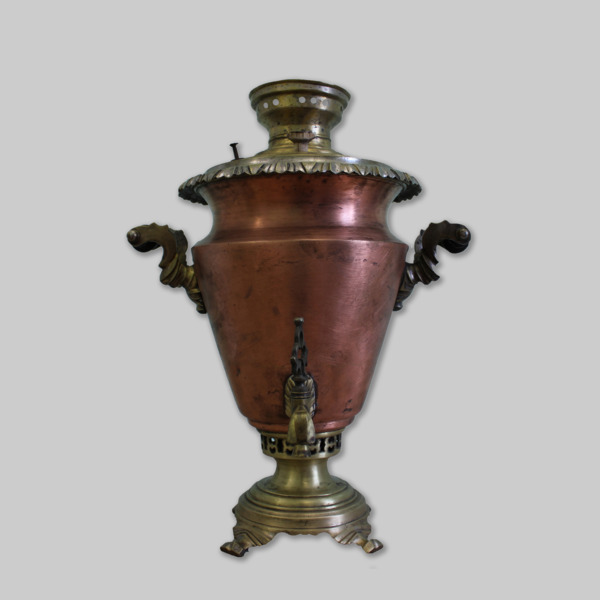
Samovar
#20
#13
Samovar — a metal vessel for boiling water and making tea. Initially, water was heated in an internal firebox — it was a tall tube filled with charcoal. Later there were other types of samovars — kerosene and electric.
Appliances like samovar have long been known in China. They were used for preparing hot water, and also had all the main features of a samovar-combined in one design a water vessel, a brazier for coals and a pipe passing through the vessel. Samovar devices have long been used in Azerbaijan — clay samovars, which are at least 3600 years old, was discovered at archaeological excavations.
In Russia, hot water began to be used for tea as its consumption spread, starting from the XVII century. Tula is considered the homeland of Russian samovars, but historical facts indicate that it belongs to the Ural people — they began to be made between 1738 and 1740 at the Irginsky factory (village of Nizhneirginsky, Sverdlovsk region).
Samovar production turned out to be very profitable. Artisans quickly turned into manufacturers, workshops — into factories. In 1808, eight samovar factories were operating in Tula. In the first half of the XIX century, they began to be made from silver substitutes, and samovars became popular among the middle-class urban population — they were bought by representatives of the bourgeoisie, officials, intelligentsia of various ranks, and nobles.
In the 1840s, the fashion for the so-called ‘second Rococo’ came to Russia, which is characterized by rich, lush ornamentation. The trend also affected household utensils — the base, handles, top of the body and edges of samovars were decorated with borders of intricate plant curls and flowers.
In 1850, there were already twenty eight samovar factories in Tula — they produced about 120 thousand samovars a year and many other copper products. The cone-shaped samovar presented at the Museum is made of copper and from one of the factories in Tula. The lid and handles of the samovar are decorated with floral ornaments. This samovar was purchased at the beginning of the XX century: for a long time it was stored in a barn, then it was transferred to the Museum.
Appliances like samovar have long been known in China. They were used for preparing hot water, and also had all the main features of a samovar-combined in one design a water vessel, a brazier for coals and a pipe passing through the vessel. Samovar devices have long been used in Azerbaijan — clay samovars, which are at least 3600 years old, was discovered at archaeological excavations.
In Russia, hot water began to be used for tea as its consumption spread, starting from the XVII century. Tula is considered the homeland of Russian samovars, but historical facts indicate that it belongs to the Ural people — they began to be made between 1738 and 1740 at the Irginsky factory (village of Nizhneirginsky, Sverdlovsk region).
Samovar production turned out to be very profitable. Artisans quickly turned into manufacturers, workshops — into factories. In 1808, eight samovar factories were operating in Tula. In the first half of the XIX century, they began to be made from silver substitutes, and samovars became popular among the middle-class urban population — they were bought by representatives of the bourgeoisie, officials, intelligentsia of various ranks, and nobles.
In the 1840s, the fashion for the so-called ‘second Rococo’ came to Russia, which is characterized by rich, lush ornamentation. The trend also affected household utensils — the base, handles, top of the body and edges of samovars were decorated with borders of intricate plant curls and flowers.
In 1850, there were already twenty eight samovar factories in Tula — they produced about 120 thousand samovars a year and many other copper products. The cone-shaped samovar presented at the Museum is made of copper and from one of the factories in Tula. The lid and handles of the samovar are decorated with floral ornaments. This samovar was purchased at the beginning of the XX century: for a long time it was stored in a barn, then it was transferred to the Museum.
#14
Date: the beginning of the XX century
Technique: copper
Place: Tula
Dimensions: 48×35 cm
Collection: Yenisei Museum of Local Lore, History and Economy named after Alexander Ignatievich Kytmanov, Yeniseisk, Krasnoyarsk Territory
Copyright: Yenisei Museum of Local Lore, History and Economy named after Alexander Ignatievich Kytmanov, Yeniseisk, Krasnoyarsk Territory
Technique: copper
Place: Tula
Dimensions: 48×35 cm
Collection: Yenisei Museum of Local Lore, History and Economy named after Alexander Ignatievich Kytmanov, Yeniseisk, Krasnoyarsk Territory
Copyright: Yenisei Museum of Local Lore, History and Economy named after Alexander Ignatievich Kytmanov, Yeniseisk, Krasnoyarsk Territory
#6
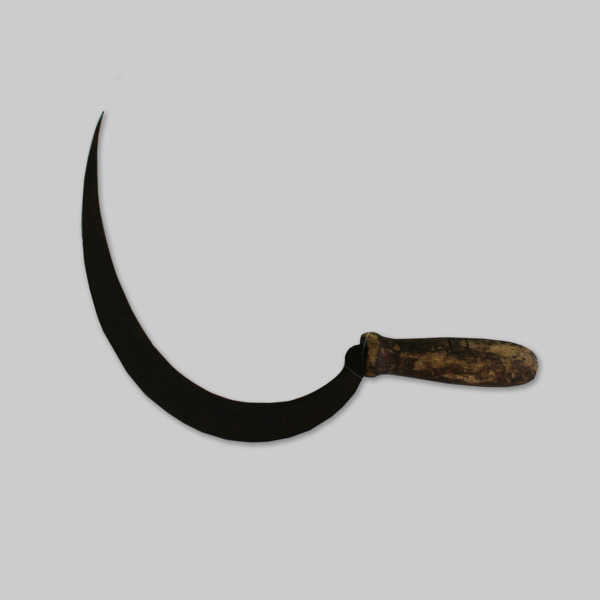
Metal sickle
#21
#15
A sickle or reaping knife — a hand-held agricultural tool with a short handle and a flat rounded blade. The cutting part of the blade has small notches on the inner edge. The blade length is 25-50 cm, width — 4-6 cm. The crescent-shaped sickle shape allows you to grasp and cut the stems. Usually, the sickle is used for harvesting small areas with grain crops, reaping grains, cutting grasses, gardening and floriculture. Also, with the help of a sickle, fresh fodder grass is mowed for pets.
The prototype of the sickle is the reaping knife, which, unlike the sickle, had a straight shape. Stone inserts into a wooden, bone, or horn handle were made using the technique of microliths (sections of prismatic plates) or represented a single blade. Reaping knives have been used in gathering since the Paleolithic and especially since the Mesolithic. As the tool became more specialized, it acquired a curved shape that was more suitable for reaping. As a result, the sickle appeared, and this time is considered the beginning of the transition to agriculture.
In the bronze age, sickles made of baked clay, solid stone sickles were known, and metal ones also appeared. In Europe, bronze sickles spread: among the steppe people, they acquired a perfect shape with the top of the arc of bending in the first third of the blade, best suited for cutting a large bundle of ears near the ground. Researchers associate the development of arable farming with the appearance of this shape. In China, sickles with a blade set perpendicular to the handle, like a scythe, became widespread. In the first millennium BC, bronze sickles were replaced by iron ones.
The sickle crossed with a hammer was the state emblem of the USSR, personifying the unity of workers and peasants. Now it continues to be widely used as a symbols of various communist parties around the world, including Russia.
The tool displayed at the museum has a traditional semi-oval blade shape with a serrated blade. It was made in an artisanal way and used for cutting grass and crops.
The prototype of the sickle is the reaping knife, which, unlike the sickle, had a straight shape. Stone inserts into a wooden, bone, or horn handle were made using the technique of microliths (sections of prismatic plates) or represented a single blade. Reaping knives have been used in gathering since the Paleolithic and especially since the Mesolithic. As the tool became more specialized, it acquired a curved shape that was more suitable for reaping. As a result, the sickle appeared, and this time is considered the beginning of the transition to agriculture.
In the bronze age, sickles made of baked clay, solid stone sickles were known, and metal ones also appeared. In Europe, bronze sickles spread: among the steppe people, they acquired a perfect shape with the top of the arc of bending in the first third of the blade, best suited for cutting a large bundle of ears near the ground. Researchers associate the development of arable farming with the appearance of this shape. In China, sickles with a blade set perpendicular to the handle, like a scythe, became widespread. In the first millennium BC, bronze sickles were replaced by iron ones.
The sickle crossed with a hammer was the state emblem of the USSR, personifying the unity of workers and peasants. Now it continues to be widely used as a symbols of various communist parties around the world, including Russia.
The tool displayed at the museum has a traditional semi-oval blade shape with a serrated blade. It was made in an artisanal way and used for cutting grass and crops.
#16
Date: XIX century
Technique: metal, forging
Place: Yeniseysk
Dimensions: 46×0,5 cm
Collection: Yenisei Museum of Local Lore, History and Economy named after Alexander Ignatievich Kytmanov, Yeniseisk, Krasnoyarsk Territory
Copyright: Yenisei Museum of Local Lore, History and Economy named after Alexander Ignatievich Kytmanov, Yeniseisk, Krasnoyarsk Territory
Technique: metal, forging
Place: Yeniseysk
Dimensions: 46×0,5 cm
Collection: Yenisei Museum of Local Lore, History and Economy named after Alexander Ignatievich Kytmanov, Yeniseisk, Krasnoyarsk Territory
Copyright: Yenisei Museum of Local Lore, History and Economy named after Alexander Ignatievich Kytmanov, Yeniseisk, Krasnoyarsk Territory
read morehide
00:00
00:00
1x
Basket, Bast shoes, Door hinge, Samovar, Sickle
Collection
Exhibition
1
 Point your smartphone camera to open in the app
Open in app
Share