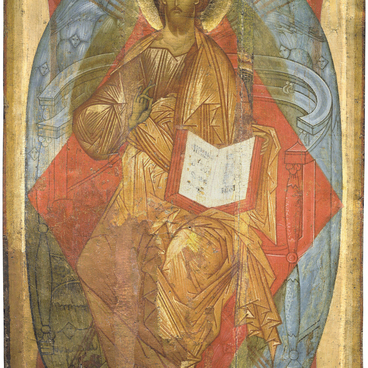
John the Baptist is considered to be the last Old Testament prophet. The main source of information about his life is the New Testament — the Gospels and Acts of the Apostles. The earliest images of John the Baptist appeared in catacomb paintings dating from no later than the 3rd century AD. The earliest icon depicting this saint alone dates back to the 6th century. In the 10th –11th centuries, icons of John the Baptist began to be included in the Deesis row. The word “δέησις” (Deesis) is translated from Greek as “prayer” or “supplication”. This reflects the meaning of the composition — a prayer on behalf of humanity.
In the center of the Deesis row is Jesus Christ. He is flanked by the Virgin Mary (on the right) and St. John the Baptist (on the left). The most prominent row of the iconostasis also includes images of archangels, apostles, and saints.
The iconography of the Deesis row was inspired by the church service, in particular, the prayer of thanksgiving for the Holy Eucharist or the lity service. The lity involves praying for the intercession of the Virgin Mary, John the Baptist, the angels, apostles, ecumenical teachers, saints, martyrs, and venerable saints. It determined which saints were to be included in the Deesis composition.
The icon of John the Baptist from the exhibition “Masterpieces of the Andrei Rublev Museum” originated from the cathedral at the Nikolo-Pesnoshsky Monastery near Dmitrov, Moscow Oblast. Since the lower part of the icon board is damaged, for a long time, it was assumed that John the Baptist was depicted full-length. However, later, it was discovered that the icon had always featured a half-length image of the saint.
In Byzantium, in particular, in the monasteries of Mount Athos, Deesis rows with half-length images of saints were widespread. They became popular in Russian ecclesiastical art in the late 14th century and in the first half of the 15th century.
Chronologically, the displayed icon is among the
images most closely related to the times of Andrei Rublev and his school. The
similarity to the Rublev school can be seen in the figure’s proportions, with
wide shoulders and an elongated neck, and in the delicate facial features.
However, the dominating role of lines and the muted, almost monochromatic color
palette indicate that the icon was likely created by a representative of a
later generation of icon painters.