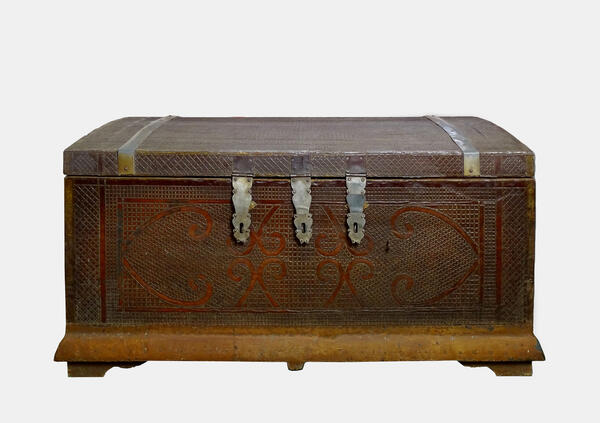
The history of the chest originates in Egypt. Up to the thirteenth century, early European chests, which were chiselled in wood, were common. Much later, the chest familiar to us was formed, made of slats connected by nails and upholstered with metal bands. A simple box chipped from boards acquired a lid, lock and ornamentation and was reborn as a chest.
“Chests and boxes are indigenous Russian utensils”, Vladimir Dahl testified in his “Explanatory Dictionary of the Living Great Russian Language”.
In the centre of the hut there was necessarily a chest — a box (in Russian: скрыня). Cossacks kept their clothes, daughters' dowries and valuables in the chest. Usually it was placed in the most prominent place in the front room — the first room of the hut. It was covered with a cape like a doormat.
Usually such chests were made by ordering from local craftsmen. The main material was wood. At the customer’s request it was framed with metal or decorated with painting or artistic carving. Chests were of different sizes and purposes, be it for home or travelling. There could be several of them in the house, as there were no wardrobes at that time. And everything was stored in them. The inside of the chest was often pasted with pictures from old newspapers and magazines, and later with photographs.
From childhood, a dowry was prepared for a future bride. A Cossack kept her dowry in the chest — sheets and cushions, table cloths and curtains for the windows. In the old days, every Cossack girl prepared such a dowry herself, with her own hands.