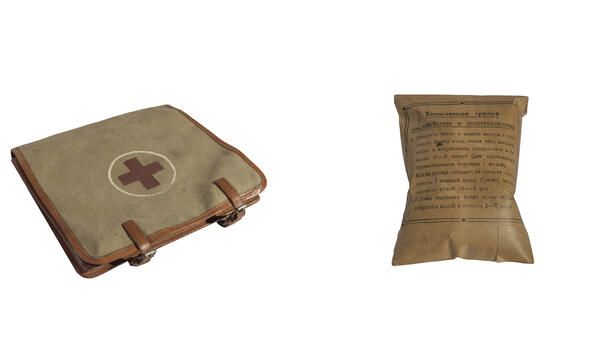
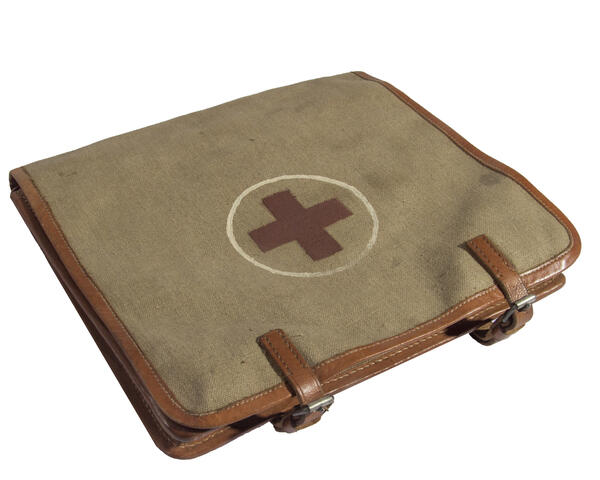
The collection of the Military Medical Museum contains a saddlebag of a mercy dog. Specially trained animals helped the orderlies to search for the wounded and to take them off the battlefield. The dogs also delivered medicine to the battlefront.
In 1905, the article “Dogs in the Police and Military Medical Service” was published in the “Niva” magazine issue No. 37. It read, “Dogs play an honorable and useful role in the military medical service. They are specially trained to locate the wounded on the battlefield and to supply them with food, drinks, some medicines (in case the wounded serviceman can use all this on his own). Four-legged orderlies perform their duties brilliantly, but, unfortunately, they are still not widely used. However, mercy dogs have already participated in the current [Russo-Japanese] war: a dog detachment was sent to the 1st Army Corps in a timely manner.”
At the climax of World War I, in April 1915, the first in the history of the Russian army, School for military sentry and mercy dogs was created on the Southwestern Front, in Lvov. Later, due to the enemy offensive, the institution was evacuated to Kiev. By March 1916, 86 dogs finished this school and joined the army.
By the end of the 1920s, it became clear how to select working dogs, how to breed and keep them, treat and train them, and what exactly they should do. The Caucasian shepherd dogs, huskies, pointing dogs and mongrels at least one and a half years old were considered most suitable for training. The stages of training the mercy dogs included fostering an interest in finding the wounded, teaching them to approach the lying and sitting people safely, training them to lie down near the wounded, and bring the orderly to the injured.
The dog on the battlefield could accurately tell an alive person from a dead one. It crawled to a wounded soldier, lay down beside him and waited for him to take the bandages out of the saddlebag and to apply a bandage to his wound. If the injured was unconscious, the dog would grab a snaffle, a wooden bite stick on the collar, and return to the handler holding the snaffle with its teeth. Then the dog accompanied the paramedic to the soldier on command. Often the wounded were evacuated by dog sleds. In 1941–1945, mercy dogs carried over 700 000 wounded soldiers off the battlefield.