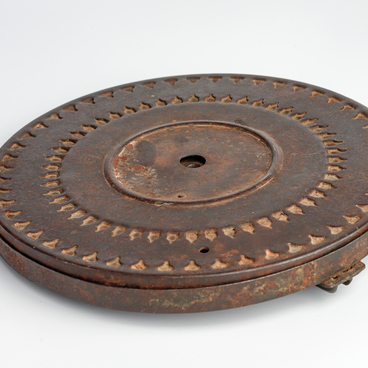
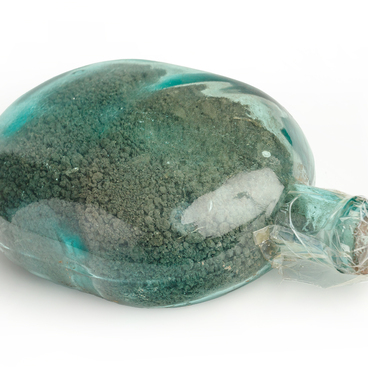
The Museum of Intelligence Officer Nikolai Kuznetsov houses a barrel from a German MG-42 machine gun. Widely feared by Allied troops, the MG-42 earned grim nicknames such as “bonecutter”, “Hitler’s saw”, and others — largely due to its exceptionally high rate of fire. Renowned for its reliability, the weapon performed effectively on every front and in all climatic conditions. By the end of the war, more than 400,000 units had been produced.
The MG-42’s design prioritized mass production: it made extensive use of stamped metal components and spot welding, and its total number of parts was reduced to just 200. The weapon featured a recoil-operated roller locking mechanism, with the bolt locked by rollers housed in the bolt head. The firing mechanism was integrated into the bolt assembly, and the trigger mechanism permitted only fully automatic fire.
One of the MG-42’s defining characteristics was its extraordinarily high rate — up to 1,500 rounds per minute. While this provided devastating suppressive fire, it also reduced controllability, so gunners were trained to fire in short bursts of 5–7 rounds. Barrel changes were dramatically simplified: a single soldier could replace an overheated barrel in as little as six seconds. Each spare parts kit included one spare barrel and two bolts.
The MG-42 used the standard German 7.92x57mm Mauser cartridge — the same as the earlier MG 34 — and was fed by belts holding either 50 or 250 rounds, loaded from left to right. It could be fired from a bipod for light support roles or mounted on a universal tripod for sustained fire. For anti-aircraft use, a dedicated anti-aircraft sight was employed; optical sights were also authorized in certain roles. The standard iron (sector) sight enabled aimed fire at distances up to 2,000 meters.
In 1943, efforts to further refine the design led to the development of the MG 42(V) — later designated MG 45 — a lighter prototype weighing just 6.5 kilograms and capable of an astonishing rate of fire of up to 2,400 rounds per minute, the highest of any infantry machine gun of the Second World War. However, it entered development too late to see service and was never adopted.
After the war, the MG-42 was adapted to fire the 7.62x51mm NATO cartridge and formed the basis for several postwar machine guns. It remained in service with numerous armed forces around the world. In Yugoslavia, production resumed in the mid-1950s under the designation M53, a near-identical copy of the original MG-42.