In those distant times, when volcanoes on Earth continuously spewed poisonous gases and ultraviolet rays mercilessly irradiated its surface, cyanobacteria appeared in the ocean. These microorganisms were the first on the planet to master the process of photosynthesis and saturate the earth’s hydrosphere and atmosphere with oxygen with their vital activity.
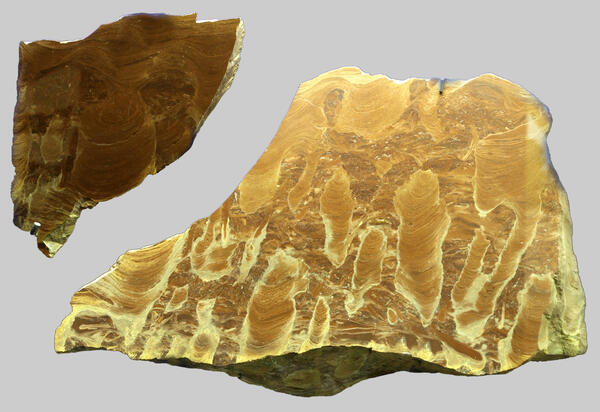
Communities of these and other bacteria formed entire colonies in the coastal zone, which were covered with a layer of mucus. Slime trapped particles of sedimentary rocks like glue - as a result of the alternation of ebbs and flows and the influence of other environmental conditions, layered structures of various shapes and sizes were created. These structures are called stromatolites. The word comes from the Greek stroma - “bedding” and lithos - stone, which literally means “carpet stone”.
The oldest stromatolites are about 3.7 billion years old. They are found in a fossil state in Siberia, Karelia and the Urals, as well as in Africa, Canada and Australia. The difference in the size of ancient structures are striking: stromatolites could grow up to only 1 mm, but could also reach 1 km in width and up to 75 m in height.
In some extreme biotopes, for example, in warm and salty shallow waters, stromatolites are formed in today. Some of the most famous clusters are found off the coast of Western Australia in Shark Bay and on the Atlantic coast of the Bahamas. The oldest remains of cyanobacterial mats are found in the Isua Formation in Greenland. The largest modern stromatolites are only 1 m wide.
Stromatolites have high decorative properties. The material is highly polished - the polished specimens exhibit a layered stone texture. They are considered valuable specimens for mineralogical or paleontological collections. It is very important and interesting to study stromatolites, since they store information about the first stages of the origin of life on Earth.
The stromatolite presented in the “Museum of Nature and Man” was discovered in Bashkiria. According to experts, the age of this sample is about 650-1650 million years.
Communities of these and other bacteria formed entire colonies in the coastal zone, which were covered with a layer of mucus. Slime trapped particles of sedimentary rocks like glue - as a result of the alternation of ebbs and flows and the influence of other environmental conditions, layered structures of various shapes and sizes were created. These structures are called stromatolites. The word comes from the Greek stroma - “bedding” and lithos - stone, which literally means “carpet stone”.
The oldest stromatolites are about 3.7 billion years old. They are found in a fossil state in Siberia, Karelia and the Urals, as well as in Africa, Canada and Australia. The difference in the size of ancient structures are striking: stromatolites could grow up to only 1 mm, but could also reach 1 km in width and up to 75 m in height.
In some extreme biotopes, for example, in warm and salty shallow waters, stromatolites are formed in today. Some of the most famous clusters are found off the coast of Western Australia in Shark Bay and on the Atlantic coast of the Bahamas. The oldest remains of cyanobacterial mats are found in the Isua Formation in Greenland. The largest modern stromatolites are only 1 m wide.
Stromatolites have high decorative properties. The material is highly polished - the polished specimens exhibit a layered stone texture. They are considered valuable specimens for mineralogical or paleontological collections. It is very important and interesting to study stromatolites, since they store information about the first stages of the origin of life on Earth.
The stromatolite presented in the “Museum of Nature and Man” was discovered in Bashkiria. According to experts, the age of this sample is about 650-1650 million years.