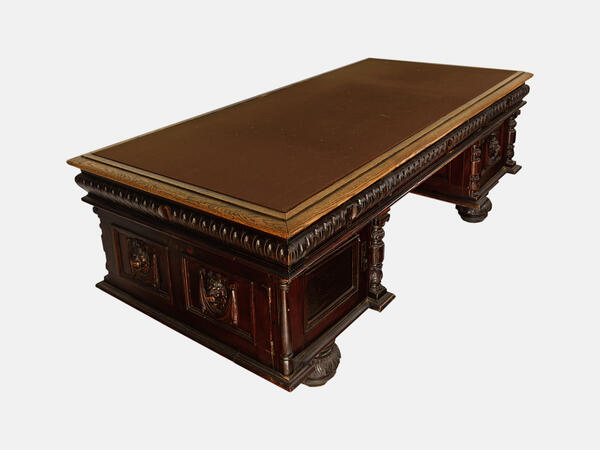
There are four drawers in each of the two cabinets of the displayed desk and one pullout drawer in the middle. The writer worked at this desk, sometimes for 10–12 hours a day. The desk is near the window overlooking the sea.
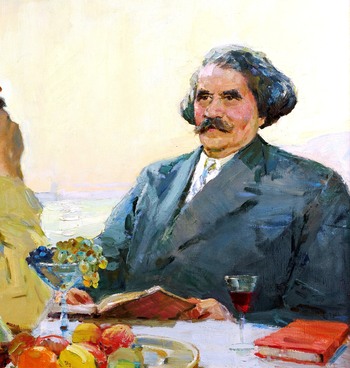
Sergey Sergeyev-Tsensky said about himself,


Writing desk
Creation period
the first half of the 20th century
Place of сreation
the USSR
Dimensions
67x160x80 cm
Technique
wood, polishing
Collection
0
Open in app #2
#6
I live here at the confluence of two elements — the sea and the land… I live on the colors of the sea and the land, one might even say that I graduated from the workshop of Alushta outskirts.
#7
On the table, there is the correspondence that the writer received during the last months of his life, his personalized notebook, an academician’s guide, a volume of the epic “Russia’s Transfiguration”, and a desk calendar.
Despite the illness that was wearing him down, Sergeyev-Tsensky was full of new creative plans and ideas even during his last days: he dreamed of writing a play about the Decembrist poet Ryleyev, a cycle of historical stories, and epics about the events of 1812 and the Great Patriotic War. He was in a hurry to finish the novel “Spring in Crimea” and planned to write a few more novels — “Down with the Tsar!”, “The Arrival of Lenin” and “The Great October”, which would have completed his grandiose epic “Russia’s Transfiguration”.
In the last few years of his life, Sergeyev-Tsensky conducted scientific and preparatory work, studied books that were either bought from booksellers or sent from libraries all over the country, and started writing new novels and articles. The interesting articles — “Lermontov — a Singer of Caucasus”, “Pushkin’s Lyrics” and “Talent and Genius” (about Gogol) — remained unfinished. He began writing articles on Goncharov and Chekhov and outlined ideas for the articles on Leskov and the poetry of Fet, Maykov, Tyutchev, and Polonsky. For the epic “Down with War!”, which was dedicated to the events of 1812 and was supposed to be the beginning of the trilogy “Russia and the West”, Sergeyev-Tsensky wrote only “Prologue” in verse and a play in verse called “Bonaparte at the Gate”.
On the table, there are neatly arranged writing tools of the past that the writer used — a paperweight and inkwells. In the center, there is a personalized notebook, a pen and a pencil. Most of the time, he used a simple school pen. The thick pencil was his latest working tool. Suffering from senile cataracts, he could not do without magnifying glasses and spectacles. Nevertheless, he tried to answer all letters personally, refusing help from secretaries.#8
Writing desk
#5
Ministry of Culture of the Russian Federation
read morehide
00:00
00:00
1x
Writing desk
Creation period
the first half of the 20th century
Place of сreation
the USSR
Dimensions
67x160x80 cm
Technique
wood, polishing
Collection
0
 Point your smartphone camera to open in the app
Open in app
Share