


Agalmatolite carving is one of the rarest stone-carving arts and has survived and continues to develop in Tuva. Agalmatolite is mined in the Bay-Tayga mountains in the west of the republic.
Agalmatolite is an opaque decorative mineral, a type of pyrophyllite. Its name comes from the Greek words ‘agalma’ meaning ‘sculpture, statue’ and ‘lithos’ which stands for ‘stone’. The term ‘agalmatolite’ was introduced in the mineralogical nomenclature in 1797. In the village of Kyzyl-Dag, which is not far from its deposit, the mineral is called chonar-dash, ‘ornamental stone’.
Agalmatolites come in white and gray with greenish and yellowish hues. Less common are varieties of red and even dark cherry. Agalmatolite received another name, wax stone, or grease stone, for its smooth, ‘soapy’ surface. It makes the soft mineral easy to work with, using a simple knife or chisel.
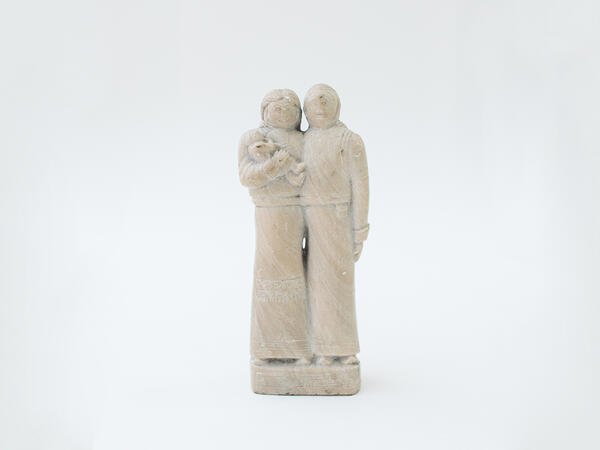
Traditionally, Tuvans considered the desire to have children to be of the highest value, so one of the most common subjects in stone art was the motifs of family and love for children. This tendency is reflected in the Agalmatolite figurine from the museum collection.
The figurine was made in the 19th century. It depicts a man and a woman holding an infant child in their arms. In a Tuvan family, caring for children was mostly a woman’s responsibility.
The carver outlined the faces of the man and woman, as well as some details of the clothing, in a sketchy manner. Such figurines were mostly for decorative purposes, so details were not heightened. However, this figurine is symmetrical and balanced. The image reveals certain national features, for example, the man has a braid. This hairstyle was called “kezhege”, and all boys wore it from the age of three.
The Tuvan stone art also included figurines of animals, mythical creatures, everyday scenes, as well as historical and folklore ones. Children’s toys and various household items were also carved from agalmatolite: hooks for suspending children’s cradles (kavai), cups, and inkpots — special boxes in which ink and water were mixed. Ritual sculptures, such as pictures of Buddhist gods, Buddhist attributes, and symbols occupied a special place.
Agalmatolite is an opaque decorative mineral, a type of pyrophyllite. Its name comes from the Greek words ‘agalma’ meaning ‘sculpture, statue’ and ‘lithos’ which stands for ‘stone’. The term ‘agalmatolite’ was introduced in the mineralogical nomenclature in 1797. In the village of Kyzyl-Dag, which is not far from its deposit, the mineral is called chonar-dash, ‘ornamental stone’.
Agalmatolites come in white and gray with greenish and yellowish hues. Less common are varieties of red and even dark cherry. Agalmatolite received another name, wax stone, or grease stone, for its smooth, ‘soapy’ surface. It makes the soft mineral easy to work with, using a simple knife or chisel.
Traditionally, Tuvans considered the desire to have children to be of the highest value, so one of the most common subjects in stone art was the motifs of family and love for children. This tendency is reflected in the Agalmatolite figurine from the museum collection.
The figurine was made in the 19th century. It depicts a man and a woman holding an infant child in their arms. In a Tuvan family, caring for children was mostly a woman’s responsibility.
The carver outlined the faces of the man and woman, as well as some details of the clothing, in a sketchy manner. Such figurines were mostly for decorative purposes, so details were not heightened. However, this figurine is symmetrical and balanced. The image reveals certain national features, for example, the man has a braid. This hairstyle was called “kezhege”, and all boys wore it from the age of three.
The Tuvan stone art also included figurines of animals, mythical creatures, everyday scenes, as well as historical and folklore ones. Children’s toys and various household items were also carved from agalmatolite: hooks for suspending children’s cradles (kavai), cups, and inkpots — special boxes in which ink and water were mixed. Ritual sculptures, such as pictures of Buddhist gods, Buddhist attributes, and symbols occupied a special place.


