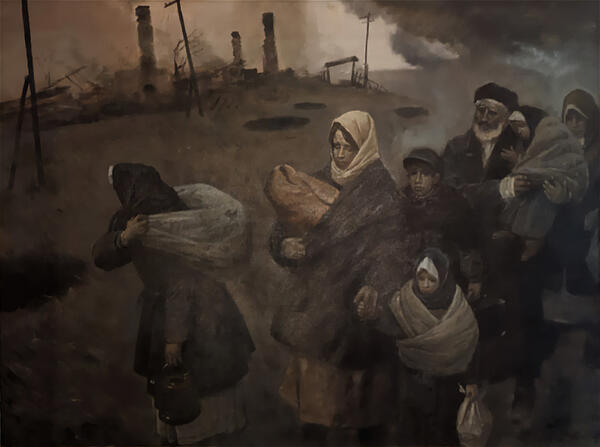
The painting “Old Unecha” offers visitors a vivid glimpse of what the fledgling village looked like in the late 19th and early 20th centuries.
It was created by Evgeny Vasilyevich Fetisov, an Honored Artist of the Russian Federation from Bryansk, specifically for the museum exhibition. Drawing on archival documents and memoirs of local elders, Fetisov meticulously recreated the appearance of Unecha Station.
On August 8, 1887, the official act commissioning the sixth section of the Polesie Railways was signed, and the first train passed through Unecha Station. The first settlers were railroad workers and merchants — predominantly Jewish — who left behind the most detailed accounts of life in the region at that time.
One of the earliest residents of Unecha, L.G. Kokotov, described the village in his book “To My Children, Grandchildren, Great-Grandchildren”:
“In my childhood, it was a squalid village. As soon as I close my eyes, it rises before me with its ever-present puddles, crooked houses, and a vast, filthy market square where dingy shops hunched together, exhaling the stubborn stench of tar, kerosene, and rusty herring. Everything — houses, shops, the splintered boardwalks, and the dusty streets — was cast in the same drab, gray-brown hue. Not a single bush or tree graced the streets or courtyards. Enthusiasts occasionally tried to plant trees; there were even attempts to establish a small park on part of the market square, but goats invariably devoured them before they could take root… The Jewish community clustered along four or five streets lined with wooden houses roofed in tin or thin wooden shingles. Among these buildings, the large synagogue stood out prominently. Meanwhile, railroad workers lived in tidy, yellow-painted state-owned houses. Each home had a garden, a vegetable plot, and a barn full of livestock. There was even an entire street of such houses, occupied by engine drivers, firemen, cashiers, station attendants, switchmen, and conductors — all of them living, by and large, a respectable life.”
The primary cargo shipped from Unecha Station was timber and sawn wood. German merchants traveled here specifically to purchase spruce for shipbuilding — a prized wood used for ship masts. Local peasants transported it from surrounding forests and numerous sawmills to the station using horse-drawn carts. In addition to timber, Unecha actively exported hemp, grain, food, and — especially in bumper harvest years — potatoes.
Classified as a third-class station, Unecha featured five tracks, a single-story station building, a water tower, a freight platform, a warehouse, and a locomotive depot capable of housing one or two reserve steam locomotives. Just west of the station, four one-story houses were built for station and depot managers.
The growth of the railway station directly fueled the expansion of the entire village. The railway unlocked new commercial opportunities, attracting a steady stream of newcomers and transforming Unecha from a remote waystation into a bustling commercial and transportation hub.