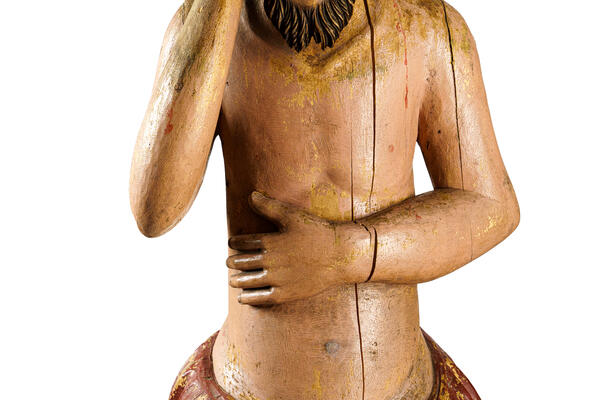
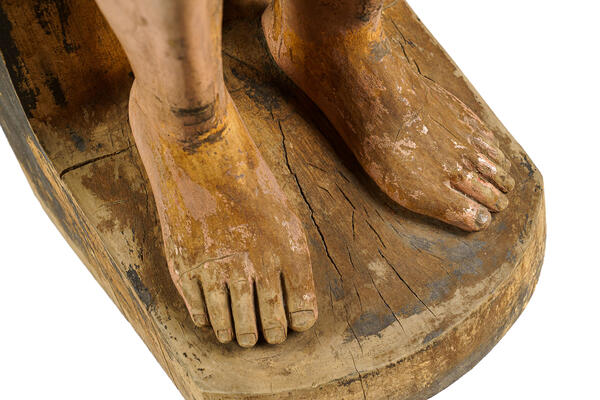
“Christ in the Dungeon”, also known as “Midnight Savior”, is a wooden statue depicting Jesus Christ in the dungeon after being tortured, shortly before crucifixion. Such religious statues appeared in Russian churches only in the 17th–18th centuries and became widespread in the 18th–19th centuries. They were popular in the agricultural regions of the Volga Region and the Russian North, and among the Russian population of industrial towns in the Urals and Siberia.
Such sculpture reflects the revival of ancient traditions of three-dimensional carving and the interpretation of European artistic styles, such as Classicism and Baroque, in Russian art. The statue was usually placed in an improvised wooden dungeon inside a church.
The statue is a life-size figure of the Savior. “Christ in the Dungeon” stands out for its monumental scale, vivid imagery, and emotionality. Christ is portrayed naked, with the Crown of Thorns on His head, and blood dripping from beneath the thorns. His body position conveys suffering, with His ribs visible through His skin.
After being beaten and mocked, Christ spent a brief night in the dungeon between the evening inquest at Caiaphas’s palace and the morning visit to Pontius Pilate. This is how Boris Ilyich Gladkov interprets the Gospel story,