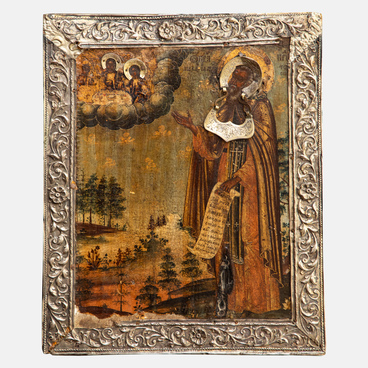
Icons of the Russian North, or, as they are commonly called, “northern images”, represent a unique cultural phenomenon. Art critics note their stylistic heterogeneity, archaic and “folk” features, clear contours and muted color palettes, predilection for a certain range of subjects and laconic compositions.
The shoulder-length image of Christ the Almighty appeared in Russian art in the 14th century, the oldest examples are represented in monumental church art. Similar images of a smaller size, for praying at home, became widespread only in the 16th–17th centuries.
The presented icon of the Savior comes from the Cathedral of the Nativity of Christ and echoes its architecture with its conciseness and impressiveness.
The uniqueness of the icon becomes obvious in comparison with the vast majority of images created at that time. The artistic trends of the 18th century were distinguished by a desire to arouse the beholder’s interest and to attract their attention with a complex pattern, the finest elaborate details and abundant ornamentation; the proportions and features of the faces were exquisitely refined.
Instead of all that, the face of Christ in the presented image amazes with power and reminds of the insignificance of earthly life and the need for repentance.
Most likely, the master who painted this icon was guided by a smaller reference and had to solve scaling issues, in which he was not entirely successful. Having enlarged the face, he could not convincingly convey the dimensionality, so the image looks rather flat; disproportionately elongated eyes, a line of eyebrows reaching to the auricles, and a narrowing chin give the appearance of the Savior fantastic features. The huge face seems to be cramped on the surface of the board, and this makes the image more expressive.
Natalia Vitalyevna Bitsadze (“Icons of the Russian
North in the Context of the Culture of the 16th –18th Centuries”) focuses on the fact that the violation of proportions, unevenly
painted face and other “errors”, which in another cultural context would be
regarded as a disadvantage, “in the case of the northern icon are perceived as
evidence of a unique originality… they imbue the ‘folk’ image… with a special
lyricism… and humanity.”