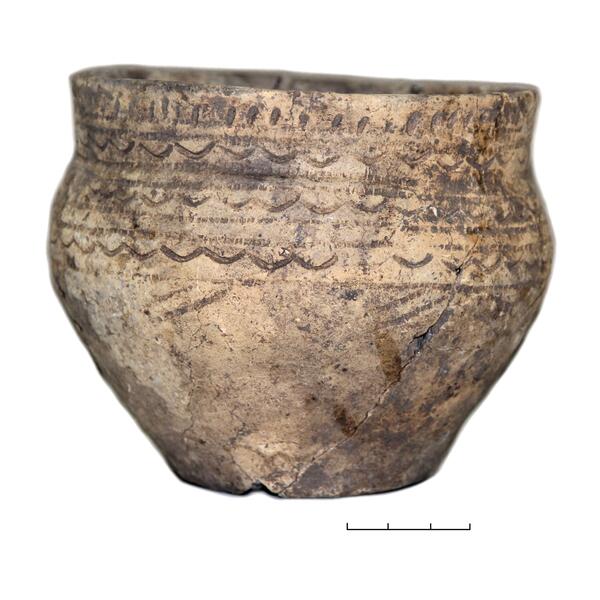
The vessel presented in the museum’s collection was discovered in 2006 during the archaeological study of the burial mound Borovyanka-XXVII. This is a site containing both the burials of the Bronze Age (Suzgun-Irmen time, 13th–8th centuries BCE) and the Early Iron Age (Sargat cultural and historical community, 7th century BCE — 5th century CE).
The ceramic vessel is of medium proportions, flat-bottomed, and has a neck slightly bent outward. Along the neck and shoulders it is decorated with rows of comb stamp impressions and repeated rows of bracket-shaped impressions. On the body there are poorly distinguishable geometric patterns in the form of a series of descending triangles, also made with a comb stamp. The decoration allowed the researchers to attribute this vessel to the Suzgun archaeological culture that existed in Western Siberia in the 13th–9th centuries BCE. The decoration was supposed to protect food from evil spirits, as well as to ensure that food stayed fresh longer.
The vessel was probably used as tableware. It was made of yellow clay typical for the Irtysh region, and fired on a bonfire in an open way. Before firing, the vessels were usually dried in the sun for a long time.
Ceramic vessels were actively used in the funeral rite by representatives of almost all peoples and cultures of Eurasia until the 20th century. This vessel was found in a burial site, which by all indications can be attributed to the Irmen culture. This is supported by the orientation and position of the deceased, as well as part of the grave goods. However, the complex of ceramics belongs to the Suzgun culture. Based on these facts, it can be concluded that the burial was made in the 10th–9th centuries BCE, when the Irmen population of the Omsk Irtysh region was experiencing significant influence by the neighboring culture.
The Suzguns, like the Irmens, were cattle breeders,
raising horses, large and small cattle. Agriculture and handicrafts (bronze
casting) also played an important role. Irmen occupied the forest-steppe region
of Western Siberia, living in the middle reaches of the Ob and Irtysh, from the
Ishim River to the foothills of the Altai. The Suzguns lived to the north and
west, in the taiga zone, on the Tobol River and in the lower reaches of the
Irtysh.