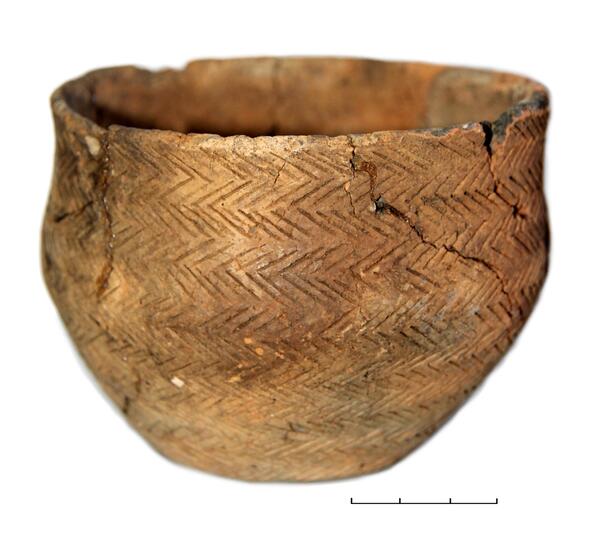
The ceramic vessel presented in the museum’s collection was discovered as a result of an archaeological study of the Borovyanka-XVII burial ground in one of the burials dating back to the Andronovo time.
The vessel has a jar shape with a rim slightly bent outwards. Its bottom is flat. The entire body of the vessel is decorated with inclined impressions forming a multi-row chevron pattern. The surface of the Chernoozersk type vessels of the Andronovo cultural and historical community was usually covered with a simple chevron decoration, multi-row zigzags, and belts of inclined impressions of a combed and smooth stamp.
The Andronovo cultural and historical community occupied a huge territory of the Southern Trans-Urals, the south of the West Siberian Plain, Kazakhstan, the Altai Ob region, the Kuznetsk and Khakass-Minusinsk basins. It was singled out by the researcher Sergei Alexandrovich Teploukhov in 1927 and named by him after the burial ground near the village of Andronovo (Khakassia).
Andronovo people occupied a large settlement area due to the structure of their economy. Cattle breeding played an important role, which required the presence of extensive pastures. The animals provided meat, wool, skins, bone for tools, and fuel in the form of dung. Andronovo people also knew how to make products from milk — cheese and cottage cheese. The main animals were sheep, cows, and horses.
Craft was also developed, including pottery. Andronovo ceramics is well studied. On its basis, the main types of the development of this culture were identified. In particular, this ceramic vessel belongs to the Chernoozersk type.
Currently, many Andronovo burial grounds have been
excavated, and in almost every burial there is a ceramic vessel, as in this
case. It contained the ritual food which the deceased needed in the afterlife.
A distinctive feature of the Andronovo vessels was a flat bottom.
Representatives of the Suzgun and Irmen cultures, who replaced the Andronovo
people, made vessels with a round bottom, in which it was convenient to cook
over a campfire. Flat-bottomed vessels required a hearth made of flat stones,
or an adobe oven.