Font
Color
Graphics
Изображение точки

To see AR mode in action:

1. Install ARTEFACT app for iOS or Android;

2. Find the exhibition «Into the Depths of Centuries»

3. Push the «Augmented reality» button and point your phone's camera at the exhibit;

Скрыть точки интересаПоказать точки интереса
Показать в высоком качестве

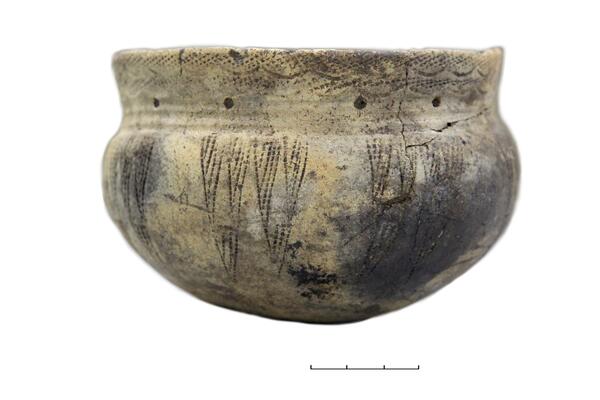
Vessel

Creation period
10th–9th century BCE
Place of сreation
Suzgun archeological culture
Dimensions
7,5x11x11 cm
Technique
clay, modeling
1
Open in app
#2

The object featured in the museum’s collection was discovered in one of the ground burials during the archeological study of the Borovyanka-XVII burial ground. Despite the fact that the place mostly has burials of the Andronovo (Bronze Age, 14th–11th centuries BCE) and Sargat cultures (5th century BCE — 5th century CE), there are also separate burials of the 13th–9th centuries BCE, belonging to the Suzgun and Irmen archeological cultures that existed in the Irtysh region.

The vessel from the collection belongs to the Suzgun archeological culture. It got its name from the sacrificial site located on the right bank of the Irtysh River, near the city of Tobolsk, in the Suzgun area. Monuments of the Suzgun culture are spread along the Tobol and Irtysh rivers.

All Suzgun vessels discovered by archeologists can be divided into two types:

#5
  • small flat-bottomed and round-bottomed vessels (for serving food);
  • jar-type vessels (for storing liquids).
#6

The main occupation of the Suzguns was animal husbandry — breeding of large and small cattle, horses, and dogs. Hunting and fishing also occupied an important place.

In its shape, the presented vessel is squat, wide-necked and round-bottomed. It was burned in an oxidizing environment with partial oxygen access. It is decorated along the neck with inclined impressions of a comb stamp and a “bracket” pattern. The transition zone from the neck to the shoulders is decorated with horizontal grooves and dimpled indentations. These design elements serve as delimiters of decoration zones. The body is decorated with grouped paired festoons (triangular decorative compositions) applied with a comb stamp.

Decorative motifs are one of the oldest ways to adorn dishes. Each archeological culture, sometimes even a cultural and historical community, has its own unique decoration, which helps the archeologists to distinguish them. An ornament on the vessel was believed to protect the food inside from spoilage, and prevented evil spirits from poisoning it. Often, ideas about the structure of the world and the universe were reflected through it. Decorative elements were used to convey symbols and information understood only by representatives of a particular people.

#4
read morehide
00:00
00:00
1x

Vessel

Creation period
10th–9th century BCE
Place of сreation
Suzgun archeological culture
Dimensions
7,5x11x11 cm
Technique
clay, modeling
1
Point your smartphone camera to open in the app
Share
VkontakteOdnoklassnikiTelegram
Share on my website
Copy linkCopied
Copy
Open in app
To see AR mode in action:
  1. Install ARTEFACT app for 
  2. iOS or Android;
  3. Find and download the «Paintings in Details» exhibition
  4. Push the «Augmented reality» button and point your phone's camera at the painting;
  5. Watch what happens on your phone screen whilst you flip through the pictures.
 
We use Cookies
Cookies on the Artefact Website. We use cookies to ensure that we give you the best experience on our website. If you continue without changing your settings, we'll assume that you are happy to receive all cookies on the Artefact website. However, if you would like to, you can change your cookie settings at any time.
Learn more about useHide
Content is available only in Russian

X

Нашли опечатку?...

%title%%type%