Bolsherechensky district of the Omsk region is rich in archaeological sites no less than other areas of the Middle Irtysh region, since its natural and geographical features made its territory very favorable for living in antiquity and the Middle Ages. People have never avoided such places. This can be evidenced by the excavations of Leonid Ivanovich Pogodin and his colleagues in the area of Lake Krivoe, in the Island area, an object of archaeological heritage — Mogilno-Starozhilsk-III.
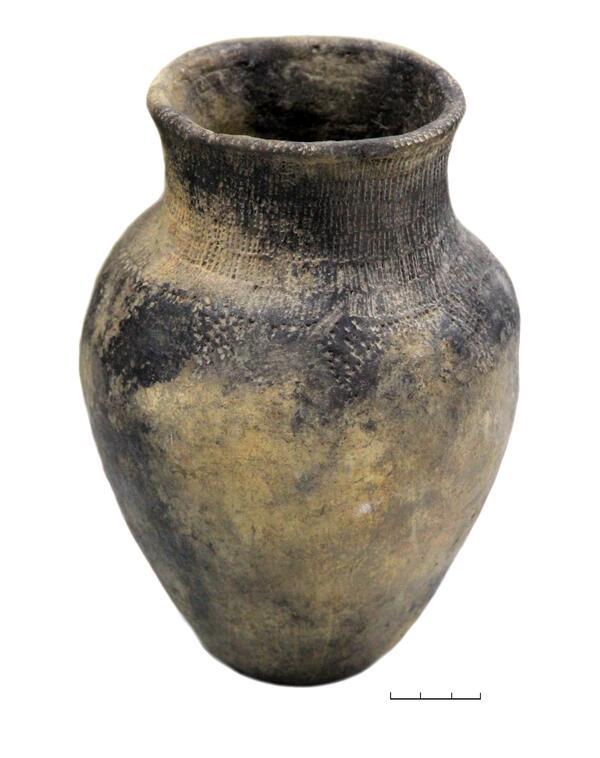
During the archaeological study of the burial mound of Mogilno-Starozhilsk-III, a ceramic vessel of elongated (jug) shape was discovered, with a high neck, inflated body and flattened bottom. Along the neck it is decorated with horizontal rows of straight-set impressions by a comb stamp, and on the shoulders with triangular festoons made with the same stamp.
The decorative features allowed this vessel to be attributed to the Kushnarenkovo archaeological culture of the early Middle Ages, which existed in the Southern Urals and Western Siberia in the 6th–8th centuries CE. It is named after a burial ground near the village of Kushnarenkovo in the Republic of Bashkortostan. It was first described in 1959 by Vladimir Fedorovich Gening.
Initially, the Kushnarenkov tribes settled in the Urals. At the Manyak stage, they expanded the territory, occupying the lands of the Turbaslin-Imenkov population of Eastern Zakamye. During the Magyar-Pecheneg wars of the second third of the 9th century, the Kushnarenkov lands were emptied, the population went to the Western Zakamye, where they participated in the formation of the Bulgarian ethnos and culture. All dishes related to this culture are molded, round-bottomed, pot-shaped or bomb-shaped. Attention is drawn to its thinness and elegance of decoration.
In burial grounds, vessels were usually located at
the head, and food remains (horse or sheep bones) are found next to them.
Skulls and bones of horse limbs are found under mounds or in graves (perhaps
the animal’s skin was placed with them). The almost complete absence of “clean”
Kushnarenkovo settlements and stationary dwellings indicates a nomadic or
semi-nomadic lifestyle, and cattle breeding as the basis of farms.