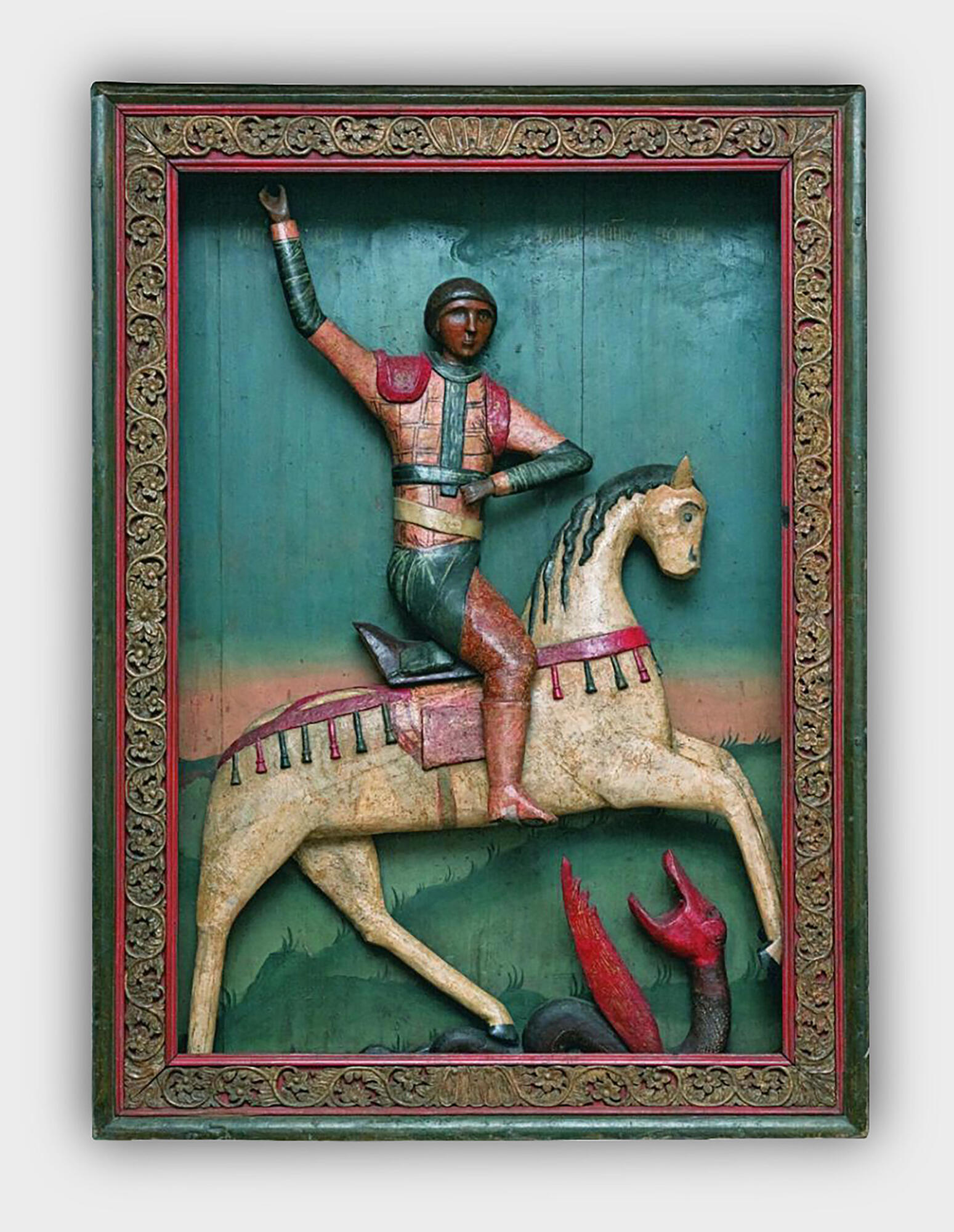


The composition “Saint George and the Dragon” is based on the hagiographic story in which Saint George defeated a dragon and rescued the princess. This image also has a deeper symbolic meaning as a metaphor for victory over the devil and evil in general.
In this Solvychegodsk statue, the swarthy and bright-eyed Saint George is depicted standing up in the saddle while riding a white horse galloping to the right. The rider’s figure is of correct proportions and has a small, rounded head. The noble and delicate facial features with a sharp, elongated nose and small mouth create an expressive and memorable image.
The short brown hair fits tightly to the head, with the ears seen partly under the hair. The artist carved the hair as a single round shape without dividing it into separate strands. The curls are not sculptured but only outlined with paint. This technique is typical of the statues of Saint George made in the Mezensky, Kholmogorsky, and Pinezhsky districts.
A white horse with a dark gray mane, a curved “swan-like” neck, and a small head is depicted rearing. However, there is no dynamism or swiftness in the movement — the horse is calm and graceful. The festive harness consists of a gray and pink saddle and red gear with alternating red and gray tassels. This would better suit a parade than a fight against a beast.
The rider’s figure is carved in the technique of round sculpture. The shapes of the horse are somewhat flattened and, in some areas, look like a high relief. The peculiarities of the figures are characteristic of the icons created in the Russian North art centers where the scene “Saint George and the Dragon” gained particular popularity in the 16th and 17th centuries.
In Russia, the image of Saint George became widespread in the 11th century. He was especially venerated among the people. The saint was sometimes called “Yegoriy the Brave” and was perceived as a mythical hero. Of all the hagiographic scenes, the most common was the one where Saint George was depicted as a warrior in the moment of a heroic feat.
Simplified versions of
this composition depict George riding a horse and piercing a dragon with a
raised spear. The full version included the image of the rescued princess and
the city with its inhabitants delivered from the trouble. In rare cases, a figure
of a rescued boy was added to this image.