#1

Casket, Medal, Mug, Souvenir Plate
#2
#3

#4
This casket (chest) was created in 1750—1770 by artisans of the Russian North from wood and bone: they used mammoth tusk and tarsometatarsus (bones found in lower legs of birds). It is decorated with details from metal, fabric, paper, and mica. The inner side of carved bone inlays is covered with multicolored mica, a mineral that can be easily separated into thin, transparent layers used for decoration. The artists used not only carved inlays but also tinted mica and foil, a typical decoration methods used for chests back in those times.
The chest is decorated with multiple traditional ornaments from the Slavic mythology. The media used are shading, carving, and engraving. Legend has it that the bird on the carved bone inlay symbolizes a supreme Slavic deity. This deity created the whole world and is the embodiment of the unity of all descendants, the entire Universe and nature, the ground zero of all things. In its earthly form, the deity looked like a gray duck, the symbol and conduit of its power.
The patterns engraved on the casket can be distinguished by color. For instance, the red ones represent the energy of life, fire, sun. They grant good health, perfection, warmth, and protect from evil eye. The color black is the symbol of earth, fertility, and motherhood. The green background represents youth and revival, the triumph of life; it is a symbol of a sown field and young crops. The tree of life was always painted with green.
The Kudryavtsev family from Mytishchi kindly donates this casket to the Mytishchi History and Art Museum. They inherited the casket as a wedding gift in 1916. The chest was passed down for generations as a holiday present. On the bottom of the chest, there is an inscription made when it was gifted back in the 19th century. It reads: ‘19 May 1851’.
The patterns engraved on the casket can be distinguished by color. For instance, the red ones represent the energy of life, fire, sun. They grant good health, perfection, warmth, and protect from evil eye. The color black is the symbol of earth, fertility, and motherhood. The green background represents youth and revival, the triumph of life; it is a symbol of a sown field and young crops. The tree of life was always painted with green.
The yellow background stands for the sun, intelligence, intuition, faith, the divine, nobility, and dignity. The white background symbolizes air, enlightenment, purity, chastity, holiness, redemption, and spiritual power. This color also represents day time, the time of labor and good deeds. Stylized ornaments contain sacred symbols, like the circle that is a symbol of eternal life and the Sun. Three circles refer to a charm protecting its owner from ill-wishers.
The Kudryavtsev family from Mytishchi kindly donates this casket to the Mytishchi History and Art Museum. They inherited the casket as a wedding gift in 1916. The chest was passed down for generations as a holiday present. On the bottom of the chest, there is an inscription made when it was gifted back in the 19th century. It reads: ‘19 May 1851’.
#5
Date: 1750–1770
Technique: wood, bone (mammoth tusk, tarsometatarsus), metal, fabric, paper, mica, carving, paints
Place: Russian North
Dimensions: 23×18×8 cm
Collection: Fabrics, Leather, Ivory
Copyright: Municipal Budget Cultural Institution ‘Mytishchi History and Art Museum’
Technique: wood, bone (mammoth tusk, tarsometatarsus), metal, fabric, paper, mica, carving, paints
Place: Russian North
Dimensions: 23×18×8 cm
Collection: Fabrics, Leather, Ivory
Copyright: Municipal Budget Cultural Institution ‘Mytishchi History and Art Museum’
Restorers: L.V. Getman
#6
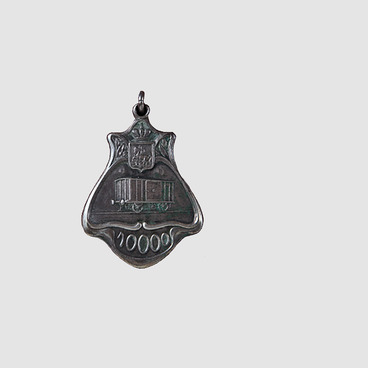
Commemorative Medal (Pendant) on the Occasion of the Coronation of Nikolas II
#7

#8
The pendant is minted from bronze in 1896–1898. The diameter of this copy in the Numismatics collection is 25 mm. The metal has grown dark with time and the item itself is very worn.
The coronation of Emperor Nikolas the Second was the last coronation the Russian Empire saw. It was celebrated on Tuesday, May 14, 1896, at the Dormition Cathedral of the Moscow Kremlin. However, preparations for this day, very important for the whole country, started long before. One of the aspects was making commemorative pendants, medals, and coins. In June 1895, the medal sculptor Anton Vasyutkin presented his sketches of the coronation medals, pendants, and rubles. Nikolas II didn’t like them and rejected the first project. He ordered to make the tail side the same as on the coronation medals of his late father, later Emperor Alexander III, and make them of the same type, size, and weight.
All days from May 6 until May 26 of 1896 were announced the coronation period. On May 25 the country celebrated Empress Alexandra Feodorovna’s birthday. On May 14, 1896, 100 collections of four medals and two pendants each, and 170 large golden medals were given away during the feast at the Faceted Chamber. Apart from medals, each collection also contained a silver coronation pendant. Such pendants were also distributed among the common folk. After the coronation festivities were over, anyone could buy medals and pendants from the metal of choice, including bronze now, at the Saint Petersburg Mint.
The commemorative pendant in the collection of the Mytishchi History and Art Museum was minted from light bronze suggesting it was made at the request of a ministry to be distributed among common people. On the obverse, the head side, there is an image of a crown and the phrase ‘Crowned in Moscow in 1896.’ On the reverse, the tail side, we see an image of a crown and the phrase ‘God Is With Us’ and the initials ‘N II A.’ During the Revolution of 1917, having such pendants in one’s possessions was frowned upon, so people normally hid them. Today these pendants are very rare and have high historical and cultural value.
#9
Date: late 19th century
Technique: bronze, minting
Place: Russia
Dimensions: d: 2,5 cm
Collection: Numismatics
Copyright: Municipal Budget Cultural Institution “Mytishchi History and Art Museum”
Technique: bronze, minting
Place: Russia
Dimensions: d: 2,5 cm
Collection: Numismatics
Copyright: Municipal Budget Cultural Institution “Mytishchi History and Art Museum”
#10
Commemorative Mug On the Occasion of Coronation of Nikolas II
#11

#12
A man named Yermakov got this commemorative metal enameled mug with printed monograms of Emperor Nikolas the Second and his spouse Empress Alexandra Feodorovna on the day of coronation of Nikolas the Second. The mug was donated to the museum in 1977.
The mug reminds us of the magnificent celebration arranged for the coronation of the last Russian emperor and of the tragic events that took place on the Khodonka field in May 1896. Coronations were most important events in the political life of the Russian monarchy. Demonstrating unity between the king and his people was a vital part of the ceremony. That is why, according to the long-standing tradition, each coronation was accompanied by mass revels and mandatory giving away of gift from the royal family.
This time, the Emperor ordered to make 400,000 royal presents for the people, composed of various products. Apart from food, each present included a white enameled metal mug with red and blue patterns. On one side of the mug there were the Emperor’s initials and the year of coronation, 1896. The other side was decorated with a two-headed eagle. The rim of the mug was gilded. They were not expensive, however, these mugs were not for sale. They were showed off in show-cases of stores. Moscow-based author and scholar of local lore Vladimir Gilyarovsky wrote: “People went to Khodynka not just to celebrate, but rather to get themselves a mug.” Back then, enameled dishes were a rarity.
On the morning of May 18, at least 500,000 people gathered on the Khodynka field. And they kept coming. The disaster broke out when someone started a rumor that there weren’t enough mugs for everyone because servers kept some for their friends. The whole crowd moved towards the tents where the mugs would be distributed. The horrible stampede claimed 1,379 lives and left many disabled. Nikolas II said the tragedy happened because the Moscow authorities did not do enough to organize such a huge crowd of people.
As a result, the royal family donated 90,000 rubles to the families of the victims and sent a thousand bottles of Madeira wine to hospitals. Apart from it, the Emperor ordered to give a coronation mug to each person who ended up in a hospital after the accident on the Khodynka field.
#13
Date: 1896
Technique: metal, enamel, printing
Place: Russia
Technique: metal, enamel, printing
Place: Russia
Dimensions: 11×6,5 cm
Collection: Metal
Copyright: Municipal Budget Cultural Institution ‘Mytishchi History and Art Museum’
Collection: Metal
Copyright: Municipal Budget Cultural Institution ‘Mytishchi History and Art Museum’
#14
Souvenir Plate
#15

#16
Matvey Kuznetsov, a talented and savvy industrialist, came from a family of porcelain manufacturers. His factories sold porcelain items in all Russia and could compete successfully with factories of Europe and the East. Kuznetsov constantly improved the technology used at his factories. The late 19th and early 20th centuries saw colored printing catch on.
Decal is a method of transferring an image on a glass, clay, or porcelain dish upon high heat. It was used to decorate plates, cups, and glasses. The souvenir plate exhibited here is decorated using this medium. Decal uses the technique of moving an image upon contrast. First, it is printed on paper that is then covered with lacquer. After that, the paper is left to soak in water and then placed on a ceramic or glass surface. High temperature causes the paint to bake into the surface, forming a hard homogeneous mass. If the colors resulted too pale, the multi-colored decal was finished by hand.
Artists borrowed plots for decals from life and history. Such glass, porcelain, and ceramic items were popular among customers who wanted to make their houses cozier and keep an important memory from their life.
A visit to the Holy Trinity Monastery had a very big spiritual and moral importance for a Russian man. The Holy Trinity Monastery was founded in the 14th century by the most venerated Russian saint Sergius of Radonezh. Pilgrims from all corners of Russia poured to the Trinity Monastery.
Dmitry Donskoy is believed to have started the pilgrimage of the grand Russian princes and tsars to the monastery. He himself confessed to His Reverence Sergius in his home many times. The last major walking pilgrimage to the Trinity Lavra of St. Sergius was the procession of 1892 to celebrate Sergius of Radonezh’s 500th death anniversary. The procession walked from Moscow to the Lavra for four days and was several kilometers long.
The souvenir plate depicted the Trinity Lavra of St. Sergius. The Trinity Cathedral is the main cathedral and the most ancient building in the monastery that survived to our day, the first stone building of the Lavra. It was erected “to honor” the founder of the monastery, St. Sergius of Radonezh.
#17
Date: late 19th century
Technique: porcelain, glazing, decal
Dimensions: d — 13,2 cm
Collection: Glass, Ceramics, Porcelain
Collection: Glass, Ceramics, Porcelain
Copyright: Municipal Budget Cultural Institution “Mytishchi History and Art Museum”
Goskatalog Number: 21825839
Goskatalog Number: 21825839
#18
Municipal Budget Cultural Institution “Mytishchi History and Art Museum”
read morehide
00:00
00:00
1x
Casket, Medal, Mug, Souvenir Plate
Collection
Exhibition
3
 Point your smartphone camera to open in the app
Open in app
Share