Font
Color
Graphics
Изображение точки

To see AR mode in action:

1. Install ARTEFACT app for iOS or Android;

2. Find the exhibition «“Sakhalin Island”: An Open-Ended Story»

3. Push the «Augmented reality» button and point your phone's camera at the exhibit;

Скрыть точки интересаПоказать точки интереса
Показать в высоком качестве

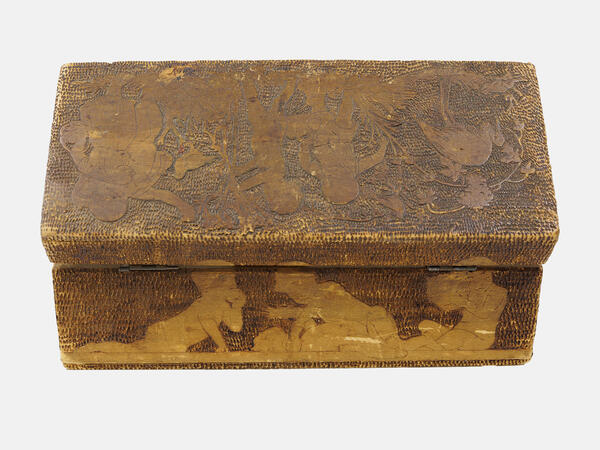
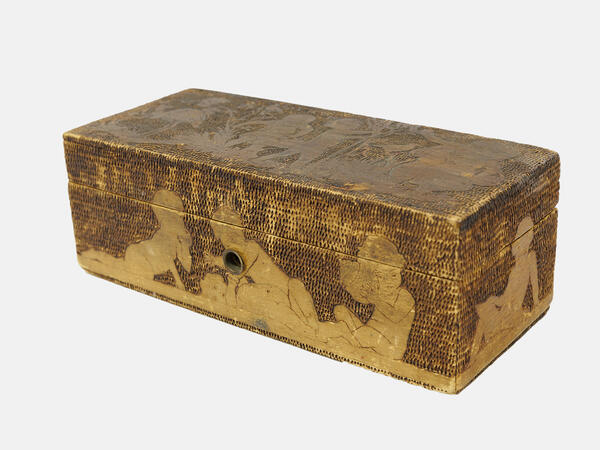
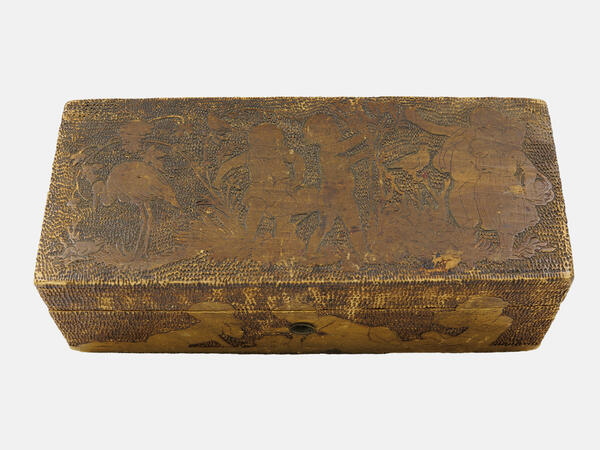
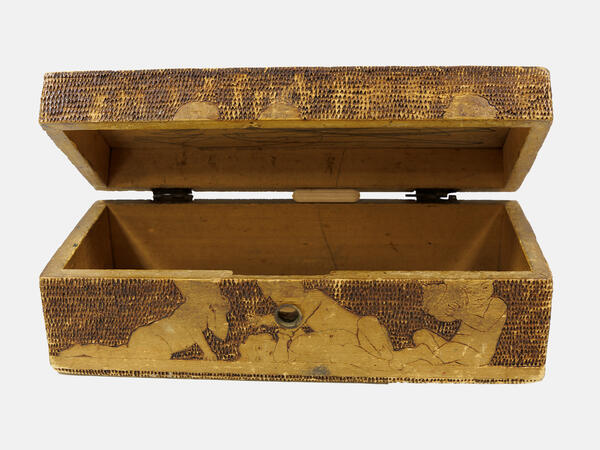
Wooden casket “Children Playing”

Creation period
the 19th century — the early 20th century
Place of сreation
the Russian Empire
Dimensions
20x8,5x7 cm
Technique
wood; pyrography, handmade
1
Open in app
#8

This casket is believed to have belonged to the Chekhov family. It was donated to the museum by the widow of the writer’s nephew, Sergey Chekhov.

This is a handmade wooden casket. It is decorated with carvings and images of children playing. The front side has a hole for a lock. Inside the lid, there is an inscription, “To my dear Shuryonochka from Seryozha. IXX.I/VII 1914”.

A casket was a popular gift for girls, young ladies, and women. In her letter to her husband, Olga Knipper-Chekhova thanked him for such a souvenir,

#9

Here I am, writing away, and haven’t thanked you for the box you sent. But you are a bit of a joker, Mr Chekhov! To give a poor actress of the Art Theater a box for her ‘gold and jewels’. Do we usually have any? I shall keep letters from a dear, good man from Yalta in it. But when am I going to get a photograph of you with your eyes open? Couldn’t you have put it in the box as a surprise? You’re a hard man.

#10

Sergey Chekhov, whose family kept the wooden casket “Children Playing”, is the son of Anton Chekhov’s younger brother, Mikhail. Sergey was three years old when his famous uncle died. He graduated from the Imperial Academy of Arts, taught at the Moscow Art Theater School, and became an illustrator and curator of the family archives. He was 13 years old in 1914, so it is quite probable that he was the one to give this casket as a present.

The word “shkatulka” meaning “a casket” appeared in the Russian language in the 16th century. It is also found in many Slavonic languages. Some researchers suggest that it originated from the Latin word “scatula”, which means “a box”.

Back in the old days, small decorative boxes were kept in every Russian house. They were made of wood and decorated with carvings or paintings. Simpler caskets were often made of linden, but as the craft developed, other materials such as precious metals, porcelain, and ivory came into use as well. Rare, expensive caskets could be made in the shape of people, birds, and animals.

“Extremely expensive caskets depict the economic position of the colony just about as little as the fact that one settled exile in the south collects whalebone on the shore, and another gathers up trepangas”, Anton Chekhov wrote in his book “Sakhalin Island” after observing the talented craftsmen who had been condemned to hard labor in exile.

#12
Wooden casket “Children Playing”
#11
View in the State Catalogue
read morehide
00:00
00:00
1x

Wooden casket “Children Playing”

Creation period
the 19th century — the early 20th century
Place of сreation
the Russian Empire
Dimensions
20x8,5x7 cm
Technique
wood; pyrography, handmade
1
Point your smartphone camera to open in the app
Share
VkontakteOdnoklassnikiTelegram
Share on my website
Copy linkCopied
Copy
Open in app
To see AR mode in action:
  1. Install ARTEFACT app for 
  2. iOS or Android;
  3. Find and download the «Paintings in Details» exhibition
  4. Push the «Augmented reality» button and point your phone's camera at the painting;
  5. Watch what happens on your phone screen whilst you flip through the pictures.
 
We use Cookies
Cookies on the Artefact Website. We use cookies to ensure that we give you the best experience on our website. If you continue without changing your settings, we'll assume that you are happy to receive all cookies on the Artefact website. However, if you would like to, you can change your cookie settings at any time.
Learn more about useHide
Content is available only in Russian

X

Нашли опечатку?...

%title%%type%