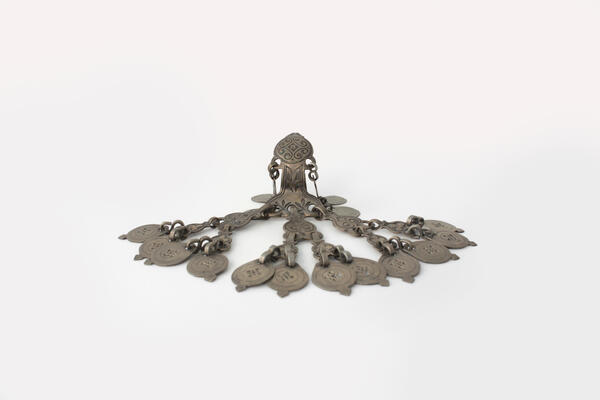
The silver collection of the Museum of History and Ethnography named after the local historian and folklorist Andrey Savvin is extensive and includes various traditional jewelry items. The exhibition, which has been formed over several years, introduces the names of talented Yakut craftsmen and the annals of folk art.
The collection contains numerous women’s precious and semi-precious jewelry, which traditionally was an integral part of the national costume. Earrings are one of the indispensable amulets of Yakut women, who wore them throughout their lives.
Earrings were attributed the power of an amulet. According to the Sakha people, ears are a special, sacral part of the body, the receptacle of the human soul.
During the “ayysyt tardar” rite, when a woman asked for a child, a white shaman “sent” a boy through her right ear and a girl through her left ear. The Vilyui Yakuts believed that “buor kut”, or “the soul of the earth”, is located in a person’s ears.
One of the most colorful periods in the art of silverware was the 19th century, when a variety of traditional original earrings were created.
The collection includes massive rings with inserted plates of different shapes. The composition of the earrings is multicomponent, dating back to the traditional form of “siel ytarqa” or “mane earrings”.
The mane earrings are a cascade of engraved tinkling petals. This shape and structure is associated with the mane of a galloping horse.
Each piece consists of a clasp earring and
pendants. The clasp earring is a ring, the front part of which is made in the
form of a flat plate of complex shape, consisting of a rosette and an elongated
trapezoid. Two lyre-shaped plates are movably attached to the rosette, which
end in two small round pendants. Attached to the clasp earring are three
massive loops, which are decorated with tubes. At the bottom on three sides are
wide plates decorated with lyre-shaped pattern, with three movable figural pendants
each with small plaques in the shape of a circle attached to them.