“Day faded; on the table, glowing,
the samovar of evening boiled,
and warmed the Chinese teapot;
flowing beneath it, vapor wreathed and coiled.”
(Alexander Pushkin from “Eugene Onegin”)
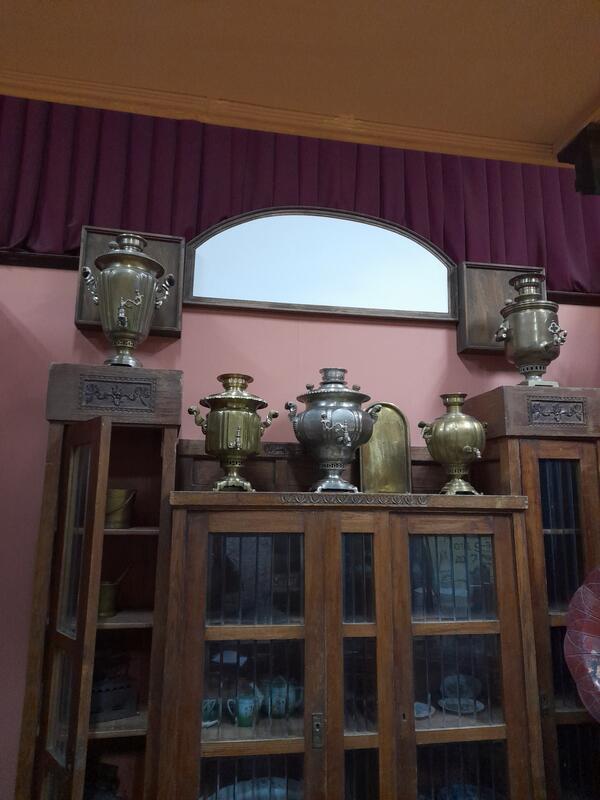
These lines from the poem by Alexander Sergeevich Pushkin involuntarily come to mind when looking at the charcoal and wood samovars displayed in the museum.
The samovar has become a symbol of Russia in the 19th and early 20th centuries. Friends and family used this iconic item of home life to prepare tea, and tea drinking has become one of the most characteristic Russian habits shared by all social classes.
A samovar is a specially designed device for boiling water and making tea. Unlike modern, largely impersonal hot water appliances, each of the samovars was unique in its own way. Despite the common design, samovars came in various shapes and sizes; they could be decorated or have maker’s marks.
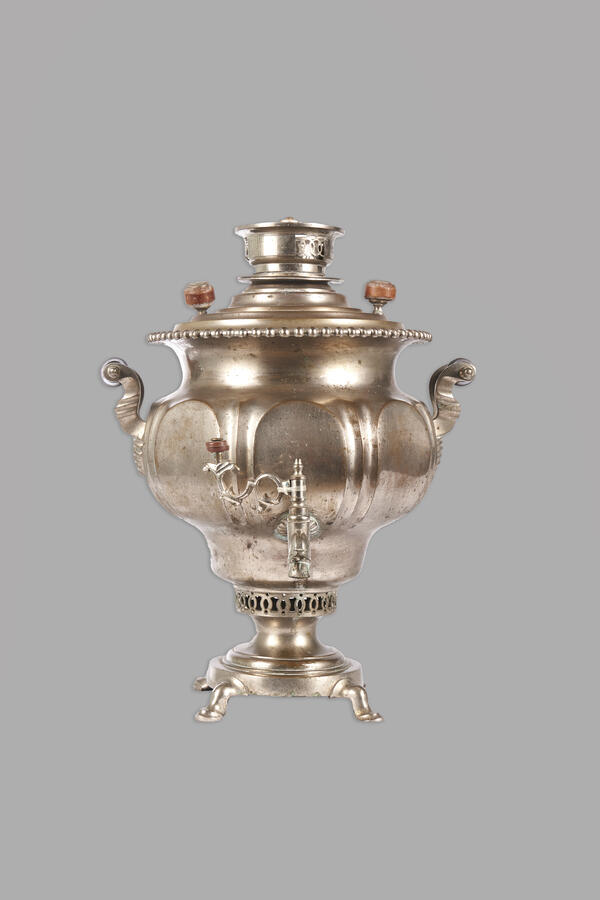
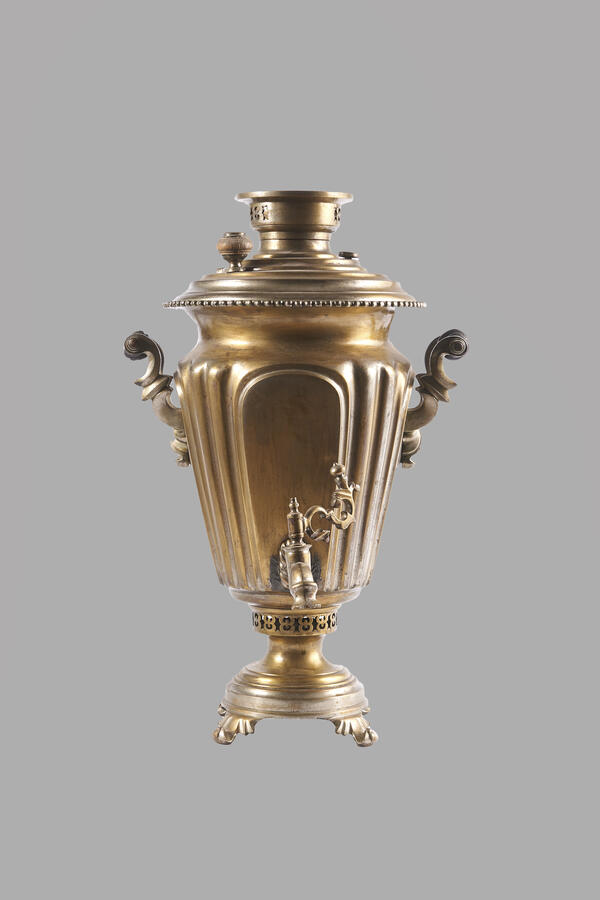
The charcoal samovar from the museum’s collection is conical-shaped. It was produced by the partnership of the Tula samovar factory of the heirs of V.S. Batashev.
The conical body of the samovar is elongated. It has three-column edges, four medallions in the form of an elongated irregular oval, with an interception in the upper part, turning into a round, multi-stage pallet with four scroll legs. In the upper part of the body, there is a circle in the form of a cast ring, which serves as a support for the lid. The side of the ring is decorated with a dense pattern in the form of miniature hemispheres. Inside the body, there is a fire grate for placing fuel — coal, with a figured grate in the lower part. In the upper part of the body, there are two fixed handles with a figured frame and corrugated wooden handles with a protrusion in the middle part. In the lower part of the body, there is a faceted plate — the basis for attaching a figured faucet spout.
The faucet is faceted, elongated, with a thickening towards the end and a figured spout. The lid is round, multi-stage, with a round hole in the center, equal in diameter to the pipe of the fire grate located inside. On the lid, there is an air vent for releasing steam after the samovar boils. It has an oblong lid with an elongated miniature handle. On the lid, there are two handles with metal hollow cylinders. On one of the handles, there is a wooden holder — a cone in the shape of a barrel. A burner with three groups of triple openwork holes for placing a teapot is put on the pipe at the end of the lid.
On the cover, there is a hallmark: the image of a double-headed eagle — a proof of the high status of the company’s products at one of the Russian trade and industrial exhibitions.
the samovar of evening boiled,
and warmed the Chinese teapot;
flowing beneath it, vapor wreathed and coiled.”
(Alexander Pushkin from “Eugene Onegin”)
These lines from the poem by Alexander Sergeevich Pushkin involuntarily come to mind when looking at the charcoal and wood samovars displayed in the museum.
The samovar has become a symbol of Russia in the 19th and early 20th centuries. Friends and family used this iconic item of home life to prepare tea, and tea drinking has become one of the most characteristic Russian habits shared by all social classes.
A samovar is a specially designed device for boiling water and making tea. Unlike modern, largely impersonal hot water appliances, each of the samovars was unique in its own way. Despite the common design, samovars came in various shapes and sizes; they could be decorated or have maker’s marks.
The charcoal samovar from the museum’s collection is conical-shaped. It was produced by the partnership of the Tula samovar factory of the heirs of V.S. Batashev.
The conical body of the samovar is elongated. It has three-column edges, four medallions in the form of an elongated irregular oval, with an interception in the upper part, turning into a round, multi-stage pallet with four scroll legs. In the upper part of the body, there is a circle in the form of a cast ring, which serves as a support for the lid. The side of the ring is decorated with a dense pattern in the form of miniature hemispheres. Inside the body, there is a fire grate for placing fuel — coal, with a figured grate in the lower part. In the upper part of the body, there are two fixed handles with a figured frame and corrugated wooden handles with a protrusion in the middle part. In the lower part of the body, there is a faceted plate — the basis for attaching a figured faucet spout.
The faucet is faceted, elongated, with a thickening towards the end and a figured spout. The lid is round, multi-stage, with a round hole in the center, equal in diameter to the pipe of the fire grate located inside. On the lid, there is an air vent for releasing steam after the samovar boils. It has an oblong lid with an elongated miniature handle. On the lid, there are two handles with metal hollow cylinders. On one of the handles, there is a wooden holder — a cone in the shape of a barrel. A burner with three groups of triple openwork holes for placing a teapot is put on the pipe at the end of the lid.
On the cover, there is a hallmark: the image of a double-headed eagle — a proof of the high status of the company’s products at one of the Russian trade and industrial exhibitions.