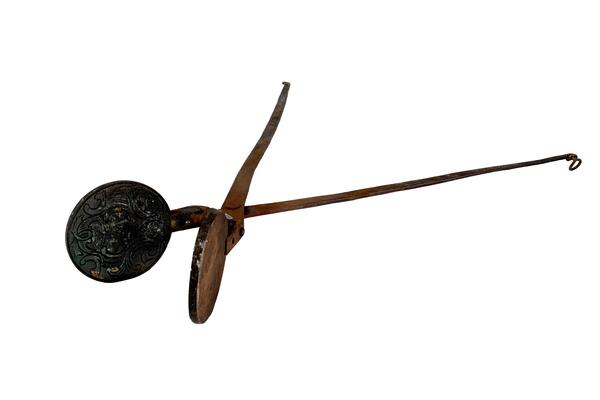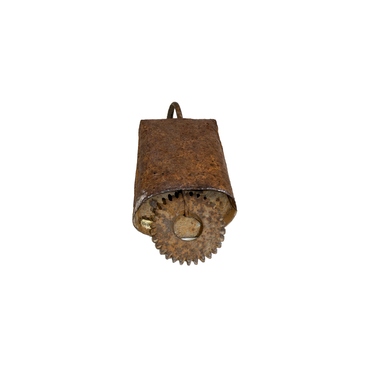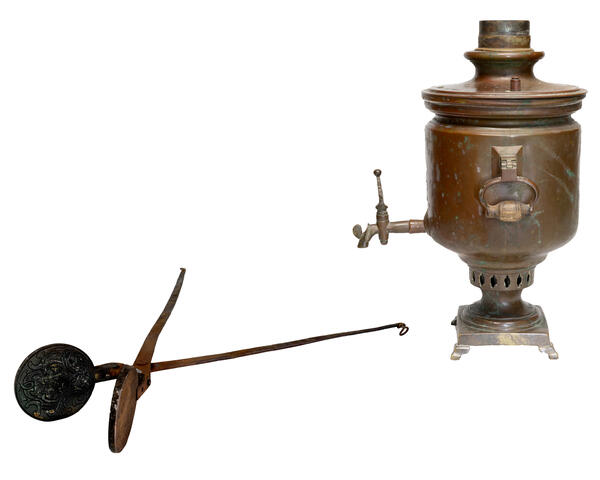
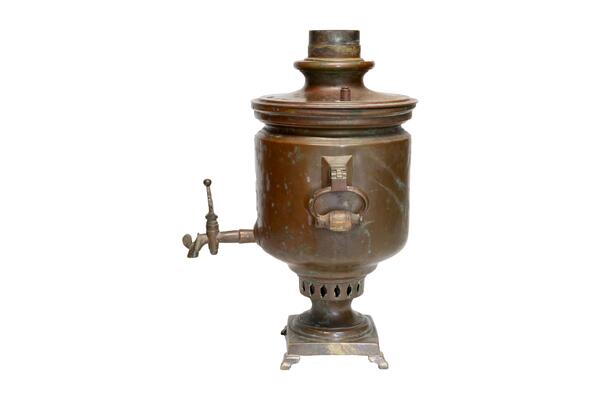
The old copper factory-made samovar came to the museum collection from Laryak village in 1997. On its lid, there is a half-erased image of a medal with an inscription in the center: “Mikhail Alekseyevich Zubov in Tula”.
In 1899, a merchant Mikhail Zubov founded a samovar factory in Tula. His goods were considered one of the best in the city. As a rule, Zubov used brass for his samovars. However, the other craftsmen usually used copper, cupronickel, or tombac — a type of brass alloy with a low zinc content. The outside of samovars, which were made for wealthy customers, was covered with gold or silver plating. Mikhail Zubov’s factory produced items of various styles and forms. Among them were samovars, which were made in the form of vases, eggs, wine glasses, fountains, etc.
Irrespective of the model, all samovars had approximately the same design. A water tank, or a body, was made of sheet metal. Cast handles, a faucet, a four-legged drip pan, and other details were attached to it. A lid was made separately from the same material. A burner, also known as a stand for a teapot, was in its upper part. If a vessel was empty, burner heat helped to dry it, but if a vessel was full, burner heat helped to brew tea better.
There was a special burner inside the body of a samovar, which helped to heat it. Cones usually served as necessary fuel. They burned out too quickly but gave water the scent of pine needles. Before the holidays, samovars were polished to a shine with wet river sand, ash, or grated bricks.
There is a legend that the first samovars were brought to Russia from Holland by Peter I (Peter the Great). As a matter of fact, such devices began to be made in the Russian Empire about 50 years after his death. The first samovars were produced at the Irginsky plant that was located on the territory of the modern Sverdlovsk Region.
The samovar plant was opened in 1778 in Tula. The merchants Nazar and Ivan Lisitsyns founded it. Thirty years later, eight plants were operating in a city. However, their number was constantly growing. Goods, which were produced by all these factories at the beginning of the 19th century, were sold by weight. Therefore, brass samovars cost 64 rubles per pood (equal to 16.38 kg), red copper samovars cost 90 rubles per pood.
In 1899, a merchant Mikhail Zubov founded a samovar factory in Tula. His goods were considered one of the best in the city. As a rule, Zubov used brass for his samovars. However, the other craftsmen usually used copper, cupronickel, or tombac — a type of brass alloy with a low zinc content. The outside of samovars, which were made for wealthy customers, was covered with gold or silver plating. Mikhail Zubov’s factory produced items of various styles and forms. Among them were samovars, which were made in the form of vases, eggs, wine glasses, fountains, etc.
Irrespective of the model, all samovars had approximately the same design. A water tank, or a body, was made of sheet metal. Cast handles, a faucet, a four-legged drip pan, and other details were attached to it. A lid was made separately from the same material. A burner, also known as a stand for a teapot, was in its upper part. If a vessel was empty, burner heat helped to dry it, but if a vessel was full, burner heat helped to brew tea better.
There was a special burner inside the body of a samovar, which helped to heat it. Cones usually served as necessary fuel. They burned out too quickly but gave water the scent of pine needles. Before the holidays, samovars were polished to a shine with wet river sand, ash, or grated bricks.
There is a legend that the first samovars were brought to Russia from Holland by Peter I (Peter the Great). As a matter of fact, such devices began to be made in the Russian Empire about 50 years after his death. The first samovars were produced at the Irginsky plant that was located on the territory of the modern Sverdlovsk Region.
The samovar plant was opened in 1778 in Tula. The merchants Nazar and Ivan Lisitsyns founded it. Thirty years later, eight plants were operating in a city. However, their number was constantly growing. Goods, which were produced by all these factories at the beginning of the 19th century, were sold by weight. Therefore, brass samovars cost 64 rubles per pood (equal to 16.38 kg), red copper samovars cost 90 rubles per pood.