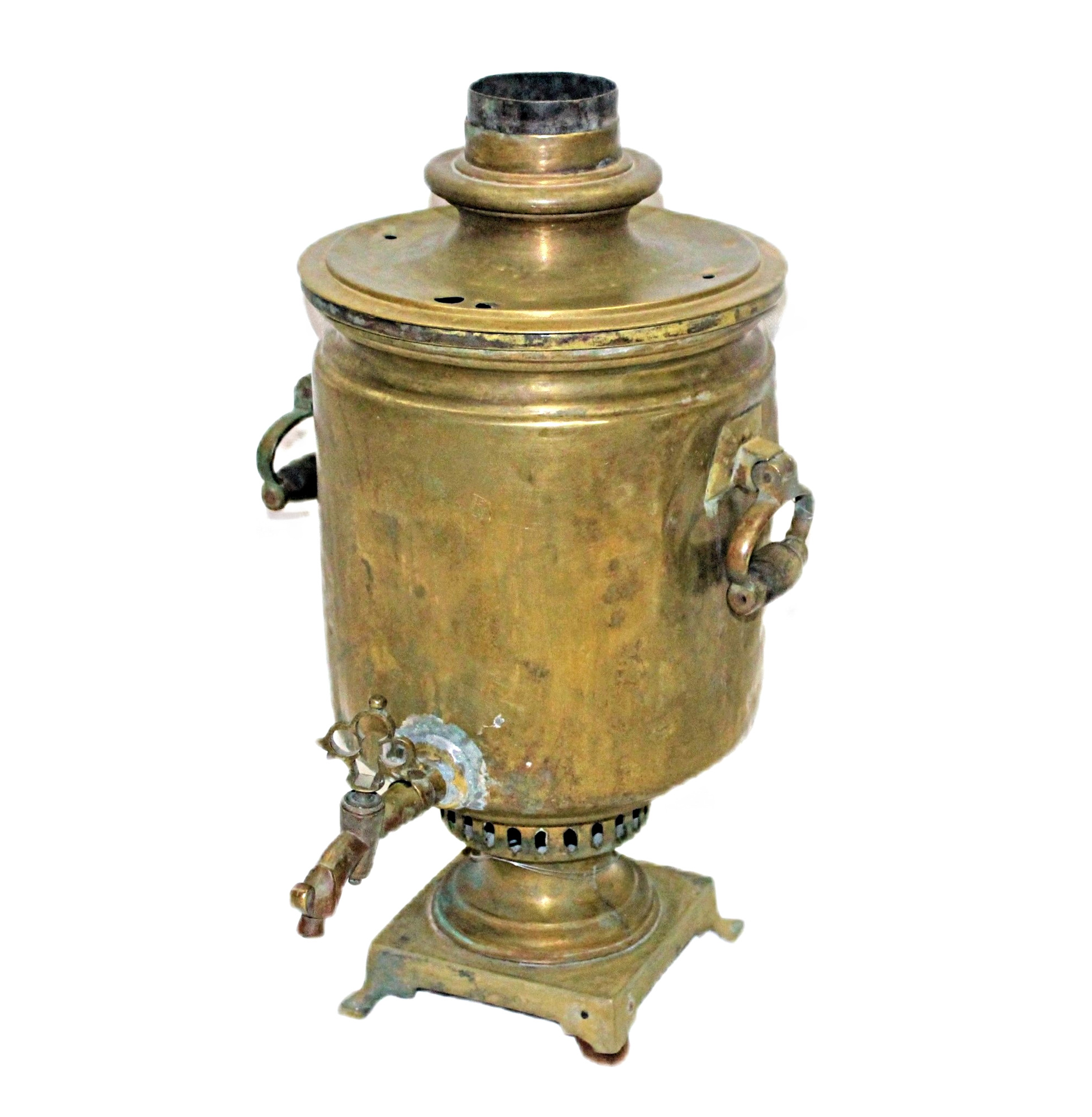


Samovar, a metal vessel for boiling water, heat, factory production, made of copper.
Inside the samovar, the internal furnace is a pipe filled with charcoal, covered with a gray coating of scale. Figuratively made metal handles with wooden fragments are attached to the sides of the samovar. On the side there are two medals and the stamp of the Tula plant: “Tula plant 1850”. In the lower part of the rounded body there is a crane without a handle. The top of the samovar is closed with a lid. The lid is tightly attached to the pipe. There are no handles and plugs for steam on the lid.
The samovar is mounted on a square stand, the legs of which have a stepped shape, leaf-shaped, one of them is replaced by an iron plate. Structurally, the samovar is quite complicated. It consists of several dozen large and small parts that are made separately, and then the master puts the parts together, creating a copper miracle.
The manufacture of the samovar began with the selection of material — a sheet of copper was carried out with an awl or a special hook, and if the scratched line was yellow and continuous, then such copper went to a large cylinder. If the yellow line was interrupted — this indicated an admixture of copper oxide, then a fire tube or small parts were made from such a sheet, which were not subsequently sharpened and polished.
The lined copper sheets were cut according to the measurements, folded into a cylinder, along the edges of which the teeth were cut, connecting the edges together, and pressed tightly with a hammer on the kobylin. Then he was soldered in the forge. The irregularities on the soldered seams were sawn and hammered again on the mares. Then the case was annealed again and slowly cooled.
One of the main operations was aiming, which required several stages, each time accompanied by annealing in a furnace. It was often repeated twelve to fourteen times. They brought the samovar from the middle. After finishing the lower part, they began to tip the upper one. The place of soldering of the body with the neck was forged on a round mare with a pointing hammer. The necks and inner jugs (the fire tube) were guided in the same way. Then the necks were soldered to the hulls, finally brought in, carefully forged — tacked with a special tacking hammer. A cast copper hoop was soldered to the upper edge of the hull wall and a samovar and necks were sharpened.
The inner heat pipe consisted of two tightly converging parts. The soldered parts of the pipe were guided several times, etched with acid and tinned. The busy and time-consuming process of making samovars makes it possible to understand why in museum collections these products of the beginning of the first half of the XIX century are represented by a small number of copies. At that time, they were made relatively little, they were of considerable value to the owners, were inherited, were used in the family for more than one generation, so often they ran out of safety margin, and they simply did not survive.
The very first Russian samovar was made of copper and appeared in the Urals. The first factory specializing exclusively in the production of samovars was opened in Tula by gunsmith Fyodor Lisitsyn in 1778. The samovars of the Lisitsyn dynasty became famous for a variety of types and finishes: barrels, vases with embossing and engraving, egg-shaped samovars, with dolphin-shaped cranes, with loop-shaped handles. Each form of samovar had its own name: “egg”, “ball”, “glass”, “vase”, “turnip”. Since there were more and more people who wanted to get a fashionable and necessary samovar in everyday life, production facilities were opened in many cities of Russia.
Initially, in each city it was called differently: in Kursk — “samokipets”, in Yaroslavl — “samogar”, and in Vyatka — “samogre”. The new business turned out to be so profitable that artisans converted workshops into factories. Soon in Russia, the samovar became the main subject of tea drinking. Copper samovars were replaced by zinc and copper alloy samovars.Samovar, a metal vessel for boiling water, heat, factory production, made of copper.
Inside the samovar, the internal furnace is a pipe filled with charcoal, covered with a gray coating of scale. Figuratively made metal handles with wooden fragments are attached to the sides of the samovar. On the side there are two medals and the stamp of the Tula plant: “Tula plant 1850”. In the lower part of the rounded body there is a crane without a handle. The top of the samovar is closed with a lid. The lid is tightly attached to the pipe. There are no handles and plugs for steam on the lid.
The samovar is mounted on a square stand, the legs of which have a stepped shape, leaf-shaped, one of them is replaced by an iron plate. Structurally, the samovar is quite complicated. It consists of several dozen large and small parts that are made separately, and then the master puts the parts together, creating a copper miracle.
The manufacture of the samovar began with the selection of material — a sheet of copper was carried out with an awl or a special hook, and if the scratched line was yellow and continuous, then such copper went to a large cylinder. If the yellow line was interrupted — this indicated an admixture of copper oxide, then a fire tube or small parts were made from such a sheet, which were not subsequently sharpened and polished.
The lined copper sheets were cut according to the measurements, folded into a cylinder, along the edges of which the teeth were cut, connecting the edges together, and pressed tightly with a hammer on the kobylin. Then he was soldered in the forge. The irregularities on the soldered seams were sawn and hammered again on the mares. Then the case was annealed again and slowly cooled.
One of the main operations was aiming, which required several stages, each time accompanied by annealing in a furnace. It was often repeated twelve to fourteen times. They brought the samovar from the middle. After finishing the lower part, they began to tip the upper one. The place of soldering of the body with the neck was forged on a round mare with a pointing hammer. The necks and inner jugs (the fire tube) were guided in the same way. Then the necks were soldered to the hulls, finally brought in, carefully forged — tacked with a special tacking hammer. A cast copper hoop was soldered to the upper edge of the hull wall and a samovar and necks were sharpened.
The inner heat pipe consisted of two tightly converging parts. The soldered parts of the pipe were guided several times, etched with acid and tinned. The busy and time-consuming process of making samovars makes it possible to understand why in museum collections these products of the beginning of the first half of the XIX century are represented by a small number of copies. At that time, they were made relatively little, they were of considerable value to the owners, were inherited, were used in the family for more than one generation, so often they ran out of safety margin, and they simply did not survive.
The very first Russian samovar was made of copper and appeared in the Urals. The first factory specializing exclusively in the production of samovars was opened in Tula by gunsmith Fyodor Lisitsyn in 1778. The samovars of the Lisitsyn dynasty became famous for a variety of types and finishes: barrels, vases with embossing and engraving, egg-shaped samovars, with dolphin-shaped cranes, with loop-shaped handles. Each form of samovar had its own name: “egg”, “ball”, “glass”, “vase”, “turnip”. Since there were more and more people who wanted to get a fashionable and necessary samovar in everyday life, production facilities were opened in many cities of Russia.
Initially, in each city it was called differently: in Kursk — “samokipets”, in Yaroslavl — “samogar”, and in Vyatka — “samogre”. The new business turned out to be so profitable that artisans converted workshops into factories. Soon in Russia, the samovar became the main subject of tea drinking. Copper samovars were replaced by zinc and copper alloy samovars.