Font
Color
Graphics
Изображение точки

To see AR mode in action:

1. Install ARTEFACT app for iOS or Android;

2. Find the exhibition «“Sakhalin Island”: An Open-Ended Story»

3. Push the «Augmented reality» button and point your phone's camera at the exhibit;

Скрыть точки интересаПоказать точки интереса
Показать в высоком качестве

Traveling bag

Creation period
the 19th century
Place of сreation
the Russian Empire
Dimensions
40x62 cm
Technique
canvas, metal, fabric, twine; sewing
0
Open in app
#4

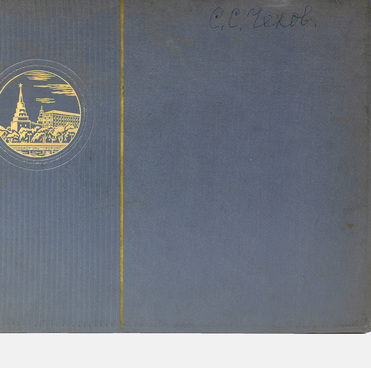
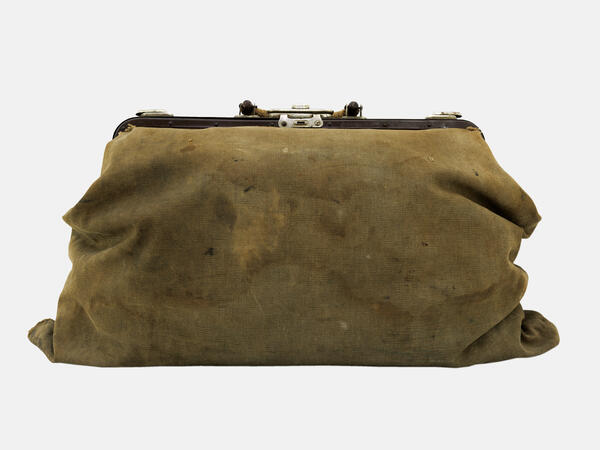
The traveling bag on display is believed to have belonged to the Chekhov family. It was donated to the museum by the widow of the writer’s nephew Sergey Chekhov. This canvas bag has a handle and two metal locks. The handle is wrapped in rope, and there are remnants of leather straps at the bottom.

Traditionally, a traveling bag was a large bag of a regular shape with two short handles and fasteners along the top edge. The first traveling bags appeared in the United States in the mid-19th century, during the railroad boom. Hardly any well-to-do American missed the opportunity to go on a short train journey across the country. Bulky rigid trunks were not suitable for such trips, and so the need for a convenient small bag arose.

The Russian word “sakvoyazh” which translates as “a traveling bag” originated from the French expression “sac de voyage” with the same meaning. The first traveling bags were made of old Oriental rugs and were appropriately called “carpet bags”. They were inexpensive but wore out quickly during trips. Soon, high-quality leather began to be used for bags along with a waxed cord for fastening, making this item of luggage affordable only for well-to-do travelers.

By the end of the 19th century, a traveling bag had become an attribute of doctors and electricians. Such a bag had a latch at the top, two large compartments inside, and a small button pocket. Anton Chekhov was a practicing physician and an active traveler, which is why he had several different traveling bags at his disposal.

A traveling bag was a feature of its time and was often mentioned in 19th-century literature, for example, in Anton Chekhov’s 1886 story “Carefully Disguised”,

#5

There is an old woman dressed as a benefactress, riding in a luxurious sleigh. She is skillfully dressed up: there is a dumb impression of self-importance on her face, a small dog at her feet, and a footman on the backboard. In her traveling bag, there are 1013 rubles and 43 kopecks she has collected for the suffering.

#6

Anton Chekhov’s wife, the actress Olga Knipper-Chekhova, wrote him in 1900,

#7

There’s only one woman with us, we’ve called her Hedda Gabler because of her hairdo. She has a woman’s journal and a check traveling bag — I wonder who she is. She knows Gorky.

#10
Traveling bag
#9
View in the State Catalogue
read morehide
00:00
00:00
1x

Traveling bag

Creation period
the 19th century
Place of сreation
the Russian Empire
Dimensions
40x62 cm
Technique
canvas, metal, fabric, twine; sewing
0
Point your smartphone camera to open in the app
Share
VkontakteOdnoklassnikiTelegram
Share on my website
Copy linkCopied
Copy
Open in app
To see AR mode in action:
  1. Install ARTEFACT app for 
  2. iOS or Android;
  3. Find and download the «Paintings in Details» exhibition
  4. Push the «Augmented reality» button and point your phone's camera at the painting;
  5. Watch what happens on your phone screen whilst you flip through the pictures.
 
We use Cookies
Cookies on the Artefact Website. We use cookies to ensure that we give you the best experience on our website. If you continue without changing your settings, we'll assume that you are happy to receive all cookies on the Artefact website. However, if you would like to, you can change your cookie settings at any time.
Learn more about useHide
Content is available only in Russian

X

Нашли опечатку?...

%title%%type%