One of the most interesting exhibits in the collection of the Solvychegodsk Museum-Reserve is the so-called “painted sakkos”.
The word “sakkos” is translated from Hebrew as “sackcloth” or “hair shirt”, that is, a vestment of sorrow, humility, and repentance. In ancient times, the sakkos was made of simple fabrics, served as a vestment for the clergymen of the highest ranks, and was worn only three times a year, on the main feasts.
Later, the sakkos, as well as other types of church vestments, began to be decorated with gold embroidery — images of saints and various religious scenes made using colorful silk, precious gold and silver threads.
This Solvychegodsk sakkos is unique. There are no other similar artifacts in terms of material, artistic concept, and technique in Old Russian decorative and applied art.
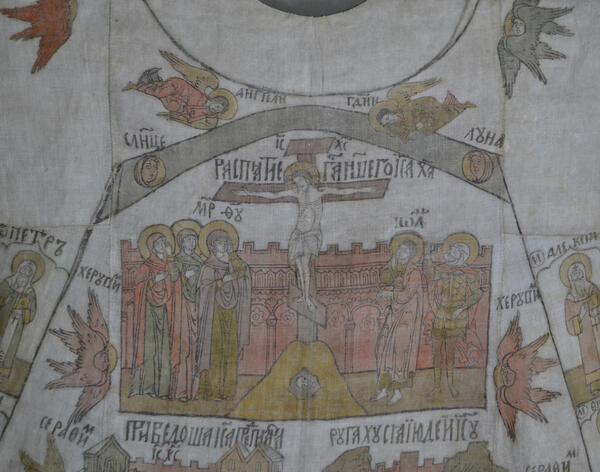
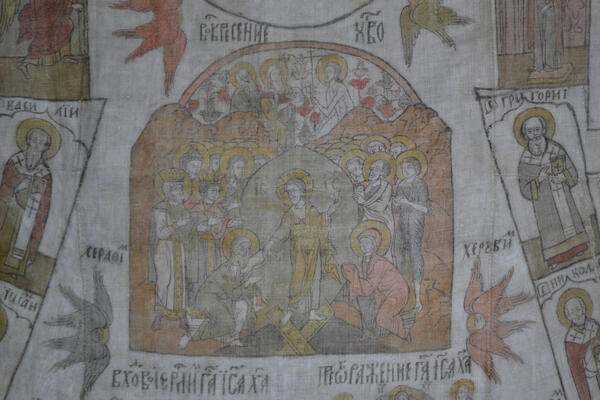
The sakkos has a traditional shape and is sewn from dense linen cloth. The front, back, and sleeves are covered with picturesque images painted with a brush on glued canvas.
This sakkos was not decorated with gold embroidery but was left as a template for other items embroidered with colored and precious threads.
The Solvychegodsk sakkos features complex images with Gospel scenes: on the front side, there are “The Resurrection”, “Christ’s Entry to Jerusalem”, “The Transfiguration of Jesus”, “The Last Supper”, and “The Kiss of Judas”; on the back side — “The Crucifixion”, “Jesus Before Pilate”, “Torturing of Jesus”, “The Descent from the Cross”, and “The Deposition”. These images create the main composition of the sakkos. Between them, there are hovering cherubim, seraphim, angels, and at the bottom — the symbols of the evangelists.
On the sleeves, there are images of “The Eucharist” — “Communion with Bread” on the right and “Communion with Wine” on the left. On the sides of the sakkos, in kiot-style border scenes, there are paired images of saints depicted in full length. The hem features a wide border decorated with a floral and herbal pattern. The total number of figures and fragments on both sides of the sakkos is around 150.
Among the images of saints in the border scenes,
there are Saint Dmitry of Uglich and Pelagia the Martyr, the patron saints of
Andrey Semyonovich Stroganov’s children. This suggests that the sakkos was made
upon his commission in the workshop of his wife Anna Ivanovna Stroganova.