Traditional clothing is a significant aspect of any nation’s culture. It reflects ideas about the world order, religious beliefs, climate, and achievements in arts and crafts. One of the main advantages of traditional clothing of the northern peoples is its practicality. It not only provides excellent protection against the extreme weather of the North but is also adapted to the peculiarities of the work and lifestyle of the local population.
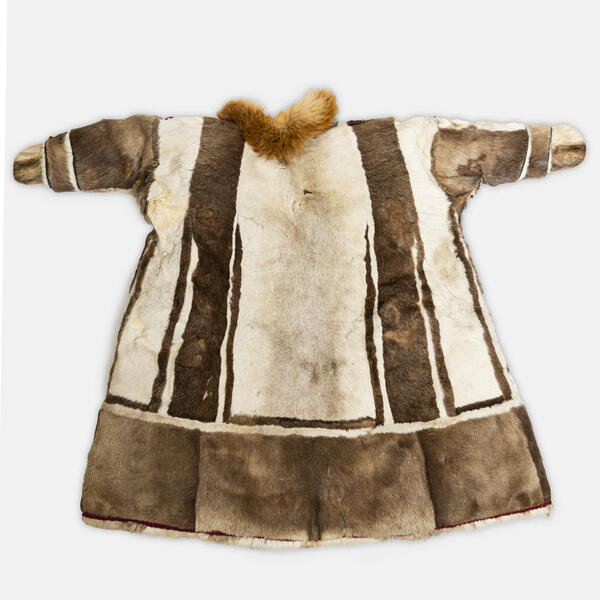
A sak is a traditional Khanty and Mansi women’s winter outerwear, a fur coat with a front opening. A sak is sewn in two layers. In areas where there are few reindeer, the lining is made of swan, hare, squirrel, and loon skins.
It takes three deer hides to make a sak. The inner part is made from the hide of a deer obtained in winter: it has a thicker and denser pile. The outer part is made from the hide obtained in summer. The decorative patterns are created using fur mosaic from kamus — the skin from the lower leg of a deer.
Both a sak and its patterns are sewn by hand. It takes experienced craftswomen up to three months to make a sak. Preparatory work begins in summer: the hides are dressed, dried, cleaned, and processed. The drying method depends on the season: the best time is spring when the sun shines brightly and the wind is piercing. Hides dried in early spring are easier to dress.
In early spring, hides are dried by being laid out on trampled snow. To keep them from shrinking, their edges are fixed with wooden spokes. The hides are dried on poles with spacers because they can rot if they contact the ground. Prior to dressing, the hides are soaked by being covered with damp moss or left outside in the rain or snow. This process helps to smooth out the hides.
The sewing usually begins in late fall and ends in spring. The décor of the sak can indicate where the wearer lives. The sak from the collection of the Ethnographic Museum of the Varyogan Village is made of summer reindeer hides and equipped with a red fox collar. It is decorated with fur mosaic — eight strips of decorative patterns.
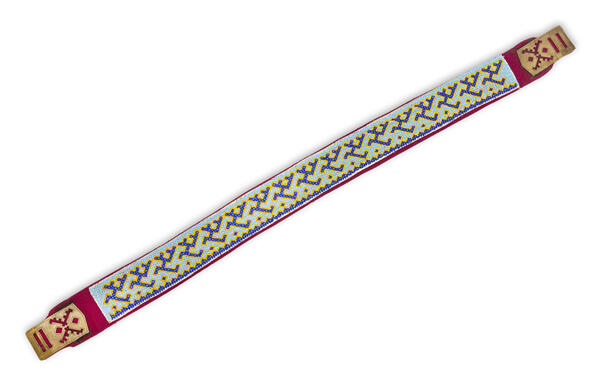
All patterns are made from cloth strips sewn to the
fur with white pearls. The mittens are sewn to the sleeves of a sak so that
they do not get lost in cold weather.