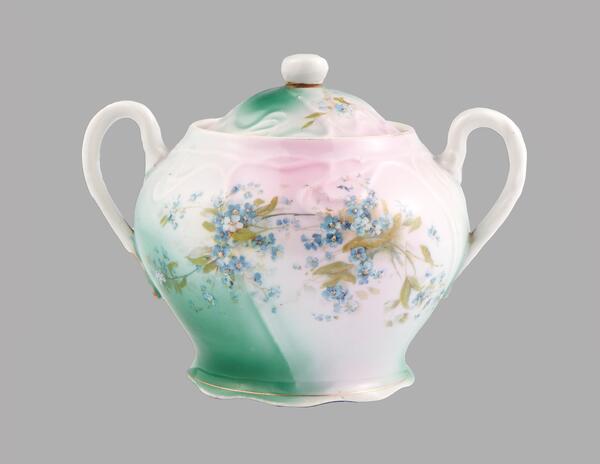
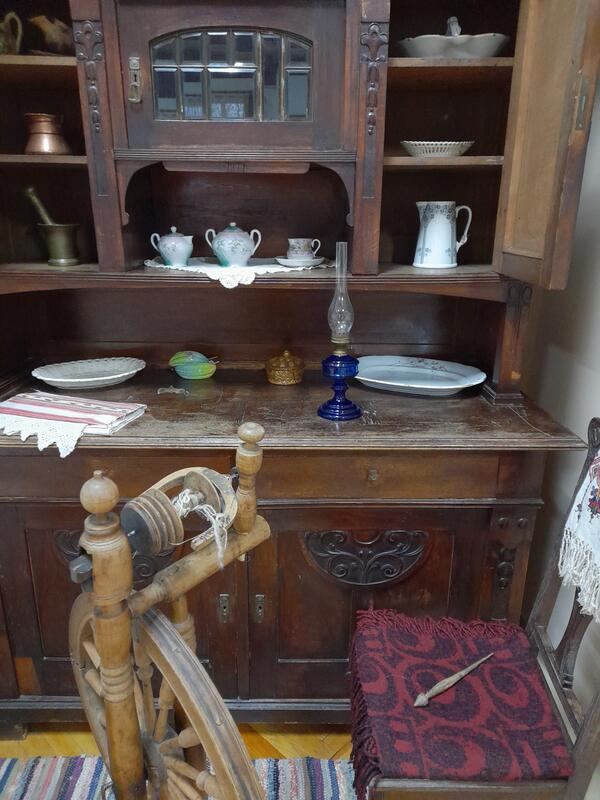
The sugar bowl from the museum’s collection was made at the Volkhov factory of Ivan Emelyanovich Kuznetsov. The factory was founded in 1878 and existed until 1941.
It was built near the Volkhov station of the Nikolaevskaya railway, three kilometers from the Sosninskaya pier, which was located at the intersection of the railway and waterways and was an important transshipment point. This location was chosen for construction for a number of reasons. The nearby forests provided fuel, the navigable Volkhov River was a cheap water transport, cheap laborers could be hired in the surrounding villages and the local clay was suitable. The Volkhov factory began to produce porcelain, faience, semi-faience, majolica, and fire-resistant tableware.
The cousins Kuznetsov subsequently had to negotiate with each other and divide the sales markets: Matvey Sidorovich began to supply ceramics to Moscow and the southern regions, and Ivan Emelyanovich — to Novgorod, St. Petersburg and other northern cities, as well as to Siberia. The products of I.E. Kuznetsov factory were renowned for their unchanging high quality, amazing white porcelain and delicate creamy faience. Tableware and teaware made by I.E. Kuznetsov enterprises were often decorated with wonderful simple images of cornflowers, daisies and other wildflowers.
Affordable simple tableware with traditional folklore patterns was produced for peasants. Townspeople were offered a simplified version of the “noble” services with scenes from the paintings of the first half of the 19th century, including romantic landscapes, gallant scenes, and bouquets of flowers in a gold frame. Such tableware became accessible to the middle class, since, along with hand-painting, the Kuznetsovs began to make extensive use of mechanical techniques when decorating porcelain, such as decal, airbrush, silk-screen printing, and stamping.
The enterprises of the “porcelain empire” carried out serious work when studying demand, so the style of Kuznetsov porcelain reflected the tastes of the consumers and expressed the style and emotional mood of that period. The factories also produced highly artistic items that could satisfy the most demanding tastes. The thinnest porcelain cups rivaled the best samples of Chinese and Western European porcelain. The porcelain of M.S and I.E. Kuznetsov factories often received awards at various Russian and foreign exhibitions.
It was built near the Volkhov station of the Nikolaevskaya railway, three kilometers from the Sosninskaya pier, which was located at the intersection of the railway and waterways and was an important transshipment point. This location was chosen for construction for a number of reasons. The nearby forests provided fuel, the navigable Volkhov River was a cheap water transport, cheap laborers could be hired in the surrounding villages and the local clay was suitable. The Volkhov factory began to produce porcelain, faience, semi-faience, majolica, and fire-resistant tableware.
The cousins Kuznetsov subsequently had to negotiate with each other and divide the sales markets: Matvey Sidorovich began to supply ceramics to Moscow and the southern regions, and Ivan Emelyanovich — to Novgorod, St. Petersburg and other northern cities, as well as to Siberia. The products of I.E. Kuznetsov factory were renowned for their unchanging high quality, amazing white porcelain and delicate creamy faience. Tableware and teaware made by I.E. Kuznetsov enterprises were often decorated with wonderful simple images of cornflowers, daisies and other wildflowers.
Affordable simple tableware with traditional folklore patterns was produced for peasants. Townspeople were offered a simplified version of the “noble” services with scenes from the paintings of the first half of the 19th century, including romantic landscapes, gallant scenes, and bouquets of flowers in a gold frame. Such tableware became accessible to the middle class, since, along with hand-painting, the Kuznetsovs began to make extensive use of mechanical techniques when decorating porcelain, such as decal, airbrush, silk-screen printing, and stamping.
The enterprises of the “porcelain empire” carried out serious work when studying demand, so the style of Kuznetsov porcelain reflected the tastes of the consumers and expressed the style and emotional mood of that period. The factories also produced highly artistic items that could satisfy the most demanding tastes. The thinnest porcelain cups rivaled the best samples of Chinese and Western European porcelain. The porcelain of M.S and I.E. Kuznetsov factories often received awards at various Russian and foreign exhibitions.