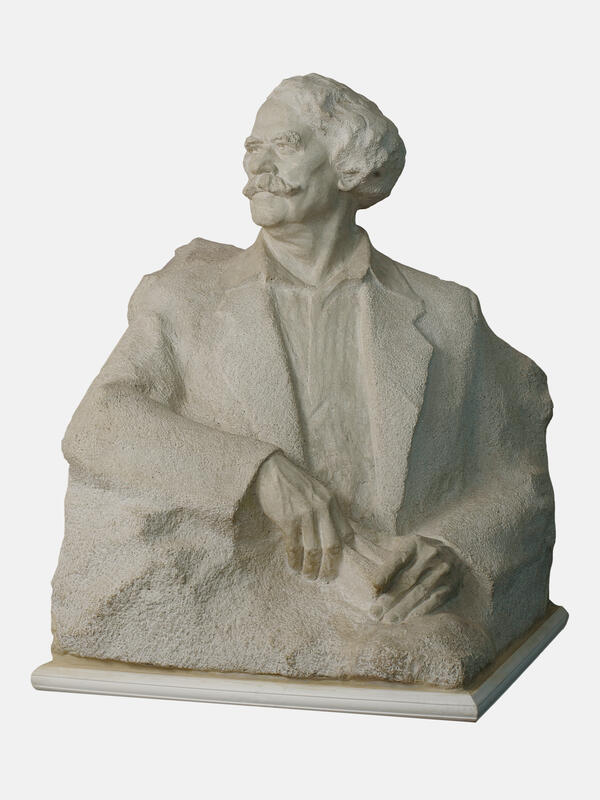
A sculptural portrait of Sergey Sergeyev-Tsensky was cast from ground marble. The writer seems to emerge from a block of stone. He is dressed in a jacket and a shirt with a collar and has no headdress. He holds a book in his hands.
The sculpture was made in Simferopol in 1960 by the Crimean sculptor Nina Petrova, the wife of the battle painter Ivan Petrov. She created numerous sculptural portraits and memorials in Crimea, as well as beyond its territories (for example, her works include busts of Anton Chekhov in Yalta and Vladimir Kornilov in the panorama “Defense of Sevastopol”). The sculptor made this bust as a copy of the monument on the writer’s grave.
The memory of Sergey Sergeyev-Tsensky is perpetuated in sculptures. In 1966, after extensive preparatory work that was carried out by the writer’s widow Khristina Mikhailovna Sergeyeva-Tsenskaya, Sergeyev-Tsensky’s friend and writer Ivan Shevtsov, and Ivan Fesiura, the first director of the museum dedicated to the writer, a monument to Sergeyev-Tsensky was unveiled in Alushta. The monument was created by the Soviet sculptor Nikolay Tomsky, who was also a member of the USSR Academy of Arts, Hero of Socialist Labor, and winner of one Lenin Prize and five Stalin Prizes. The white marble monument depicts Sergeyev-Tsensky in full length. The writer attended the unveiling ceremony of the monument, which was erected in a park near the city’s main embankment, as evidenced by the photographs in the museum’s collections.
Another sculptural portrait of Sergeyev-Tsensky was placed on the embankment of the Tsna River in Tambov, the writer’s homeland. It was created by the sculptors Sergey Lebedev and Tatiana Veltsen and the architect Alexander Kulikov. The foundation was laid in 1959, as evidenced by the photos in the museum archives; the writer Ivan Shevtsov spoke at the meeting dedicated to the foundation of the monument. The unveiling ceremony in 1975 was timed to coincide with the 100th anniversary of Sergeyev-Tsensky’s birth, which was widely celebrated throughout the Soviet Union and particularly in Crimea and the Tambov region. Both monuments have survived to this day.