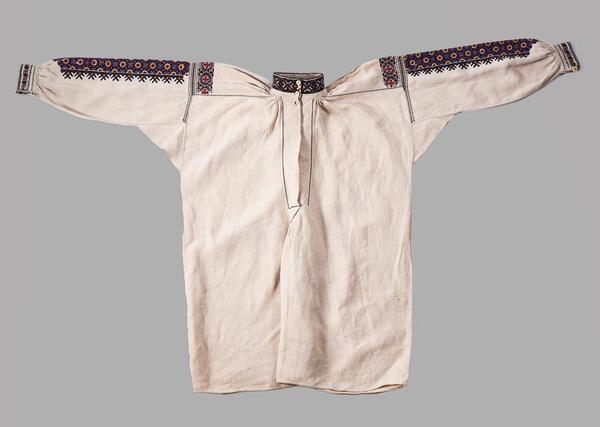
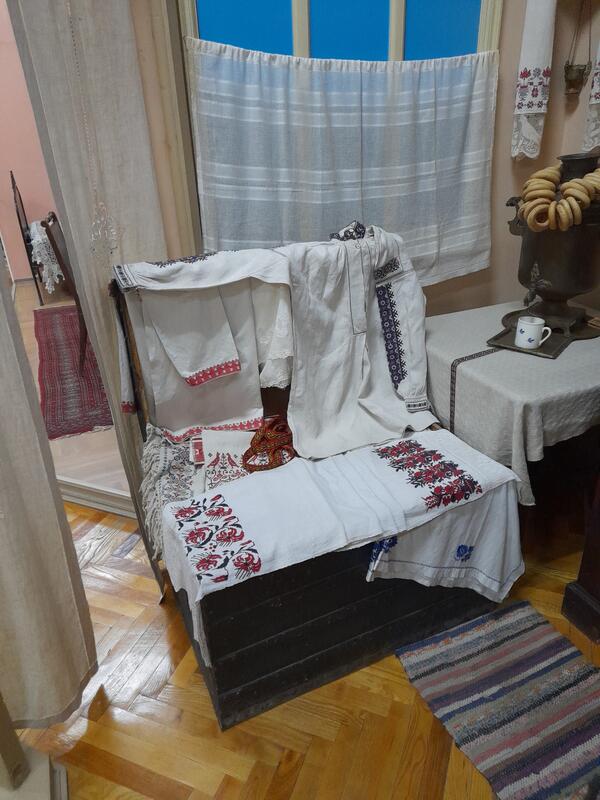
This women’s shirt made of coarse homespun linen was handmade by Anna Romanovna Stetsishina in 1916.
The shirt was the most common example of underwear of the early Slavs. This was the simplest type of attire: the fabric was folded in half and a hole was made for the head. Gradually, people began to fasten shirts on the sides and add rectangular pieces of fabric — sleeves.
In Rus, a women’s shirt was a fundamental element of the national costume. In the southern part of the country, a skirt called a “poneva” was worn on top, and in the central and northern parts women put on sundresses. Shirts could be one-piece and compound. A compound shirt had two parts — an upper and a lower one.
This shirt from the collection of the Novorossiysk Historical Museum-Reserve was made of coarse homespun linen and cut out of rectangular pieces. The sleeves were connected to the main part at a right angle. In general, the cut was extremely simple and economical — all pieces of fabric came in handy. The shirt had rectangular and wedge-shaped parts. A stand-up collar was sewn to the neck of the shirt. There were folds made along the neckline. The collar, shoulders, sleeves and cuffs of this shirt were embroidered with cotton threads.
It has long been believed that apart from serving the aesthetic purpose, national costume was also supposed to protect its wearer from evil. In Rus, embroidery was of paramount importance. According to the beliefs of the early Slavs, only those parts of the shirt through which evil forces could access the body and soul were usually decorated with embroidery. The shirt itself also protected against dark forces, so the so-called protective pattern was applied where the fabric ended: on the cuffs, on the collar, on the hem and cuts, and on the sleeves. The seams with which the shirt was embroidered should be countable — that is, performed according to the number of fabric threads.
There were all kinds of shirts for various life occasions: for divination, for working in the field (mowing), for feeding babies, as well as ceremonial and festive clothes. In her dowry chest, a bride would keep 5–6 or even a dozen shirts. The most beautiful one was worn on the wedding day. It was sewn from the best homespun cloth.
The shirt was the most common example of underwear of the early Slavs. This was the simplest type of attire: the fabric was folded in half and a hole was made for the head. Gradually, people began to fasten shirts on the sides and add rectangular pieces of fabric — sleeves.
In Rus, a women’s shirt was a fundamental element of the national costume. In the southern part of the country, a skirt called a “poneva” was worn on top, and in the central and northern parts women put on sundresses. Shirts could be one-piece and compound. A compound shirt had two parts — an upper and a lower one.
This shirt from the collection of the Novorossiysk Historical Museum-Reserve was made of coarse homespun linen and cut out of rectangular pieces. The sleeves were connected to the main part at a right angle. In general, the cut was extremely simple and economical — all pieces of fabric came in handy. The shirt had rectangular and wedge-shaped parts. A stand-up collar was sewn to the neck of the shirt. There were folds made along the neckline. The collar, shoulders, sleeves and cuffs of this shirt were embroidered with cotton threads.
It has long been believed that apart from serving the aesthetic purpose, national costume was also supposed to protect its wearer from evil. In Rus, embroidery was of paramount importance. According to the beliefs of the early Slavs, only those parts of the shirt through which evil forces could access the body and soul were usually decorated with embroidery. The shirt itself also protected against dark forces, so the so-called protective pattern was applied where the fabric ended: on the cuffs, on the collar, on the hem and cuts, and on the sleeves. The seams with which the shirt was embroidered should be countable — that is, performed according to the number of fabric threads.
There were all kinds of shirts for various life occasions: for divination, for working in the field (mowing), for feeding babies, as well as ceremonial and festive clothes. In her dowry chest, a bride would keep 5–6 or even a dozen shirts. The most beautiful one was worn on the wedding day. It was sewn from the best homespun cloth.