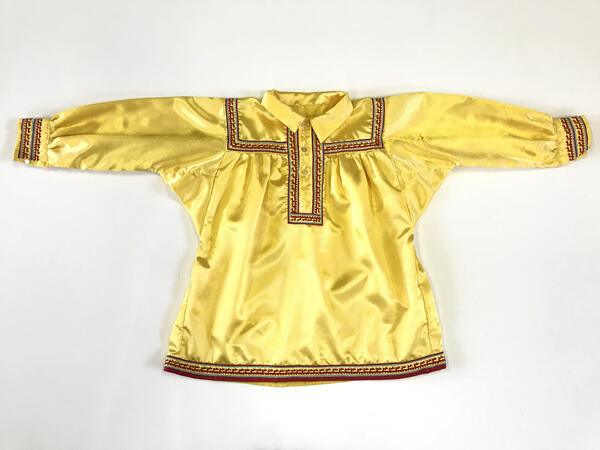
The museum houses a traditional ornamented shirt for a boy. It is called ‘ai iki yarnas’ in the Khanty language. The shirt is made of yellow satin. Its lower hemlines, the line of the yoke (a cut-off part that is sewn to the back) and the cuffs are decorated with an ornament of colored cotton stripes of red and blue colors.
Each color has a symbolic meaning among the Khanty people. For example, yellow symbolizes the sun, green means the taiga, blue means water and the sky.
The traditional children’s clothes of the Khanty was almost the same as the clothes of the adults, except for the size. Besides, more protective ornaments were applied on children’s clothes, since a child was especially vulnerable to evil spirits.
In the old days, clothes for all family members was made by a woman. If the bride could sew well and fast, she was considered a good match. The indigenous peoples of the North valued handcraft skills and housework more than an attractive appearance.
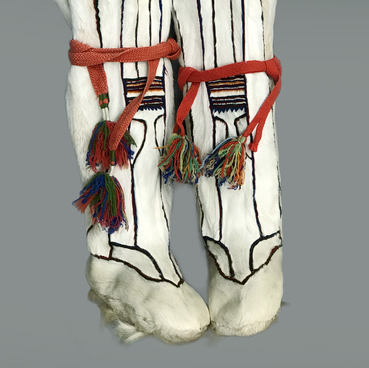
The mother of a newborn baby sewed him or her a rabbit fur coat with a cloth cape and fur stockings. Three beads were sewn on it to ward off the evil eye. Boys were given their first shirt by the age of two or three, and girls were given a dress. By the age of four or five, children had a full set of traditional clothes. A boy got a belt that had to be worn on top of a shirt in summer and on top of a malitsa (national fur coat) in winter. A wooden knife in a scabbard and bells were hung on this belt — the ringing of the bells scared away evil spirits and helped parents to keep an eye on their child.
The cut of the summer and winter men’s clothes did not differ. The material was the only difference. In the past, the Khanty made cloth for sewing light things from nettles. The plant was harvested in the autumn and dried, and then processed. Nettle fibers were spun, and then the threads were bleached or dyed. Thin canvases were used for sewing underwear, and thick ones were used for outer garment. Decoctions made of berries, roots, or herbs were used to dye the threads.
In the old days, ornaments were embroidered with dyed deer hair, which had been taken from the neck area. Moreover, clothes were decorated with colored leather straps and beaded amulets.
Each color has a symbolic meaning among the Khanty people. For example, yellow symbolizes the sun, green means the taiga, blue means water and the sky.
The traditional children’s clothes of the Khanty was almost the same as the clothes of the adults, except for the size. Besides, more protective ornaments were applied on children’s clothes, since a child was especially vulnerable to evil spirits.
In the old days, clothes for all family members was made by a woman. If the bride could sew well and fast, she was considered a good match. The indigenous peoples of the North valued handcraft skills and housework more than an attractive appearance.
The mother of a newborn baby sewed him or her a rabbit fur coat with a cloth cape and fur stockings. Three beads were sewn on it to ward off the evil eye. Boys were given their first shirt by the age of two or three, and girls were given a dress. By the age of four or five, children had a full set of traditional clothes. A boy got a belt that had to be worn on top of a shirt in summer and on top of a malitsa (national fur coat) in winter. A wooden knife in a scabbard and bells were hung on this belt — the ringing of the bells scared away evil spirits and helped parents to keep an eye on their child.
The cut of the summer and winter men’s clothes did not differ. The material was the only difference. In the past, the Khanty made cloth for sewing light things from nettles. The plant was harvested in the autumn and dried, and then processed. Nettle fibers were spun, and then the threads were bleached or dyed. Thin canvases were used for sewing underwear, and thick ones were used for outer garment. Decoctions made of berries, roots, or herbs were used to dye the threads.
In the old days, ornaments were embroidered with dyed deer hair, which had been taken from the neck area. Moreover, clothes were decorated with colored leather straps and beaded amulets.