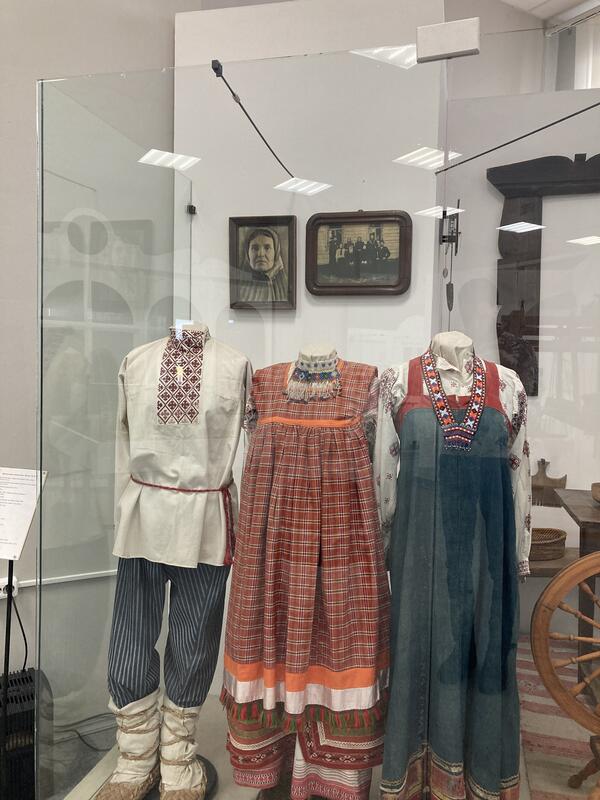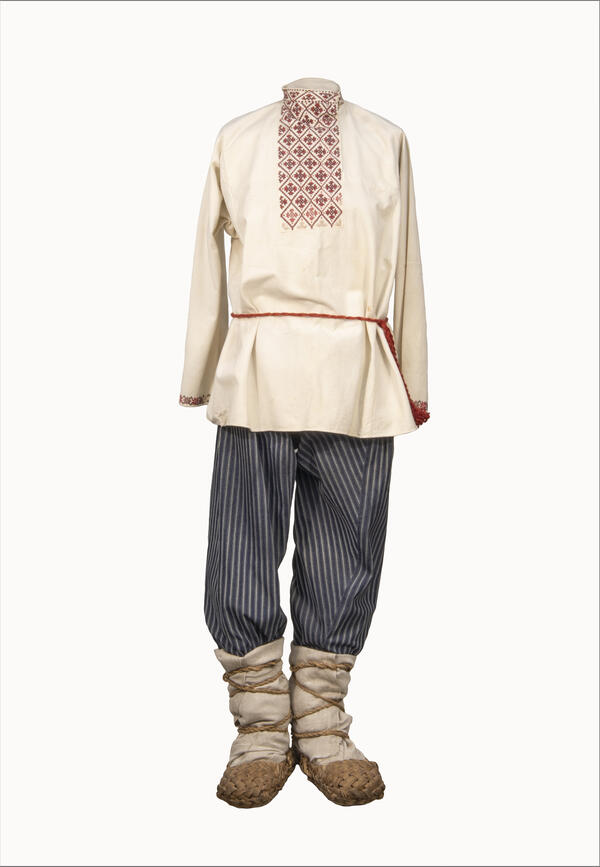
A kosovorotka shirt was the main element of Russian men’s national costume. Its name (rubakha in Russian) comes from the Old Russian word “rub”, which means a rough, simple cloth, and its first mention dates back to the 11th century. Kosovorotka refers to a shirt with a slit not in the center of the chest, but on the side, fastened with a button. According to the historian Dmitry Likhachev, such a cut was made so that in the course of work the baptismal cross would not slip out from under the clothes. The style of the shirt was the same for men of all estates, the only difference was in the quality of fabric and trimmings.
The shirt fulfilled not only a utilitarian but also a magical function. A newborn boy was wrapped in his father’s shirt, which was then used to make the baby’s first shirt. In ancient times people believed that in this way the power of ancestors and clan would protect the child from evil and disease. A shirt made of new cloth — novina — was given to a boy on his third birthday. Little children, boys and girls, wore identical shirts until they were 12 years old.
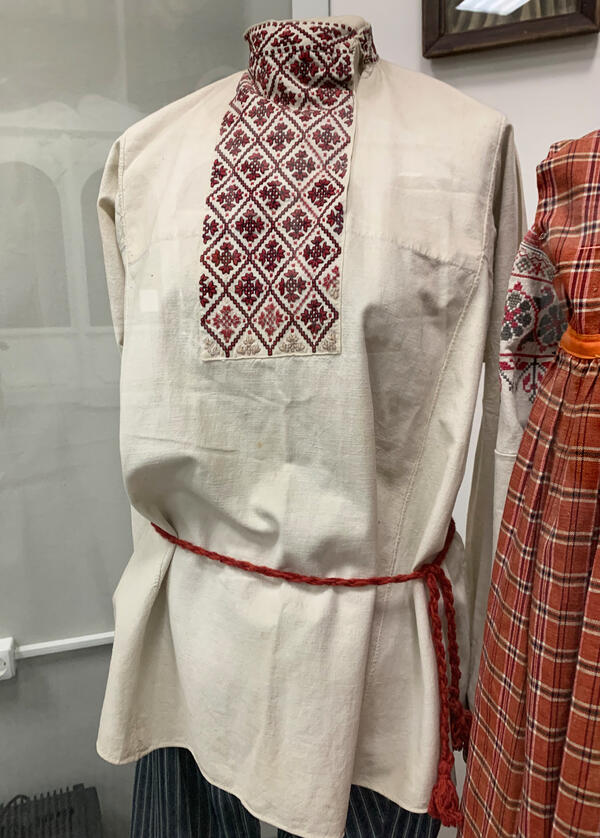
The embroidery on the shirt also served as a protective amulet. Traditionally, the embroidery was used to decorate the bottom of the sleeves, collar and chest — the borders of uncovered body parts, through which evil spirits could penetrate a person. The pattern on the collar and chest was made up of traditional geometrical diamond-shaped elements. A flower with triple petals was inserted into each of them. The embroidery is done in red and black threads in different techniques: satin and running stitch, and double cross. Such a combination of colors was characteristic of the southwestern regions of Kaluga Governorate.
The shirt was made of four wide sheets of linen canvas, reaching to the thighs or knees. The upper part was additionally reinforced against wear and tear by a lining. The main part of the shirt is called “stan” and there are shoulder insets sewn on to it to widen the neck. The sleeves are straight and under the arms there are square pieces of cloth — gussets. They were sometimes made in red, and served to give more freedom of movement. The stand-collar was 2–7 cm in height, and if it was absent, the shirt was called a “bareneck”.
In addition to the shirt, men’s costume included a belt and trousers. The shirt was worn untucked, only young men in some governorates tucked the shirt into their trousers or used braces. Middle-aged and elderly men always wore a shirt over their pants. The shirt was always tied with a silk or woven belt, which was considered a personal talisman.
The shirt fulfilled not only a utilitarian but also a magical function. A newborn boy was wrapped in his father’s shirt, which was then used to make the baby’s first shirt. In ancient times people believed that in this way the power of ancestors and clan would protect the child from evil and disease. A shirt made of new cloth — novina — was given to a boy on his third birthday. Little children, boys and girls, wore identical shirts until they were 12 years old.
The embroidery on the shirt also served as a protective amulet. Traditionally, the embroidery was used to decorate the bottom of the sleeves, collar and chest — the borders of uncovered body parts, through which evil spirits could penetrate a person. The pattern on the collar and chest was made up of traditional geometrical diamond-shaped elements. A flower with triple petals was inserted into each of them. The embroidery is done in red and black threads in different techniques: satin and running stitch, and double cross. Such a combination of colors was characteristic of the southwestern regions of Kaluga Governorate.
The shirt was made of four wide sheets of linen canvas, reaching to the thighs or knees. The upper part was additionally reinforced against wear and tear by a lining. The main part of the shirt is called “stan” and there are shoulder insets sewn on to it to widen the neck. The sleeves are straight and under the arms there are square pieces of cloth — gussets. They were sometimes made in red, and served to give more freedom of movement. The stand-collar was 2–7 cm in height, and if it was absent, the shirt was called a “bareneck”.
In addition to the shirt, men’s costume included a belt and trousers. The shirt was worn untucked, only young men in some governorates tucked the shirt into their trousers or used braces. Middle-aged and elderly men always wore a shirt over their pants. The shirt was always tied with a silk or woven belt, which was considered a personal talisman.