#2
#19
At the age of 17, Anton Chekhov wrote to his cousin Mikhail Chekhov about his attitude toward his parents, “Father and mother are the only people in the whole world for me, for whom I will never spare anything. If I rise high, it is thanks to them, they are glorious people, and their boundless love of children puts them above all praise, covering all their faults, which may come from a bad life.”
The writer’s mother, Yevgenia Yakovlevna, was born in 1835 in Shuisky Uyezd, Ivanovo Governorate, in the family of the cloth merchant Morozov. She was taught to read and write at home for a short time. She was 11 years old when her father died and she moved with her mother and sister to Taganrog. Yevgenia Yakovlevna graduated from Madame Kurilova’s Private Institute for Noble Maidens, where she learned manners, etiquette, and dancing. She was a gentle, calm, and wise woman who appreciated education, but paid just as much attention to the moral virtues of her children.
The writer’s father, Pavel Yegorovich, was ten years older than his wife. He was born into the family of a serf peasant in Voronezh Governorate. When Pavel was 16, his father bought manumissions for the whole family. Young Pavel moved to Taganrog, where he was assigned to serve in one of the shops of the merchant Kobylin.
Pavel Yegorovich and Yevgenia Yakovlevna were married on October 29, 1854. They had six children, Anton being the third. Pavel Yegorovich brought up his sons in a strict manner, and did not tolerate disobedience. Chekhov senior had been working for merchant Kobylin for 13 years, saved 3,000 rubles and opened his own shop “with sugar, tea and other goods”. He was confirmed as a merchant of the second guild, was engaged in social activities of the city government, was a member of the trade deputation, sang and recited in the choir, along with psalmists. Later he became master of the choir, which he headed for several years, and then organized a church choir, in which his sons sang.
Having become broke, in 1876 the Chekhovs moved to Moscow, where for a long time Pavel Yegorovich struggled to provide for the family until he handed over the role of the head of the family and breadwinner to his middle son, Anton. In 1892, Chekhov’s parents moved to the Melikhovo estate, where Pavel Yegorovich began to keep a diary of life in Melikhovo, a true family chronicle.
#20
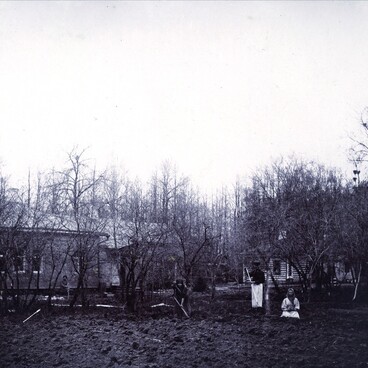
Наименование: Yevgenia and Pavel Chekhov on the veranda
Размеры: 13,5×11 см
Коллекция: The Manor House of Anton Chekhov in Melikhovo
Правообладатель изображений: The Manor House of Anton Chekhov in Melikhovo
Размеры: 13,5×11 см
Коллекция: The Manor House of Anton Chekhov in Melikhovo
Правообладатель изображений: The Manor House of Anton Chekhov in Melikhovo
#21
Alexander Chekhov and his sons
#22
Alexander Pavlovich Chekhov was the eldest of six children in the family. After graduating from Taganrog Gymnasium with a silver medal, he entered the Physics and Mathematics Department of Moscow University. Alexander Pavlovich knew six languages, he was an editor, writer, journalist, a man of encyclopedic knowledge in mathematics, physics, chemistry, medicine and agriculture.
As a student, Alexander Chekhov began working part-time in humorous magazines and newspapers in Moscow. Alexander started a family early and was married twice. He had two sons in his first marriage — Nikolay and Anton, who were called Kolya and Tosya in the family. And by his second marriage he had a son, Mikhail, who became a prominent theatrical figure. In search of a more stable income, Alexander joined the customs service, but he was bored by his position and continued to write. Helped by his brother Anton, he got a permanent job at the “Novoye Vremya” newspaper. Anton Pavlovich always supported his brother and forbade him to give up literature.
Anton Pavlovich told his brother, “Why do you write so little? What an outrage? ‘Sverchok’ and ‘Budilnik’ are full of vacancies, and you sit idly, whining, like Gershka, when he is bitten in his sleep by fleas. Why are you too lazy to work for ‘Oskolki’? All those stories you sent me to pass on to Leikin reek strongly of laziness. Did you write them all in one day? I could pick one great, talented story out of the whole mass, but the rest is all worthy of the pen of the Taganrog Zhivchik. The plots are impossible… Respect yourself, for Christ’s sake, don’t let your hands do the work when your brain is lazy! Write no more than 2 stories a week, shorten them, process them, let labor be labor. Don’t describe the sufferings you haven’t experienced, and don’t draw pictures you haven’t seen — for lying in a story is much more boring than in a conversation.”
Alexander Chekhov published eight books, including his childhood memories of his brother. He wrote under the pseudonyms A. Sedoy, Aloe, and Agafopod Yedinitsyn. Alexander Chekhov was fond of photography, “Photography is progressing slowly — there is no time for it. The negatives are intact and await better times for being printed and more light in my soul.” He compiled “The Photographer’s Chemical Dictionary” and much of the Chekhovs’ family photo archive.
#23
Наименование: Alexander Chekhov and his sons
Размеры: 12,8×9,5 см
Коллекция: The Manor House of Anton Chekhov in Melikhovo
Правообладатель изображений: The Manor House of Anton Chekhov in Melikhovo
Размеры: 12,8×9,5 см
Коллекция: The Manor House of Anton Chekhov in Melikhovo
Правообладатель изображений: The Manor House of Anton Chekhov in Melikhovo
#24
Ministry of Culture of the Russian Federation
read morehide
A.P. Chekhov's parents, Al. Chekhov and his sons
Collection
2
 Point your smartphone camera to open in the app
Open in app
Share