The death of the Savior on the Cross is described in all the Gospels. This plot is one of the most common in Western and Eastern Christian art, but its iconography did not develop immediately.
Until the 5th century, the Crucifixion was depicted conventionally: in the form of a cross and a crown of thorns, an anchor as a symbol of hope (Hebrews 6:19), and a fishing trident. Later, a half-length image of Christ was depicted over the cross.
Artifacts with a literal depiction of the sufferings on the cross began to appear only in the second quarter of the 5th century. In the 6th century in Byzantium, a traditional composition with witnesses was formed. Until the 9th century, the Crucifixion scene emphasized the idea of triumph over death: Christ was depicted with His body erect and His eyes open. Later monuments are characterized by an emphasis on the suffering of Jesus as a human, his physical death.
By the 11th century, a canon had developed in Byzantine art, combining the image of the suffering and the greatness of the upcoming triumph. Old Russian icon painters adopted this tradition.
The three canonical versions of the composition differ in the number of witnesses. Among them, icon painters could depict only the Mother of God and John the Theologian or include Mary Magdalene and the centurion Longinus, or the Myrrh-bearers, as well as criminals and soldiers.
Symbolic images of Golgotha, caves with the skull of the forefather Adam under the cross and Jerusalem walls in the background are mandatory attributes of these icons.
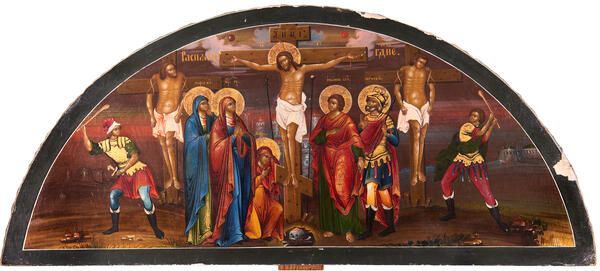
On the presented miniature icon, the entire composition is enclosed in a semicircle. The arrangement of the figures is symmetrical. The crucified Christ occupies the central place: His pose and closed eyes testify to the death that has taken place, but the face is peaceful. To the right of the viewer are the beloved disciple of Christ, John the Theologian, who was adopted by the Mother of God, and the Roman centurion Longinus. Standing at the cross and seeing the trembling of nature, he believed in Jesus and exclaimed:
Until the 5th century, the Crucifixion was depicted conventionally: in the form of a cross and a crown of thorns, an anchor as a symbol of hope (Hebrews 6:19), and a fishing trident. Later, a half-length image of Christ was depicted over the cross.
Artifacts with a literal depiction of the sufferings on the cross began to appear only in the second quarter of the 5th century. In the 6th century in Byzantium, a traditional composition with witnesses was formed. Until the 9th century, the Crucifixion scene emphasized the idea of triumph over death: Christ was depicted with His body erect and His eyes open. Later monuments are characterized by an emphasis on the suffering of Jesus as a human, his physical death.
By the 11th century, a canon had developed in Byzantine art, combining the image of the suffering and the greatness of the upcoming triumph. Old Russian icon painters adopted this tradition.
The three canonical versions of the composition differ in the number of witnesses. Among them, icon painters could depict only the Mother of God and John the Theologian or include Mary Magdalene and the centurion Longinus, or the Myrrh-bearers, as well as criminals and soldiers.
Symbolic images of Golgotha, caves with the skull of the forefather Adam under the cross and Jerusalem walls in the background are mandatory attributes of these icons.
On the presented miniature icon, the entire composition is enclosed in a semicircle. The arrangement of the figures is symmetrical. The crucified Christ occupies the central place: His pose and closed eyes testify to the death that has taken place, but the face is peaceful. To the right of the viewer are the beloved disciple of Christ, John the Theologian, who was adopted by the Mother of God, and the Roman centurion Longinus. Standing at the cross and seeing the trembling of nature, he believed in Jesus and exclaimed: