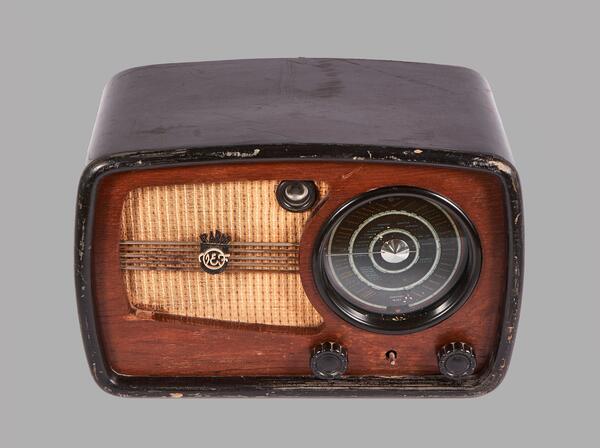
The VEF Super M-557 radio receiver was one of the first post-war receivers in the USSR. It was called “round scale” and was very rare.
After the Great Patriotic War, a small batch of the first post-war “people’s” radio receiver was released in the capital of the Latvian SSR, the city of Riga, at the State Electrotechnical Plant “VEF”. In January 1946, the model was put into large-scale production.
The VEF SUPER M-557 radio receiver was designed on the basis of the pre-war Vefsuper M-517 radio receiver, which the plant had been producing even before Latvia joined the USSR in 1940. VEF radio receivers were the brand of the plant, the highest technical level of which was noted at international exhibitions.
When Latvia entered the USSR, the models of radio receivers were transferred to the Soviet element base, and Soviet radio components were delivered to the plant. However, in 1941, the war began, Latvia was occupied by Nazi Germany, and the German company AEG became the owner of the plant. The plant continued to produce VEF Super M517 radio receivers, first using Soviet and later German tubes. In 1944, before the liberation of Riga from the fascist occupation, most of the technological equipment and finished products were taken to Germany, and the factory buildings were blown up.
The VEF Super M-557 model, which the plant began to produce after restoration, practically repeated the pre-war radio receiver with minor changes in design and electrical circuit. The VEF Super M-557 was equipped with a large round backlit tuning scale, on which the designations of wavelengths, frequencies and city names were marked in the corresponding bands in colors. At the bottom of the scale, this color indicated the wave that was on. An optical tuning indicator — the so-called “magic eye” — was used to silently tune to the desired station. The control mechanisms included: a volume control combined with a switch (left knob), a tuning knob (when it was pulled out, the ultra short bandwidth expanded), and a range switch (right knob). The VEF SUPER M-557 model was produced until 1949.
After the Great Patriotic War, a small batch of the first post-war “people’s” radio receiver was released in the capital of the Latvian SSR, the city of Riga, at the State Electrotechnical Plant “VEF”. In January 1946, the model was put into large-scale production.
The VEF SUPER M-557 radio receiver was designed on the basis of the pre-war Vefsuper M-517 radio receiver, which the plant had been producing even before Latvia joined the USSR in 1940. VEF radio receivers were the brand of the plant, the highest technical level of which was noted at international exhibitions.
When Latvia entered the USSR, the models of radio receivers were transferred to the Soviet element base, and Soviet radio components were delivered to the plant. However, in 1941, the war began, Latvia was occupied by Nazi Germany, and the German company AEG became the owner of the plant. The plant continued to produce VEF Super M517 radio receivers, first using Soviet and later German tubes. In 1944, before the liberation of Riga from the fascist occupation, most of the technological equipment and finished products were taken to Germany, and the factory buildings were blown up.
The VEF Super M-557 model, which the plant began to produce after restoration, practically repeated the pre-war radio receiver with minor changes in design and electrical circuit. The VEF Super M-557 was equipped with a large round backlit tuning scale, on which the designations of wavelengths, frequencies and city names were marked in the corresponding bands in colors. At the bottom of the scale, this color indicated the wave that was on. An optical tuning indicator — the so-called “magic eye” — was used to silently tune to the desired station. The control mechanisms included: a volume control combined with a switch (left knob), a tuning knob (when it was pulled out, the ultra short bandwidth expanded), and a range switch (right knob). The VEF SUPER M-557 model was produced until 1949.