Bit shank is an element of an ancient bridle, harness for a riding horse. This set included a bit and a pair of bit shanks that were connected to each other in a certain way. Each bit shank consisted of a pair of vertical rods. It was attached perpendicularly to the end of the bit and so they were fixed in the mouth of the animal. When a rider drew the reins, the bit pressed on the horse’s gums: so the rider was able to control it.
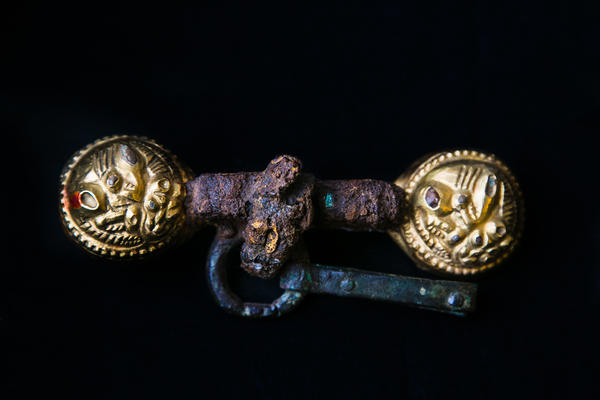
An ancient bit shank from our collection is hammered from a bar, the ends of which are flattened into round discs. Two eyes are welded in the middle of the bit shank — the outer ring of the bit was put on between them. The discs are decorated with gold phaleras. Phaleras is the name for appliques made of various metals (as a rule, gold, silver or bronze). Their cross-shaped fasteners connected the harness straps. The phaleras were often decorated with inserts of precious gems, geometric or floral ornaments, as well as zoomorphic drawings — images of animals.
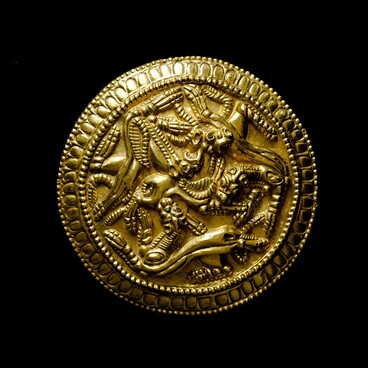
The phaleras of our exhibit are decorated with images of a curled up panther. An ancient craftsman decorated the thigh, shoulder bone, ears, eyes and paws of the animal with inserts of blue, green and brown transparent glass, and also with gray glass paste. The hair on the mane and the ribs are drawn on metal, and the tail ends with a herringbone tassel.
It is difficult to say where the phaleras first appeared — similar finds were found in Ancient Greece, Egypt, in the Black Sea coastal area and Scythia. Later, their appearance changed a lot: archaeologists are of opinion that the parade harness of the Khazar horses was also decorated with phaleras.
The bit shank from our collection was found by archaeologists from the Astrakhan expedition of Leningrad branch of the Institute for the History of Material Culture of the USSR Academy of Sciences. The expedition was headed by Valentin Shilov. The excavations were carried out in 1964 on the mound near the Zhutovo station of the Oktyabrsky District (Volgograd Region).
In 2005, the bit shank was exhibited at the Astrakhan Steppe Treasures show at the National Museum of the Palazzo Venezia in Rome, and in 2008 at the Gold of the Sarmatians exhibition in the State Historical Museum (Moscow).
An ancient bit shank from our collection is hammered from a bar, the ends of which are flattened into round discs. Two eyes are welded in the middle of the bit shank — the outer ring of the bit was put on between them. The discs are decorated with gold phaleras. Phaleras is the name for appliques made of various metals (as a rule, gold, silver or bronze). Their cross-shaped fasteners connected the harness straps. The phaleras were often decorated with inserts of precious gems, geometric or floral ornaments, as well as zoomorphic drawings — images of animals.
The phaleras of our exhibit are decorated with images of a curled up panther. An ancient craftsman decorated the thigh, shoulder bone, ears, eyes and paws of the animal with inserts of blue, green and brown transparent glass, and also with gray glass paste. The hair on the mane and the ribs are drawn on metal, and the tail ends with a herringbone tassel.
It is difficult to say where the phaleras first appeared — similar finds were found in Ancient Greece, Egypt, in the Black Sea coastal area and Scythia. Later, their appearance changed a lot: archaeologists are of opinion that the parade harness of the Khazar horses was also decorated with phaleras.
The bit shank from our collection was found by archaeologists from the Astrakhan expedition of Leningrad branch of the Institute for the History of Material Culture of the USSR Academy of Sciences. The expedition was headed by Valentin Shilov. The excavations were carried out in 1964 on the mound near the Zhutovo station of the Oktyabrsky District (Volgograd Region).
In 2005, the bit shank was exhibited at the Astrakhan Steppe Treasures show at the National Museum of the Palazzo Venezia in Rome, and in 2008 at the Gold of the Sarmatians exhibition in the State Historical Museum (Moscow).