“Christ Before Caiaphas” is a gospel episode preceding the condemnation and surrender of the Lord to the Roman authorities for the approval and execution of the sentence. The historical context is very important for understanding it.
In Jewish law, the position of the high priest lasted for the holder’s lifetime. However, as Flavius Josephus testifies, between the removal of the high priest Annas (Ananus) in 15 AD and the beginning of the reign of his son-in-law Caiaphas (Joseph) in 18 AD, three more people held this position: Ismail, Eleazar and Simon. Researchers explain the long reign of Caiaphas (from 18 to 36 AD) by his loyalty to the Roman government and de facto subordination to the more experienced Annas. The numerous miracles performed by Jesus, especially the resurrection of Lazarus, and His authority among people, frightened the Sanhedrin (Jewish Supreme Council): the miracles and His veneration were considered as threats to Sanhedrin’s power and a reason for conflicts with the Roman Empire. The decision to sentence Jesus to death had been made a long time ago, but it required a strong justification.
The trial at the residence of the high priest Caiaphas was held with many violations. The condemned Christ was brought first for interrogation to Annas, who no longer had the right to perform judicial duties, and only then to Caiaphas; the Sanhedrin was not fully convened; the trial was held at Caiaphas’s residence, at night, although the law required meetings to be held only in the Temple, in daylight; moreover, false witnesses were called.
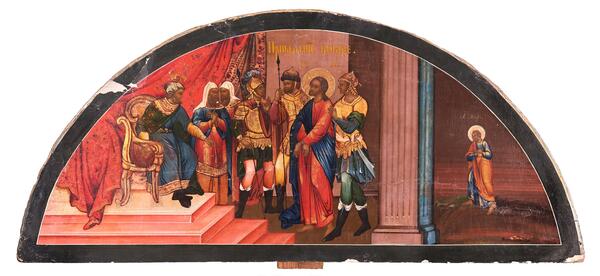
This miniature icon depicts the house of Caiaphas on Mount Zion — the area to the southwest of the Temple, where the palace of King David used to stand, and in the time of Christ the Jewish nobility lived. The high priest interrogates Jesus in the presence of the elders and guards and receives an affirmative answer to the question intended to be a provocation:
In Jewish law, the position of the high priest lasted for the holder’s lifetime. However, as Flavius Josephus testifies, between the removal of the high priest Annas (Ananus) in 15 AD and the beginning of the reign of his son-in-law Caiaphas (Joseph) in 18 AD, three more people held this position: Ismail, Eleazar and Simon. Researchers explain the long reign of Caiaphas (from 18 to 36 AD) by his loyalty to the Roman government and de facto subordination to the more experienced Annas. The numerous miracles performed by Jesus, especially the resurrection of Lazarus, and His authority among people, frightened the Sanhedrin (Jewish Supreme Council): the miracles and His veneration were considered as threats to Sanhedrin’s power and a reason for conflicts with the Roman Empire. The decision to sentence Jesus to death had been made a long time ago, but it required a strong justification.
The trial at the residence of the high priest Caiaphas was held with many violations. The condemned Christ was brought first for interrogation to Annas, who no longer had the right to perform judicial duties, and only then to Caiaphas; the Sanhedrin was not fully convened; the trial was held at Caiaphas’s residence, at night, although the law required meetings to be held only in the Temple, in daylight; moreover, false witnesses were called.
This miniature icon depicts the house of Caiaphas on Mount Zion — the area to the southwest of the Temple, where the palace of King David used to stand, and in the time of Christ the Jewish nobility lived. The high priest interrogates Jesus in the presence of the elders and guards and receives an affirmative answer to the question intended to be a provocation: