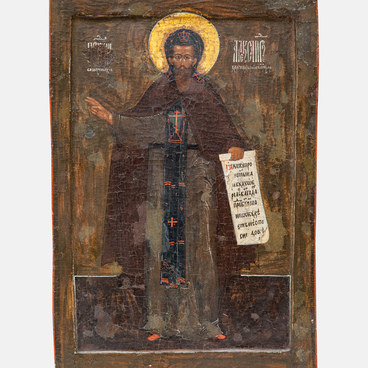
A special genre in Russian icon painting was developed in the 17th century — the so-called icons of founders. Saints appear in them together with the monasteries they founded. As a rule, such images were small in size and intended for pilgrims; however, there also were larger artifacts.
One of the most common iconographic depictions of St. Alexander Oshevensky is an example of “icons of founders”. This composition was so popular that it was used for engravings in the late 17th century.
Despite a somewhat simplified manner of painting, masters sought to accurately convey the architecture and layout of ensembles, depicting the changes that took place over time. Works of this type become a reliable source for experts engaged in reconstructing the appearance of ancient monasteries.
The growth of the Alexander Oshevensky Monastery can be traced by his images of the 17th, 18th and 19th centuries. The earliest ones show a completely wooden ensemble with two tented-roof churches and a bell tower behind log walls. Then the buildings gradually change to stone ones: the icons depict a new cathedral with five domes, a gate church, walls and outbuildings. The presented image was painted during the period when the Oshevensky Monastery was fully rebuilt in stone.
The somewhat schematically rendered space still allows us to easily recognize the monastery: the church “runs over” the northern part of the stone fence. A large tree in the monastery courtyard, a well with a crane, and a stone drainage basin are also depicted in a simplified graphic way.
The figure of St. Alexander to the right of the monastery is emphatically monumental. The saint holds a scroll with the words of his dying exhortation to the brethren. The beginning line “Do not grieve, my brothers…” is a reference to the testament of St. Cyril of Beloozero, whom Alexander revered as his spiritual patron. Such a text is characteristic of the iconography of all Russian saints, and it does not matter whether in fact the deathbed exhortation took place and whether it was similar to the one of St. Cyril.
When this image was created, the tradition of
Northern icon painting was gradually dying away. The manner in which the face
and hands of the saint are painted still echoes some elements of the style that
was characteristic of Ivan Ivanovich Bogdanov-Karbatovsky’s artel. But the
general simplification, flatness of the image, and sharp color combinations
point to another school, close to the folk style of icon painting.