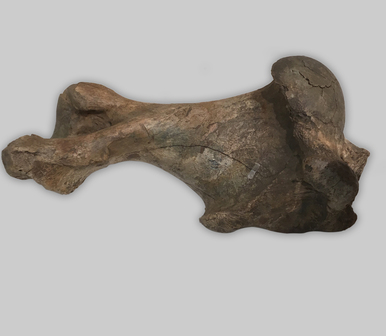
The woolly rhinoceros is an extinct animal species. Its members lived in Europe and Asia more than 200 thousand years ago. Rhinos were second only to mammoths in size: they grew up to 2.2 m in height and weighed up to 3 tons.
Compared to their southern counterparts and modern species, woolly rhinos had shorter tails and ears. So they could reduce heat loss. The animals were protected from the cold by a layer of fat several centimeters thick, a tough skin of 1.5 cm, and on top of it was a double fur coat. The first layer of the fur coat consisted of a soft undercoat, and the second - of a hard wool, hanging over the entire body in long strands.
All together, this was a reliable protection not only from low temperatures and piercing winds of the tundra steppe but also from predators, in nature there were no natural enemies to adult rhinos. Cave lions or bears had no chance of defeating the giant herbivore alone. For gregarious wolves, the rhinoceros could also be too tough. Although rhinos led a solitary lifestyle, they gathered in groups during periods of mating, with these usual living conditions they quite easily lived up to an average of 40–45 years.
Rhinos could become prey for predators or primitive people living nearby only in a weakened state. Therefore, old and sick rhinos usually suffered from attacks, or babies of young female rhinoceroses.
About 20-15 thousand years ago, the climate began to warm. Humidity increased, and this led to open spaces with grassy vegetation, where large herbivorous mammals grazed, become waterlogged and overgrown with forest. During the winter periods, more snow began to fall, which made it much more difficult to obtain food. All these circumstances caused a sharp decline in the number of some herbivores, including woolly rhinos, and after them - large predators.
The earliest bones of woolly rhinoceros found are about 10 thousand years old - these findings were made at the Lugovskoye site in the Khanty-Mansiysk region of Yugra.
Compared to their southern counterparts and modern species, woolly rhinos had shorter tails and ears. So they could reduce heat loss. The animals were protected from the cold by a layer of fat several centimeters thick, a tough skin of 1.5 cm, and on top of it was a double fur coat. The first layer of the fur coat consisted of a soft undercoat, and the second - of a hard wool, hanging over the entire body in long strands.
All together, this was a reliable protection not only from low temperatures and piercing winds of the tundra steppe but also from predators, in nature there were no natural enemies to adult rhinos. Cave lions or bears had no chance of defeating the giant herbivore alone. For gregarious wolves, the rhinoceros could also be too tough. Although rhinos led a solitary lifestyle, they gathered in groups during periods of mating, with these usual living conditions they quite easily lived up to an average of 40–45 years.
Rhinos could become prey for predators or primitive people living nearby only in a weakened state. Therefore, old and sick rhinos usually suffered from attacks, or babies of young female rhinoceroses.
About 20-15 thousand years ago, the climate began to warm. Humidity increased, and this led to open spaces with grassy vegetation, where large herbivorous mammals grazed, become waterlogged and overgrown with forest. During the winter periods, more snow began to fall, which made it much more difficult to obtain food. All these circumstances caused a sharp decline in the number of some herbivores, including woolly rhinos, and after them - large predators.
The earliest bones of woolly rhinoceros found are about 10 thousand years old - these findings were made at the Lugovskoye site in the Khanty-Mansiysk region of Yugra.