Font
Color
Graphics
Изображение точки

To see AR mode in action:

1. Install ARTEFACT app for iOS or Android;

2. Find the exhibition «Peoples of the North»

3. Push the «Augmented reality» button and point your phone's camera at the exhibit;

Скрыть точки интересаПоказать точки интереса
Показать в высоком качестве

Items of Nenets life

0
Open in app
#2
Broom made of loon feathers
#4
A chum is a traditional dwelling of the northern nomadic peoples, which they have been using for thousands of years. The Nenets word “chum” means “hearth”.

Women have always had a central role in the chum. They were the only ones allowed to touch the hearth in the chum, collect and chop wood. Women kindled the fire, talked to it, and predicted the future using the crackle of firewood, smoke, strength and color of the flame. The chum itself, its construction and arrangement were considered women’s work. In the old days, men only threw a bit of snow or earth at the sides of the chum, so that there would be no draft and dust in the dwelling, and they were also responsible for sacred household objects.

The pyramidal shape made the chum resistant to strong winds and blizzards, and the snow slid off the roof. The size of the chum depended on the number of wooden poles that were used as its frame. In winter, the walls were covered with reindeer hides (nyuks), which were cleaned, repaired, cut and handled with care. It took up to 70 deer hides to cover one chum. In summer, the chum was covered with birch bark, but with the advent of modern materials, it was replaced by tarpaulin.

The place that was chosen for the chum depended on the family’s occupation: fishermen stayed on the high banks of the rivers, and reindeer herders were looking for good pastures. The choice of location also depended on the season: in summer, the tent had to be exposed to the winds to ward off annoying insects, and in winter, on the contrary, the chum had to be protected by a dense forest.

A chum was assembled and disassembled in under an hour, there were no unnecessary things in it — everything had a practical purpose. Wardrobes and beds were rare: people slept on reindeer hides and in outerwear. The furniture consisted only of a sacred chest with home idols and a small table: they were easy to transport. To heat a chum, a fire was made right on the ground or snow — the smoke came out through a small hole at the top. It was very smoky from the fire in the tent, and there was additional soot from a tallow candle. Today, a small stove is used to heat the chum.

To keep the chum clean, women used a broom made of loon feathers — two wings of a bird, which were tied together and attached to a wooden handle with a willow vine.
#3
Name: Broom made of loon feathers
Date of creation: the 20th–21st centuries
Place of creation: Yamalo-Nenets Autonomous Okrug, Russia
Technique: feathers, wood, vine
Dimensions: 48×32 cm
#5
Nenets cradle
#8
The birth of children has always been an important event for the Forest Nenets, who lived in harsh natural conditions. It was customary for them to celebrate their birthday only once in their lives, on the day the baby was born. It was a day of great joy for parents and relatives: “In the old days, on such an occasion, a shaman was invited to initiate the child into the human world and protect it from evil spirits.” When a boy was born, a young deer was slaughtered. The guests brought expensive gifts: cuts of calico or cloth so that the mother could sew a cover for the cradle, warm diapers made of deer beard, birch bark pieces for the cradle, matches, a bag with food — a piece of deer fat, bread and sugar. Rich relatives, as well as mother and father, gave the newborn a young deer.

Children spent their first year of life in the cradle. They slept and were awake there, transported on a sled and in a boat during relocations. Regardless of the number of children, there was only one cradle in a Nenets family; it was made for the birth of the first child and passed on to each next child until it wore out. Each nation has developed its own traditions of making a baby cradle, and the design of the Nenets cradle is still in use. It has an oval shape and a flat bottom, in ancient times it was made of birch or pine and fastened with leather strips, and with the advent of modern materials, the Nenets began to use sheet plywood.

There are holes in the side of the cradle through which ropes or leather straps are passed to secure the child. In the bottom, from the side of the baby’s legs, there is a special ledge, to which a rope is tied to swing the cradle, and loops are made on the sides for hanging the cradle from the pole of the chum (a Nenets dwelling) — similar to the Russian cradle. On top of the cradle, there is an arc for fastening the canopy, which protects the baby from snow, wind and insects. Before the advent of modern baby care products, a soft skin of a young deer, sewn in an envelope, was laid in the cradle, and a special birch bark tray was placed above the baby’s legs to protect the blanket from getting wet. The Nenets have long used colored cloth, metal rings, wooden amulets and beads to decorate a baby’s cradle. The cradle was one of the main objects of the house and was valued as a work of art.
#6
Name: Nenets cradle
Date of creation: the second half of the 20th century
№: 5901964 
Place of creation: Yamalo-Nenets Autonomous Okrug, Russia
Technique: assembly, weaving, wood, leather, metal
Dimensions: 66×30 cm
#7
Women’s boots — kisy with chizhy
#10
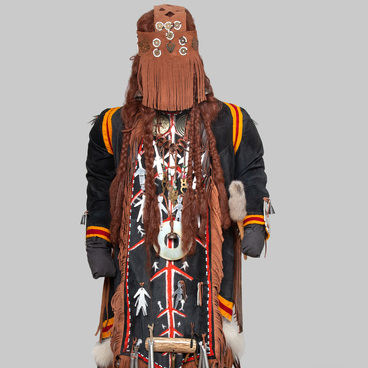
Fur clothing and shoes are a prerequisite for survival in the Arctic climate for the northern peoples. All the details of the Nenets national costume are carefully thought out: it protects from frost, blizzard and strong wind, it is convenient to work in it and it has a sacred meaning. Women’s outerwear is called a “panitsa” or “yagushka”. The design resembles a loose shirt with a slit in the front. In summer, women wear a panitsa made of cloth, and in winter — of deer fur. Sewing clothes and shoes is the main female craft of the northern peoples, which girls learn from early childhood.

Nenets national fur shoes are called “kisy” or “pimy”. These are high fur boots, which are light, warm and comfortable when walking for a long time, even in deep snow. The kisy consist of stockings sewn with fur inside — they are called “chizhy” — and upper boots made with fur outside. Boots are sewn from the fur from the lower leg of a deer, it is distinguished by a stiff pile. About eight pieces of such hide are needed to make a pair of women’s kisy. The cut of women’s pimy differs from men’s, and the pattern is located much lower — perhaps because women’s clothing is longer and covers most of the boots.

Women’s boots never have soles of deer foreheads, as on men’s shoes — this is due to the religious beliefs of the Nenets. Unlike men’s kisy, women’s kisy are tied not under the knee, but only attached with straps to the belt. The ability to sew seven fur strips into a decorative mosaic to decorate pimy is considered to be a remarkable skill. White kisy are deemed especially beautiful and rare, because the white deer is a sacred animal, which in ancient times was dedicated to the main Nenets god Num.

Applique, embroidery or scraping are used to decorate kisy. The technique depends on the skill and taste of the woman, as well as on the character of the person for whom the shoes are made. Women’s kisy are often decorated with a diamond-shaped pattern: “heads”, “calf horns” or “chum”. Girls’ kisy have a pattern of “hare ears”, which informs that the shoes belong to a baby, timid as a hare. The modern ornament includes tassels, which makes the pattern clear and bright.

To store women’s boots, a suede bag is sewn. It lies on a special sled separately from other things. The Nenets believe that a woman’s step is sacredly unclean and leads to the Lower World, so she is forbidden to step over various objects, especially those related to reindeer husbandry.
#9
Name: Women’s boots — kisy with chizhy
Date of creation: the 20th–21st centuries
Place of creation: Yamalo-Nenets Autonomous Okrug, Russia
Technique: fur processing, sewing
Dimensions: 64×25 cm
#12
Nenets men’s boots — kisy
#13
In winter, the air temperature in Western Siberia drops to –50 degrees Celsius, so warm clothes and shoes are mandatory for survival. The Forest Nenets women have long been engaged in the manufacture of clothing and learned sewing skills from their elders in the family since early childhood. The main material of Nenets clothing is deer skins. In winter, the Nenets wear double-sided fur shoes, which are called “kisy” or “pema”.

The Ayvasedo family know an old riddle regarding the layering of traditional Nenets shoes: “When going out one dives into a friend.” The fact is that fur stockings (chizhy) are inserted into the kisy. The stockings are sewn from winter calf skins with fur inside. Kisy are worn over stockings and tied under the knee with a leather strap or a colored ribbon woven from woolen threads. Insoles for boots are made of dry grass.

The top of the Nenets boots is high, up to the thigh, with an obliquely cut edge. It is sewn from strips of fur from the lower leg of a deer. It is secured to the sole with the help of two rows of straps: the lower one, which wraps around the entire foot from the heel to the nose, and the upper one in the form of wedges of different lengths. Kisy are sewn the same for both feet, and the shape of the right and left boots is formed during the process of wearing them.

Nenets shoes not only keep one’s feet warm and are resistant to northern winds, but also remain waterproof because artisans have treated the material with smoke. The sole of men’s shoes is sewn from the skin removed from the joints of the legs or the forehead of a deer. The pile on the sole is positioned in the opposite direction so that the shoes are less slippery and it is easier to walk on snow. The Nenets sew parts of boots with tendon threads.

It is possible to distinguish Nenets women’s shoes from men’s shoes by the pattern that goes down from top to bottom. The shoes are decorated with stripes — these are symbols of prohibitions: it is forbidden to steal, kill, swear, and offend the weak. For a long time, the ornament replaced writing, accompanying a person from birth to death. The image on clothes and objects was designed to mark a person’s place in society, protect people from adversity, and bring good luck. The ancient traditions of the ornament of women’s and men’s winter shoes still exist among the Nenets.
#11
Name: Nenets men’s boots — kisy
Date of creation: the second half of the 20th century
Place of creation: Yamalo-Nenets Autonomous Okrug, Russia
Technique: sewing, deer hide, embroidery
Dimensions: 76×31 cm
#14
Chum — traditional Nenets dwelling
#16
A chum is a traditional dwelling of the Forest Nenets. The Nenets word “chum” means “hearth”. Only a woman could touch the hearth in the chum, collect and chop wood. She kindled the fire, talked to it, foretold future events by the crackle of firewood, smoke, strength and color of the flame. A fire was made inside the chum on the ground or in the snow. The construction of the tent was also women’s work, hence the popular saying: “An unmarried Nenets, even having a sufficient number of deer, but not a single woman in the family, cannot travel, since there is no one to put up the chum.”

The chum is simple in design and well adapted to a nomadic lifestyle. It is quickly assembled and disassembled without losing strength and warmth. It is cone-shaped so it remains stable during winds and blizzards, and the snow does not linger on it and rolls off a steep surface. There is a smoke hole at the top of the chum, and the heat from the hearth, rising up, lingers on the sloping walls and descends in a circle. In addition, the conical shape is a symbol of human power, holiness and special dignity.

A Nenets chum is a dwelling, but not a house in the conventional sense. The house for the northern nomads is not limited to the walls of the lodging for the night, but includes the entire inhabited territory, along which the reindeer herd is driven to a new pasture. The main occupations of the Nenets are reindeer herding, hunting and fishing. Depending on the occupation, the family chooses a place for a seasonal camp — high riverbanks or pastures with reindeer lichen.

The choice of a place for putting up the chum also depends on the time of year: in summer, the place should be open and well-ventilated so that mosquitoes and midges do not bite people and animals. In winter, the Nenets choose forest clearings surrounded by tall trees to protect people from cold winds. In winter, the chum is covered with nyuks — these are the hides of reindeer, tightly sewn with tendon threads. In the summer, nyuks are knocked out, cleaned, repaired, packed and stacked on sleds until the next winter. In the old days, the chum was covered with birch bark in the summer, but today this technology is almost lost and the Forest Nenets use tarpaulin.
#15
Name: Chum — traditional Nenets dwelling
Date of creation: the second half of the 20th century
Place of creation: Yamalo-Nenets Autonomous Okrug, Russia
Technique: sewing, planing
Dimensions: 350×300×300 cm
#18
Women’s handbag for needlework — tushan
#19
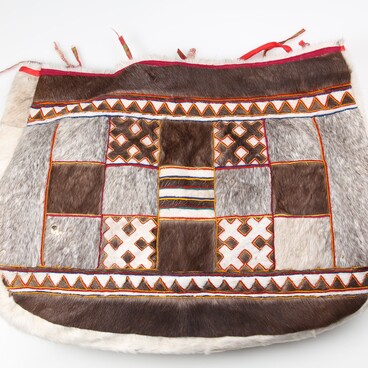
Soft bags and bags made of reindeer skin are among the most popular attributes of the nomadic Nenets. The bags vary in size and are used to store and transport various household items: clothes, shoes, underwear, and tools. A tushan is a small women’s bag for sewing accessories. Since olden times, a Nenets woman made clothes for the whole family, as well as the walls of a chum tent. A tushan is a symbol of traditions that have been passed down from mother to daughter for many centuries.

A girl receives her first handbag for needlework at the age of seven and keeps it all her life as a talisman. In ancient times, the northern people endowed every detail of the bag with meaning: one side of it meant day, and the other side meant night. They sewed tushan bags of suede or skins from deer foreheads, and the places of the eye sockets were embroidered with cloth piping.

Handbags were decorated with mosaics, embroidery and appliqué. The Nenets ornament is “patterned written language”, which shows the connection between a deer, a chum and a person. This motif was also performed on the tushan from the collection of the Purovsky Museum. The chum is reflected in the eyes of a deer, and a person sees a deer from the chum. The white part of the bag is snow, the patterns are people, the triangles are chum tents. The pattern on the deer’s forehead indicates that it is the most important being in the tundra. A border of white fur is the horizon, and cloth strips are roads and paths, traces of people, deer and animals.

A tushan handbag symbolized the dignity of a woman and her work — just like a belt with a knife, working tools and amulets meant the same for a man. Women put needle cases, thimbles, tendon threads, shreds of cloth, beads and rings for decoration into the tushan. A ceremonial bag with pieces of fur, dried entrails and bones of an otter was attached to the tushan.

A tushan handbag has its own owner or spirit — it is a spider. It tirelessly weaves its web, just as a woman mends and sews clothes for her family every day. If a woman killed a spider or tore its web, she could lose all her sewing supplies and be left “without hands.” In Nenets, the spider is called “nimi kata” — “grandmother of needles.”

A young wife takes her tushan with her when she moves into her husband’s house. If the groom is poor, cannot pay bridewealth and steals her against the will of her parents, she gets no dowry — no deer, no clothes, and no shoes. Such a bride is called “tushchanli minena”, which means “bringing only her women’s handbag to the groom’s family.”
#17
Name: Women’s handbag for needlework — tushan
Date of creation: the second half of the 20th century
Place of creation: Yamalo-Nenets Autonomous Okrug, Russia
Technique: sewing, embroidery, fur mosaic
Dimensions: 30,5×23,5 cm
#21
Birch bark container for berries
#22
Household utensils are an important part of the material culture of the people, which helps to understand their history and way of life. Nenets household items are adapted for nomadic life. The Nenets did not engage in pottery — they used affordable and durable wooden utensils. The Nenets also used the top layer of birch bark to make dishes, spoons, containers and boxes.

The Nenets carved spoons from different types of wood, depending on their purpose. The spoons differed in the length of the handle and the depth of the cavity. The scoop for fish and meat was up to 60 cm long, which made it possible to stir food while cooking in a large cauldron over a fire. The spoon for collecting fat was half as long, but four times as deep.

The Nenets used large trays and dishes to store meat and fish. Boiled fish or meat was put on a large wooden dish in the shape of a boat with a flat bottom. The dish was usually 25 cm wide and 50 cm long. It was handy and very stable.

Many peoples have long stored drinks and food in birch bark containers. Birch bark is naturally antibacterial, it is waterproof, but it allows air circulation. Products in birch bark boxes retain their temperature and stay fresh for a long time. People take birch bark containers when they go to pick berries: cloudberries, cranberries, lingonberries, blueberries, and bilberries. The northerners use berries to make drinks, teas, kissels (viscous fruit drinks), and jam. They also serve them with fish and meat. For future use, the berries are dried, preserved and pickled.

Among the Nenets, women have always been engaged in harvesting birch bark and making dishes. The collected birch bark was soaked in hot water so that the dry brittle bark became soft and elastic. Small utensils were made from raw birch bark that had been kept in dewy grass. If large pieces of birch bark were needed, they were sewn from separate parts with tendon threads.

When Russian settlers came to Yamal, wooden utensils gradually began to fall out of use, enameled and plastic containers appeared instead. Traditional scoops were replaced with ladles, wooden spoons with metal ones, teapots with thermoses. Birch bark containers are still used by the Nenets, and this tradition is returning to Russian everyday life as well.
#20
Name: Birch bark container for berries
Date of creation: 1976
Place of creation: Yamalo-Nenets Autonomous Okrug, Russia
Technique: birch bark processing
Dimensions: 50,5×27,5 cm
#24
Kettle
#25
The Nenets are a northern nomadic people who often move from place to place with their entire household and a herd of domestic deer. In a foldable Nenets house — a chum — each thing has its own place and purpose, and unnecessary items only make the process of moving more difficult. All tools and utensils in the traditional culture of the Forest Nenets are aimed at cooperation with nature, on which a person in the tundra completely depends. The usefulness of the object for the Nenets was determined by the unity of its symbolic and practical meaning.

The very process of making things, giving them a certain shape, color, and ornamentation is also important. For example, while sewing clothes, women utter an internal monologue or sing a song dedicated to the future owner of the item. In Nenets fairy tales and myths, household items have supernatural powers and abilities. This is also explained by shamanism, the traditional belief of the Nenets, according to which each part of living and inanimate nature has its own spirit. The spirits of things and phenomena are in constant connection with people and influence their life.

Metal tableware began to appear among the Forest Nenets in the 17th century, with the beginning of active commodity exchanges between the indigenous population of the North and Russian settlers. Teapots, cauldrons and spoons became the first objects of the new life. They were made of copper, cast iron or iron; teapots and cauldrons had no lids, but had an arc-shaped handle for hanging over a fire. Almost every Nenets family had a cauldron — it was protected and treated with respect. A burning hearth in a dwelling and a cauldron full of meat or fish on the fire were a symbol of the family’s stability and prosperity. If people “boiled the cauldron” in the evening, it meant that they lived the day well and had food.

Cauldrons came in the form of a round basin with a wide flat bottom and low sides. The Forest Nenets had preserved traditional sets of household utensils until the late 1930s. Gradually, wooden dishes began to go out of use. Modern Nenets use enameled and plastic containers. Traditional scoops have been replaced with ladles, and wooden spoons have been replaced by metal ones. Instead of copper kettles and cauldrons, enameled buckets and thermoses are now used.
#23
Name: Kettle
Date of creation: the 1980s
№: 6372877
Place of creation: Yamalo-Nenets Autonomous Okrug, Russia
Technique: metal processing
Dimensions: 19×35 cm
#26
Nenets women’s handbag
#28
The Nenets are a northern nomadic people. In their culture, every household item has a practical function. Some of the most popular attributes are “patku”, padded bags and deerskin sacks. They are used to store fur taken from the legs and head of a deer, blanks for sewing fur shoes, a supply of wood shavings and feathers.

Large bags are also used as pillows and insulation in the chum. Patku bags are sewn from two identical halves, often in the shape of a crescent. The front side of the bag is elegantly decorated, and the time of its manufacture can be determined by the complexity of the technique. Nenets decorative craft began with the collection of furs of various colors and progressed to embroidery with a checkerboard pattern and mosaic ornament. This is also evidenced by an old Nenets riddle about the bag: “an old woman from a hundred patches.”

Nenets bags come in several types in terms of size and purpose. The average size of fur bags is 40×60 cm. Paired straps are sewn along the mouth for tying, and the edges are trimmed with a strip of rovduga — buckskin. To store women’s things — shoes and underwear — the Nenets use bags, which are called “shupaty”. This is an important attribute of personal female property. In the chum, shupaty have a strictly designated place in the women’s half of the dwelling — on the edge of the bed in front of the entrance to the chum.

In small handbags of another type — tushany — the Nenets store handicraft accessories: needles, thimbles, shreds of fur, and tendon threads. Tushany are sewn from two oval cuts of fur, and the side seams are decorated with stripes of colored leather or cloth. Every Nenets girl learns how to sew at the age of seven and gets her own tushan bag to store her sewing items. Traditionally, this handbag accompanies a woman in a wedding caravan — it rides with the bride in the same sled. Nenets girls consider a handicraft bag to be their talisman and a friend with whom they can share all the secrets.

According to northern beliefs, it is forbidden to keep a handicraft bag empty, and it has its own patroness — nimi kata. The forest Nenets associate her image with a spider that endlessly weaves lace, just like a woman sews all her life to dress her family and keep them warm.
#27
Name: Nenets women’s handbag
Date of creation: 2001
№: 19260902
Place of creation: Yamalo-Nenets Autonomous Okrug, Russia
Technique: fabric, deer skin, sewing
Dimensions: 19×35 cm
#30
Mat
#32
The dwelling of the nomadic Nenets people is called “chum”. It is quickly dismantled and set up again, and consists of wooden poles and sewn deer skins. The interior of the chum is made of natural materials: leather, wood, wool, birch bark, and fur. A chum is pitched directly on the ground or in the snow. From ancient times, there are traditions of making floor coverings from natural materials. Even before people learned how to process animal fur and spin yarn, they paid attention to how strong some plants were. People began to use the fibers of grasses, bushes and trees for their everyday life.

Home mats made from vegetable fibers are known in Russian as “tsinovka”. This word comes from the incorrect pronunciation of the French word “china” — the so-called rugs from China, which Europeans began to use in the 19th century in the wake of the fashion for the East. Mats are woven by hand — this is a laborious and painstaking process. The Nenets use dried sedge and thin young birch trunks to make mats that cover the floor in the chum.

Nenets mats can be round and rectangular. According to one of the simplest techniques of weaving a mat, strips of grass need to be sewn into a large piece. The Nenets make narrow bunches of dried sedge or willow twigs, cut off pieces of the required length from them and connect them with tendon threads.

The Nenets choose new places for the camp in accordance with their main occupation: reindeer herders look for pastures for domestic reindeer, and fishermen look for reservoirs for fishing. Having chosen the place, all members of the Nenets family begin to settle. Traditionally, women and teenage girls set up the chum. After covering the chum with deer hides, they begin to organize the interior space of the dwelling.

Logs are placed in the center on both sides of the hearth: they protect the floor from fire. Then boards are put on top. Between the floorboards and the walls of the chum, the Nenets make a bed: spruce branches are put under mats made from young birches. On top, they lay a softer mat, made of grass, bags with deer fur, deer hides and a feather bed. Pillows are placed against the wall of the chum, and the family sleeps with their feet to the hearth. As a rule, the Nenets use a women’s yagushka as a blanket.
#29
Name: Mat
Date of creation: the 20th–21st centuries
Place of creation: Yamalo-Nenets Autonomous Okrug, Russia
Technique: assembly, weaving
Dimensions: 70×66 cm
#31
read morehide
00:00
00:00
1x

Items of Nenets life

0
Point your smartphone camera to open in the app
Share
VkontakteOdnoklassnikiTelegram
Share on my website
Copy linkCopied
Copy
Open in app
To see AR mode in action:
  1. Install ARTEFACT app for 
  2. iOS or Android;
  3. Find and download the «Paintings in Details» exhibition
  4. Push the «Augmented reality» button and point your phone's camera at the painting;
  5. Watch what happens on your phone screen whilst you flip through the pictures.
 
We use Cookies
Cookies on the Artefact Website. We use cookies to ensure that we give you the best experience on our website. If you continue without changing your settings, we'll assume that you are happy to receive all cookies on the Artefact website. However, if you would like to, you can change your cookie settings at any time.
Learn more about useHide
Content is available only in Russian

X

Нашли опечатку?...

%title%%type%