Font
Color
Graphics
Изображение точки

To see AR mode in action:

1. Install ARTEFACT app for iOS or Android;

2. Find the exhibition «Manor House in the 19th — Early 20th Centuries»

3. Push the «Augmented reality» button and point your phone's camera at the exhibit;

Скрыть точки интересаПоказать точки интереса
Показать в высоком качестве
#17
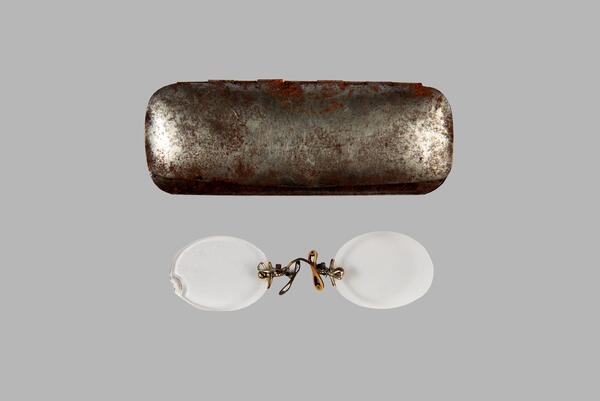
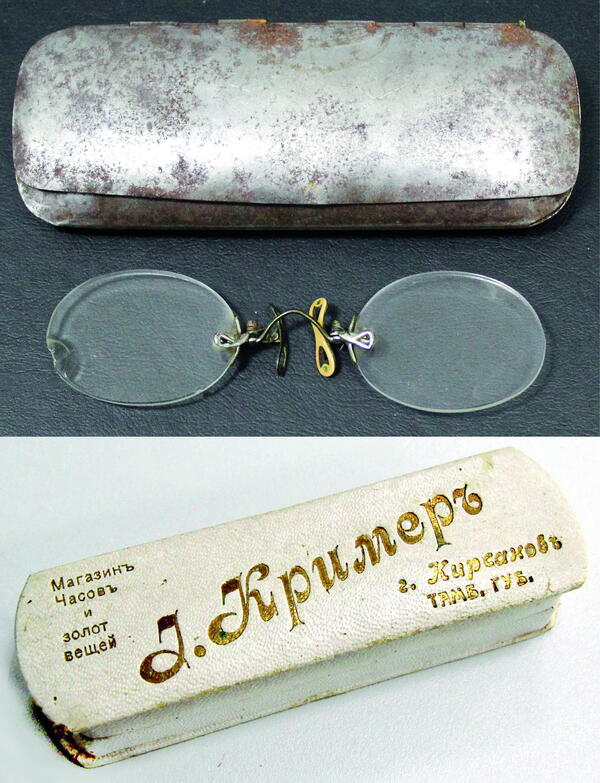
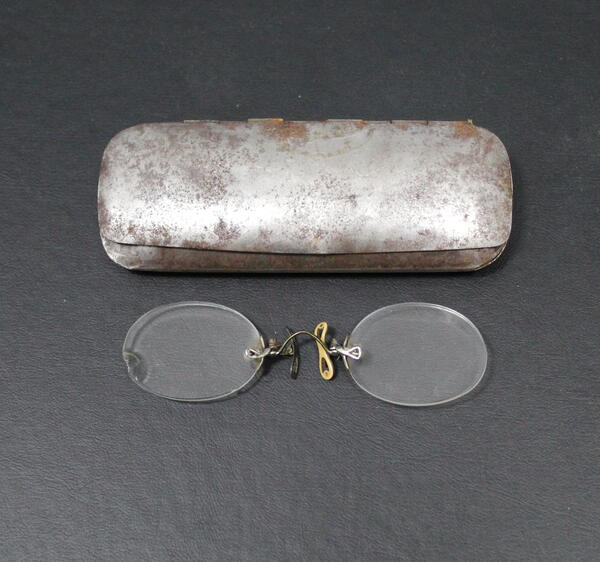
Pince-nez in a metal case
#15
The world of eyewear at the end of the 19th century was very different from today’s and was flooded with all sorts of accessories. These included pince-nez, spectacles and monocles. In the 19th century, poor eyesight became a real problem for educated people. Constant reading (often in insufficient light) gave rise to an “epidemic” of myopia, even among the very young. A gymnasium student wearing spectacles was commonplace at the time.

Gradually glasses became associated with an intelligent, intellectually developed, interesting person.
#18
He decided that he would impress them the most if he started wearing glasses. Having told his mother that his eyes were getting tired, the very next day he burdened his sharp nose with the weight of two smoky glasses. Through these glasses everything on the ground seemed strewn with a light layer of grayish dust, and even the air, while still transparent, became grayish. The mirror convinced Klim that the glasses made his thin face both look imposing and even more intelligent.
There is a remarkable fragment in Maxim Gorky’s novel “The Life of Klim Samgin”
#3
The memoirs of Anastasia Tsvetaeva (Marina Tsvetaeva’s junior sister) contain descriptions of the glasses worn in this family: “My father wore narrow gold glasses and my grandfather — those with tortoiseshell frames.” Round lenses were common as well as oval. Glasses were kept in cases of oval oreliptical shape. Cases were made of papier-mache, cardboard and thick leather. Expensive cases were covered with morocco.”

The pince-nez became a very fashionable accessory and an article of daily use, although it first appeared in the 16th century. Pince-nez (from the French pince-nez, from pincer “to pinch” and nez “nose”) are eyewear without earpieces, held on the nose by a spring that clamps the bridge of the nose. Originally the pince-nez were round to be followed in 1841 by oval pince-nez ones. The popularity of this optical device is evidenced by museum exhibits preserved in various museums in Russia and around the world.

The Kirsanov Local History Museum has preserved several pairs of eyewear belonging to the Boratynsky family. According to the recollections of Mikhail Andreevich Boratynsky, his father-in-law, Alexey Mikhailovich Zhemchuzhnikov (one of the authors of Kozma Prutkov’s works) was short-sighted in his youth and wore pince-nez. But later, according to Mikhail Andreevich, he read without glasses until his old age. However, the Kirsanov Local History Museum keeps a photo of Aleksey Mikhailovich Zhemchuzhnikov advanced in age and wisdom, where he is captured wearing a pince-nez.
#21
Name: Pince-nez in a metal case
Date of creation: the late 19th century
Technique: glass, metal, stamping, factory production
Dimensions: 2,8×9,5×1 cm
#19
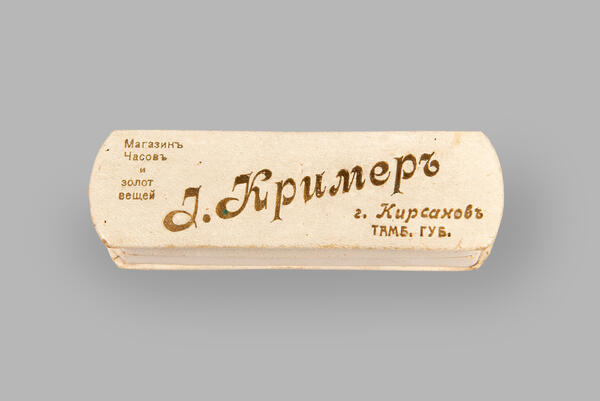
Watch case by J. Krimer
#5
The museum exhibit — a watch case — illustrates an interesting page in the life of the pre-revolutionary town of Kirsanov. The inspection log of commercial and industrial establishments in Kirsanov district for 1915 stated that the shop selling gold and silverware owned by a petty bourgeois Josel Khaimovich Krimer and his watch and silverware shop were located in Mikhailovskaya (now Sovetskaya) Street. The shop had an income of 2,000 rubles a year, and trade in silver and goldware brought 25 thousand rubles annually. Nearby was the hat workshop of Leda Krimer (possibly the wife of J. Krimer). Industrial address-calendar “All Russia” for 1912 said that Josel Krimer’s shop was located in Bolshaya Street at that time. According to this calendar, there were two watch shops in Kirsanov in 1912, one belonging to Krimer, and the other to Berka Schlemovich Bezprovanny. In Tambov Governorate in those days only large towns had watch shops: Tambov, Lipetsk, Morshansk, Kozlov (Michurinsk), Borisoglebsk and Kirsanov. At that time, as nowadays, a wristwatch was seen not only as a timekeeping device, but also as a status symbol, so it is not surprising that the rich merchant town of Kirsanov got its own watchmaker’s workshop and shops selling watches and related goods. In antique shops both men’s and women’s watches were available featuring the inscription on the dial “Krimer. Kirsanov”.

The museum keeps a men’s pocket watch made by Josel Krimer in Kirsanov. In those days, men preferred pocket watches on a chain; wristwatches were worn only by women. It was believed that a man’s wristwatch would not stand up to the usual rhythm of human life, not to mention such active male activities as hunting, sport or war. Men’s attitudes towards wristwatches are illustrated by a well-known saying of the time: “I’d rather wear a skirt than a wristwatch”. For this reason, wristwatches were produced by only a handful of firms. They were almost all small ladies’ models on a thin bracelet or chain. Judging by the size of the case preserved in the Kirsanov Local History Museum, the watch in it was just that — a small ladies’ watch.
#22
Name: Watch case by J. Krimer
Date of creation: the late 19th century
Place of creation: Kirsanov, Russian Empire
Technique: cardboard, stamping, printing
Dimensions: 3×8,5×2 cm
#20
read morehide
00:00
00:00
1x
Point your smartphone camera to open in the app
Share
VkontakteOdnoklassnikiTelegram
Share on my website
Copy linkCopied
Copy
Open in app
To see AR mode in action:
  1. Install ARTEFACT app for 
  2. iOS or Android;
  3. Find and download the «Paintings in Details» exhibition
  4. Push the «Augmented reality» button and point your phone's camera at the painting;
  5. Watch what happens on your phone screen whilst you flip through the pictures.
 
We use Cookies
Cookies on the Artefact Website. We use cookies to ensure that we give you the best experience on our website. If you continue without changing your settings, we'll assume that you are happy to receive all cookies on the Artefact website. However, if you would like to, you can change your cookie settings at any time.
Learn more about useHide
Content is available only in Russian

X

Нашли опечатку?...

%title%%type%