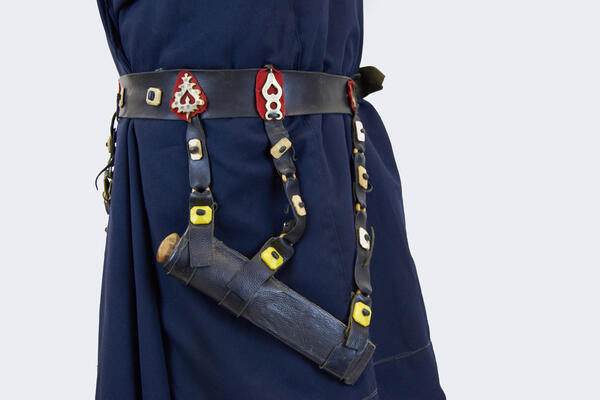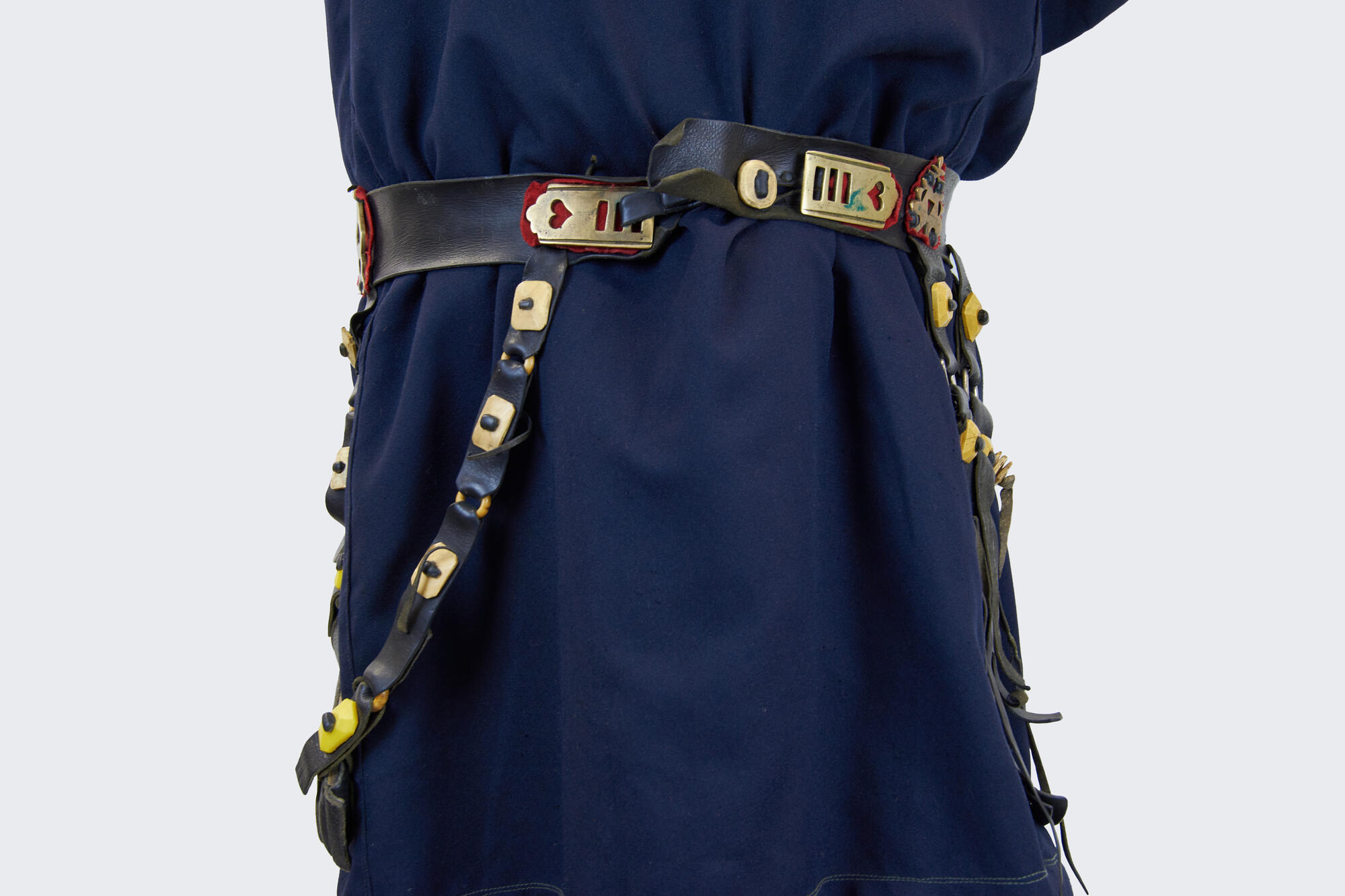


A man’s belt, tasma, is a symbol of an experienced hunter, an article of clothing combining the sacred and the material. It is an amulet and a passport of a man, it is worn at any time of the year be it with winter malitsas sewn from thick fur, or with summer ones, made of fine threadbare fur or cloth. In summer the belts are taken down, and in winter they are loosened again. To adjust the belt to the girth there is a reserve length, gathered in the middle of the belt in a tie with a leather cord, pulled through two holes and secured with buttons. Apart from hunting, the belt was worn at festive celebrations and during military action. The hunting belt was a sign of a man’s dignity. A knife (har) in a sheath (har’ se’, harnze’) was attached to the belt on metal chains on the left, a grindstone (si) in a leather sheath (siya’ se’) was attached to the right and tibiako, a bear’s fang, was attached to the back. According to the Nenets belief, it serves as a talisman against evil spirits and brings good luck in hunting. The belt fastens with a metal buckle. The malitsa is very wide and when fastened with the belt, it creates a kind of a pocket hanging over it that can be used for storage. This is where a pouch of tobacco, as well as a pipe and other necessary items are kept.
Belts are still an indispensable accessory of men’s clothing of the nomadic peoples of the North. Modern tradition prescribes wearing a sheath on the right side, which can be attributed to the way of getting on a sled. A reindeer herder sits on them on the left side, his right leg is placed on the sled and his left leg is resting on the skid. Thus, the knife, being on the right side of the belt, somehow rests on the sled and does not dangle. It prevents it from hitting branches and receiving other mechanical damages while traveling. This way, the sheath will not be clogged with snow, the knife will not fall out of it and will not get lost.
The base of the exhibit is made of calfskin. At equal distances the strap of the belt is decorated with copper patches with an openwork pattern.
A tasma is a long-lasting accessory, passed down from generation to generation, from father to son. It takes a long time to make, step by step and exclusively by hand. You can tell a lot about the owner by their tasma. Men only occasionally pass it on to one another, as a rule within the family.