Each soldier that fought in the Great Patriotic War was issued a water-proof poncho tent. These garments were made out of sturdy, highly resilient fabric. As the name implies, the ponchos could transform into single-person tents; more than that, they could be turned into sleds or stretchers for carrying the wounded, if required. Such versatility made the ponchos the irreplaceable companions of soldiers on the front lines.
Poncho tents also find active use in the modern Russian army. They are most commonly made from sturdy tarp. The standard dimensions for a single tarp cut is 180 by 180 centimeters. The natural leather grommets sewn into the cut’s corners allow the soldier to stretch the poncho over ropes or pegs. This way, the garment can transform into a tent, secured, for instance, under the forest canopy.
There also are two wooden button fasteners sewn to the two sides of the square. They correspond to overstitched loops on the other two sides: this allows for linking several ponchos together.
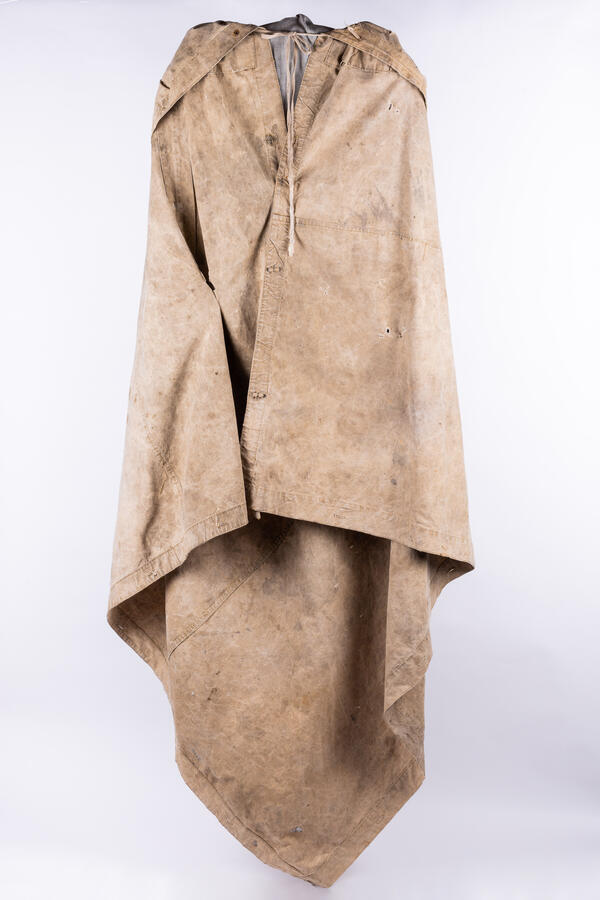
The poncho exhibited at our museum dates back to the middle of the 20th century. It used to belong to Nazar Nadzhmi, a renowned Bashkir poet and playwright. Nazar Nadshmi was born Khabibnazar Nazmutdinovich Nazmutdinov, on February 5, 1918, in the tiny community of Minishty, in what is today the Dyurtyulinsky District. In 1938, he enrolled at the Bashkir State Teachers' Training University named after K. A. Timiryazev. He began his studies at the Faculty of Language and Literature, but was conscripted into the army in 1941, presently finding himself on the front lines of the Great Patriotic War. As the poet himself would later recall, he used this very tent for sleeping, concealing himself in the trenches, and finding shelter from the rain and freezing wind. Once the war was over, he started using this waterproof tarp for covering his flowers.
Nazar Nadzhmi did not receive his university diploma until 1946, after the war had ended. Between 1947 and 1969, he stood at the helm of the the Bashkortostan Writers' Union. He worked closely with the Soviet Bashkortostani paper, the Literary Bashkortostan journal, and Khenek, a satirical magazine. His creative achievements were acknowledged with several prestigious awards, including the Maxim Gorky State Award.
Poncho tents also find active use in the modern Russian army. They are most commonly made from sturdy tarp. The standard dimensions for a single tarp cut is 180 by 180 centimeters. The natural leather grommets sewn into the cut’s corners allow the soldier to stretch the poncho over ropes or pegs. This way, the garment can transform into a tent, secured, for instance, under the forest canopy.
There also are two wooden button fasteners sewn to the two sides of the square. They correspond to overstitched loops on the other two sides: this allows for linking several ponchos together.
The poncho exhibited at our museum dates back to the middle of the 20th century. It used to belong to Nazar Nadzhmi, a renowned Bashkir poet and playwright. Nazar Nadshmi was born Khabibnazar Nazmutdinovich Nazmutdinov, on February 5, 1918, in the tiny community of Minishty, in what is today the Dyurtyulinsky District. In 1938, he enrolled at the Bashkir State Teachers' Training University named after K. A. Timiryazev. He began his studies at the Faculty of Language and Literature, but was conscripted into the army in 1941, presently finding himself on the front lines of the Great Patriotic War. As the poet himself would later recall, he used this very tent for sleeping, concealing himself in the trenches, and finding shelter from the rain and freezing wind. Once the war was over, he started using this waterproof tarp for covering his flowers.
Nazar Nadzhmi did not receive his university diploma until 1946, after the war had ended. Between 1947 and 1969, he stood at the helm of the the Bashkortostan Writers' Union. He worked closely with the Soviet Bashkortostani paper, the Literary Bashkortostan journal, and Khenek, a satirical magazine. His creative achievements were acknowledged with several prestigious awards, including the Maxim Gorky State Award.