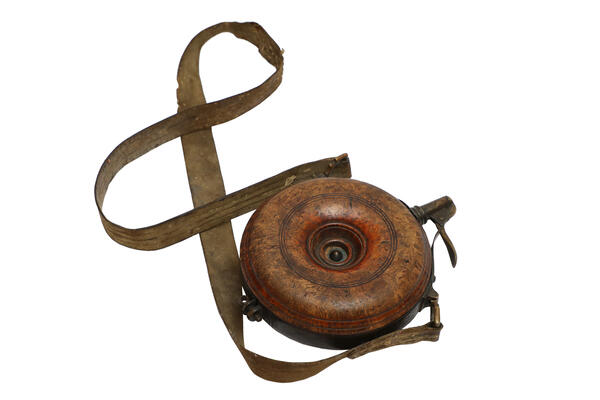
The Verkhnyaya Pyshma Historical Museum houses a powder flask — a container for gunpowder, a must-have for the 19th-century hunters.
Gunpowder was expensive and had to be stored carefully. Therefore, powder flasks stood out among the common hunting equipment — they were often made from expensive materials and decorated in exquisite ways, including carvings.
The exhibit from the museum collection was made from a solid burl — a growth on a birch. Such wood was rare and had unique texture and pattern, so products made of burl were expensive.
The weapon was charged with bullets and gunpowder, which amplified the shot. To prepare the gun for the hunt, the hunter first put the gunpowder from the powder flask into a special bone measuring cup, and then into the barrel. Bullets, shots and wads were put on top; they were carried in separate canvas bags.
In central Russia, guns appeared in the middle of the 15th century. They were mainly used by Cossacks, archers and hunters. When the Urals and Northwestern Siberia became part of the Russian state in the 16th century, the locals still preferred to hunt with a bow and arrow. The incoming population brought hunting rifles, and by the 19th century they almost completely replaced traditional hand bows.
In Russia, artisans created handmade powder flasks and sold them on city markets. There were two types of flasks: made from a cow’s horn and from wood (the second type is exhibited at the museum). In addition, souvenir powder flasks were made from leather, brass and other metals. Craftsmen decorated them with carvings, chasing, and painted them.
The shape of the powder flask was the same in all regions. It was a round flat container with a metal or copper rim. On the sides of the container were two rings, to which a belt was fastened to carry the powder flask on the shoulder or belt. There was a hole in the middle, which was tightly closed with a metal plug.
Powder flasks became obsolete at the end of the 19th century, when unitary cartridges with a gunpowder charge appeared in Russia. In remote areas where cartridges were expensive, powder flasks were used until the 1920s.
Gunpowder was expensive and had to be stored carefully. Therefore, powder flasks stood out among the common hunting equipment — they were often made from expensive materials and decorated in exquisite ways, including carvings.
The exhibit from the museum collection was made from a solid burl — a growth on a birch. Such wood was rare and had unique texture and pattern, so products made of burl were expensive.
The weapon was charged with bullets and gunpowder, which amplified the shot. To prepare the gun for the hunt, the hunter first put the gunpowder from the powder flask into a special bone measuring cup, and then into the barrel. Bullets, shots and wads were put on top; they were carried in separate canvas bags.
In central Russia, guns appeared in the middle of the 15th century. They were mainly used by Cossacks, archers and hunters. When the Urals and Northwestern Siberia became part of the Russian state in the 16th century, the locals still preferred to hunt with a bow and arrow. The incoming population brought hunting rifles, and by the 19th century they almost completely replaced traditional hand bows.
In Russia, artisans created handmade powder flasks and sold them on city markets. There were two types of flasks: made from a cow’s horn and from wood (the second type is exhibited at the museum). In addition, souvenir powder flasks were made from leather, brass and other metals. Craftsmen decorated them with carvings, chasing, and painted them.
The shape of the powder flask was the same in all regions. It was a round flat container with a metal or copper rim. On the sides of the container were two rings, to which a belt was fastened to carry the powder flask on the shoulder or belt. There was a hole in the middle, which was tightly closed with a metal plug.
Powder flasks became obsolete at the end of the 19th century, when unitary cartridges with a gunpowder charge appeared in Russia. In remote areas where cartridges were expensive, powder flasks were used until the 1920s.