The word “δέησις” (Deesis) is translated from Greek as “prayer” or “supplication”. It refers to an icon, or group of icons, that depicts Christ Pantocrator, with the Virgin Mary to His right and John the Baptist to His left, praying to Him. Deesis compositions became widespread in Byzantine art in the 10th–11th centuries.
The concept of this iconography was influenced and determined by the Divine Service. The iconostasis began to form with the Deesis row which is now considered the main row. Apart from the main image, the row may include icons of saints, martyrs, and apostles.
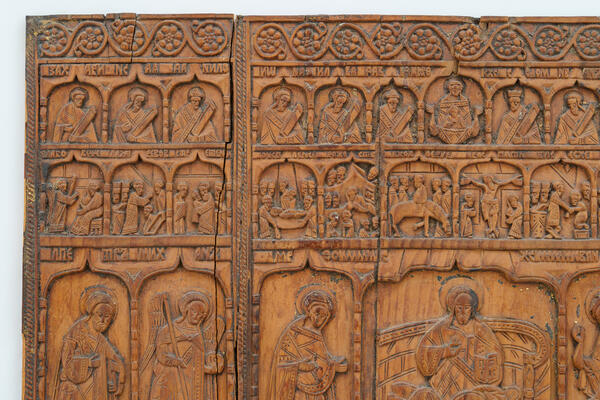
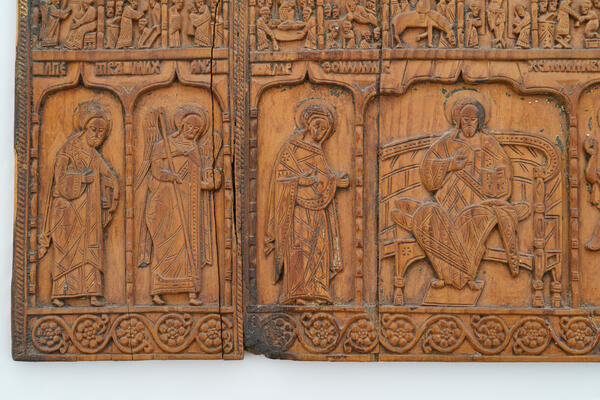
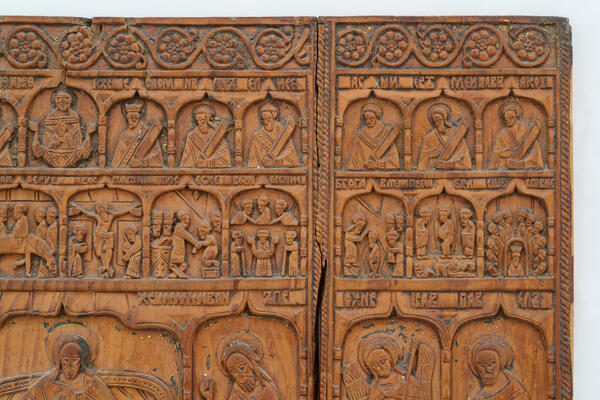
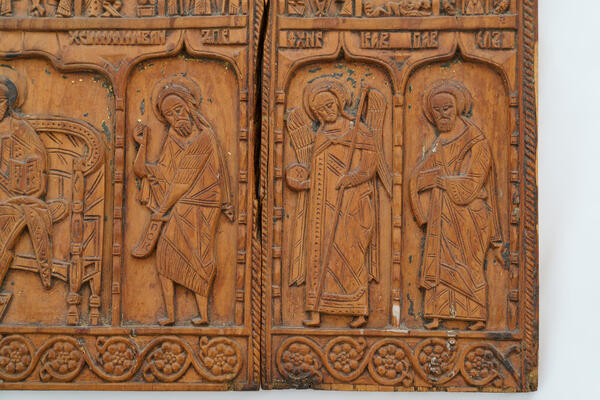
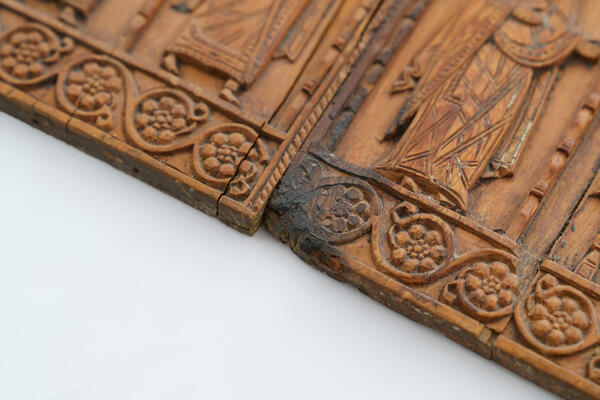
The Andrei Rublev Museum houses a three-panel folding icon made of carved wood, a smaller version of a high Russian iconostasis. It was made using the technique of flat relief carving and was painted and gilded at some point. The folding icon includes three rows — the Deesis, the Feasts, and the Prophets.
At the top and at the bottom, the icon features decorative stripes that imitate carved templa — rectangular beams placed between the eastern columns of the church, or on its eastern wall featuring icons. Each image of a saint or feast is highlighted by a keel-shaped frame with beaded columns. All three panels are separated by a narrow, vertical braided pattern on each side.
The lowest and largest row is the Deesis with seven figures portrayed full-length. In the center of this row, the Savior is depicted seated on a high throne. He is presented as the Righteous Judge, with an open Book of the Gospels in his hand. He is flanked by the Virgin Mary, John the Baptist, Archangels Michael and Gabriel, and the Apostles Peter and Paul.
Above is the row depicting the major feasts of the Orthodox Church. Usually, they are arranged in either the chronological order set out in the Bible, or according to the church calendar. In this case, however, they are organized differently: the Annunciation, the Resurrection of Lazarus, the Presentation of Jesus Christ, the Dormition of the Virgin Mary, the Nativity of Jesus, the Entrance of Christ into Jerusalem, the Crucifixion of Jesus, the Resurrection, the Ascension, the Baptism, the Transfiguration of Jesus, and the Descent of the Holy Spirit upon the Apostles.
The Prophet row includes the centerpiece titled “Our
Lady of the Incarnation” with Jesus in Her womb, surrounded by the twelve
Prophets who stand in front of Her with their scrolls unfolded.